AAFCO sets minimums of 26% protein on a dry-matter basis for adult cat food and 30% for kitten or growth food. Many healthy cats do well above that. To compare wet and dry foods fairly, convert the label's "crude protein" to a dry-matter basis first.
If you've ever wondered how much protein is in cat food, and why a can of wet food shows "10%" while kibble shows "32%," the label is playing a trick on you. The two aren't measured on the same footing. Here's how to level the playing field. For portions once you've picked a food, use our how much food should I feed my cat calculator.
How much protein should be in cat food? (AAFCO minimums)
The Association of American Feed Control Officials (AAFCO) sets nutrient profiles for "complete and balanced" pet foods. For cats, the minimum crude protein is:
| Life stage | Minimum protein (dry-matter basis) |
|---|---|
| Adult maintenance | 26% |
| Growth and reproduction (kittens, pregnant or nursing cats) | 30% |
These are minimums, not targets. Cats are obligate carnivores and generally do well on diets that go beyond the floor. Lots of cat foods land in the 35–50% range on a dry-matter basis.
Look for the statement on the package that the food is "complete and balanced" for a life stage. That tells you the food was formulated or tested to meet AAFCO profiles.
Crude protein vs dry-matter protein: why wet food looks low
The "crude protein" on a label is measured as fed, which means including the water in the food.
- Dry kibble is about 10% water.
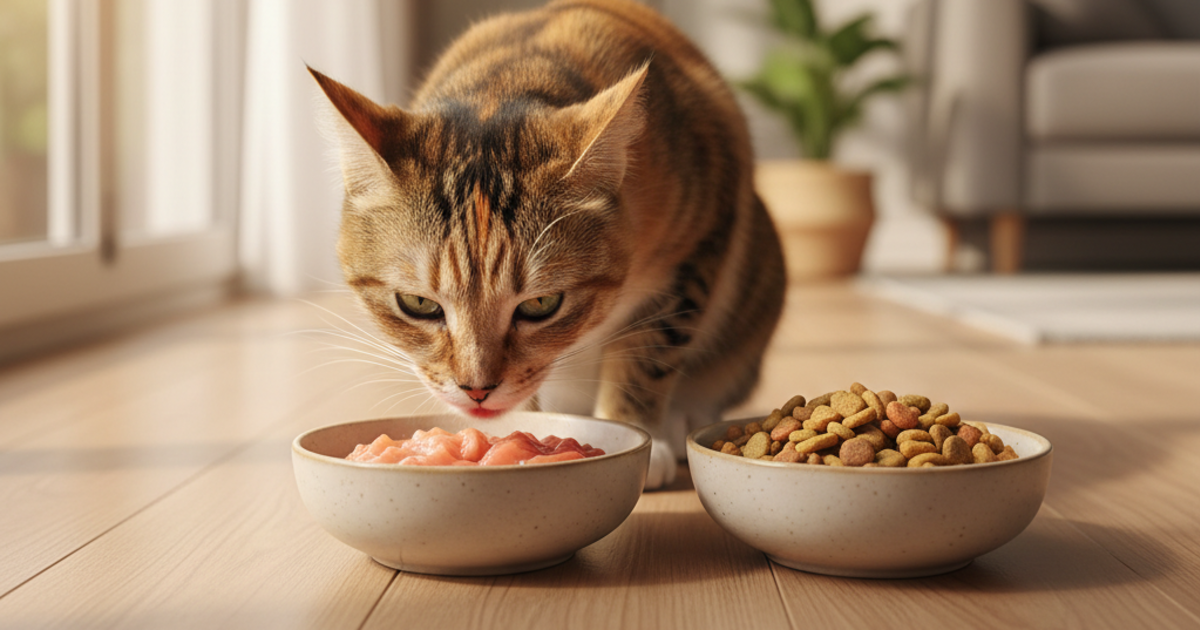
- Canned food is often 75–82% water.
Water has no protein. So a can with 78% water can only have so much protein in the remaining 22%. It might look low next to kibble, but it may be higher once you remove the water from the math. That's what "dry-matter basis" means: the nutrient level if the food had zero moisture.
Also note that "crude protein" only measures nitrogen, not how digestible or well-balanced the protein is. Two foods with the same number can differ in quality. It's a starting point, not a verdict.
How to convert a label to a dry-matter basis (worked example)
The formula:
Protein (dry matter) = crude protein % ÷ (100 − moisture %) × 100
You'll need two numbers from the "guaranteed analysis" panel: crude protein (usually "min") and moisture ("max").
Example 1: canned food. Crude protein 10%, moisture 78%.
- Dry matter = 100 − 78 = 22%.
- Protein on dry matter = 10 ÷ 22 = 0.4545.
- × 100 = about 45.5%.
Example 2: dry food. Crude protein 32%, moisture 10%.
- Dry matter = 100 − 10 = 90%.
- Protein on dry matter = 32 ÷ 90 = 0.3556.
- × 100 = about 35.6%.
So the can that looked "low" (10%) actually has more protein per bite of food solids than the kibble that looked "high" (32%).
Example 3: a pâté. Crude protein 8%, moisture 82%. Dry matter is 18%, and 8 ÷ 18 = about 44%.
| Food | Crude protein (as fed) | Moisture | Protein (dry matter) |
|---|---|---|---|
| Canned A | 10% | 78% | 45.5% |
| Pâté B | 8% | 82% | 44.4% |
| Kibble C | 32% | 10% | 35.6% |
The label numbers are guaranteed minimums and maximums, so your real result is approximate. It's still a fair way to compare.
Want a shortcut? Our dry matter basis calculator does the same math (it's on the dog protein page, but the conversion works the same for cat food). For portions, see the cat calorie calculator. And if you're mixing foods, see how to split calories in our wet and dry feeding guide.
Protein needs for kittens, adults and seniors
- Kittens. They need more (30% minimum on a dry-matter basis) because they're building bone, muscle and organs.
- Adults. 26% minimum, though most quality foods sit well above it.
- Seniors. AAFCO doesn't set a separate senior profile. Many vets say healthy older cats still need good-quality protein to hold on to muscle, since aging cats often lose muscle. Don't cut protein without a vet's advice.
For portion sizes by age, see how much a kitten or 1-year-old cat should eat, and for what changes with age, see what age a cat is a senior.
Can a cat get too much protein? (kidney disease caveat)
For most healthy cats, high protein isn't a problem. The exception is cats with kidney disease or certain other conditions. Vets sometimes recommend controlled protein and phosphorus for those cats. That's a medical decision, not something to do on your own, because cutting protein in a cat that doesn't need it can cause muscle loss.
So: if your cat has been diagnosed with kidney disease, follow your vet's diet plan. If your cat is healthy, more protein than the minimum is generally fine.
Don't judge a food by protein alone. Look at calories, ingredients, moisture and whether the food fits your budget and your cat's tastes. For the cost side, see our cat food cost calculator and our look at how much Smalls cat food costs.
Beyond protein: what else to check on the label
Protein is only one piece. When you compare foods, also look at:
- The "complete and balanced" statement. It should name a life stage (growth, adult maintenance or all life stages) and say whether it was formulated to meet AAFCO profiles or tested with feeding trials.
- Calories per can or cup. This decides how much you feed. Two foods with the same protein can differ a lot in calories.
- Moisture. Cats that eat mostly dry food get less water from their diet, so wet food helps many cats stay hydrated.
- Fat and carbohydrates. Fat supplies energy, and most cat foods keep carbohydrates low. Labels don't list carbs, but you can estimate them by subtracting protein, fat, fiber, moisture and ash from 100.
- The first ingredients. They show what the food is made of, but they don't tell the whole story on quality.
The best food is one your cat enjoys, digests well and keeps a healthy weight on.
When to call your vet
Talk to your vet before changing your cat's protein level, and call sooner if you see:
- Increased thirst or urination. These can be early signs of kidney disease or diabetes.
- Weight loss or muscle loss over the spine and hips.
- Vomiting or diarrhea lasting more than a day or two after a diet change.
- Not eating for 24 hours or more.
- A dull coat, lethargy or bad breath with a "chemical" smell.
- Straining in the litter box. In male cats, that's an emergency.
Frequently asked questions
PawCalculator Editorial
We combine veterinary references, published guidelines, and calculator-grade modeling. This article is for education, not a substitute for an exam.
+ Follow on PawTalk