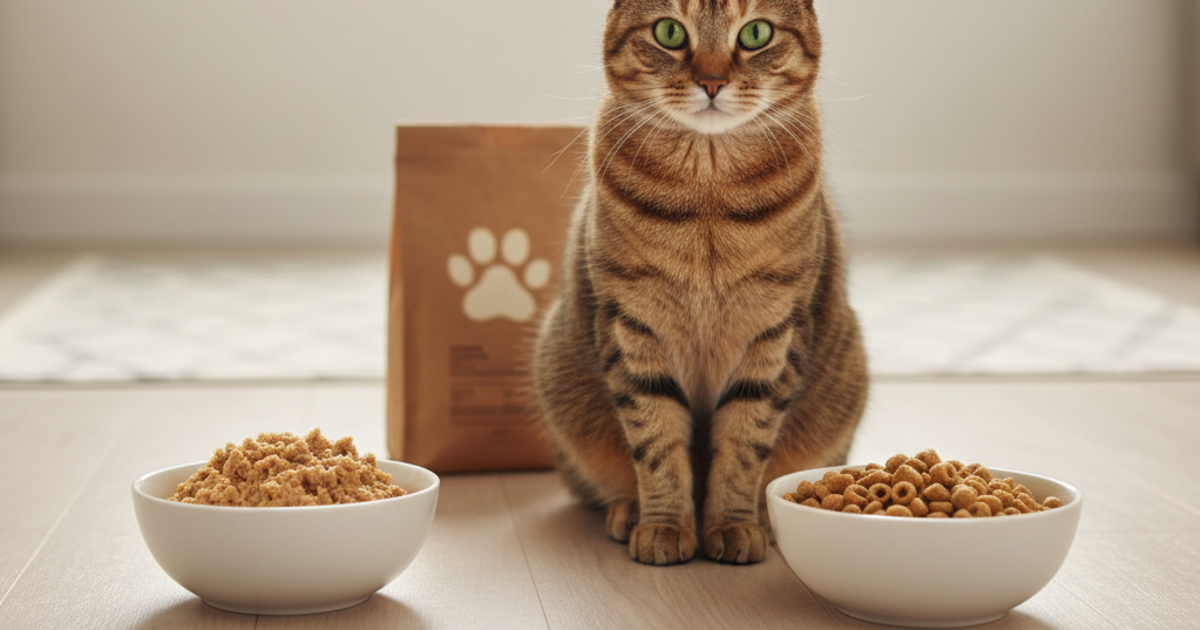
The best cat food is complete and balanced for your cat's life stage, made by a brand with qualified nutrition staff and real quality control, and suited to your cat's weight, health and taste. Wet food helps hydration, but calories and portion size matter as much as the brand name. There's no single best brand for every cat.
"Top 10 cat food" lists are usually driven by ingredient lists, star ratings and affiliate links. A more dependable approach is to check how a company makes its food, pick a formula that fits your cat, and then feed the right amount. This guide walks you through each step. When you've chosen, set the portion with the cat food calculator.
Step 1: Check the AAFCO statement
Every complete and balanced cat food should carry a nutritional adequacy statement from AAFCO (the Association of American Feed Control Officials). Look for wording such as:
- "Formulated to meet the nutritional levels established by the AAFCO Cat Food Nutrient Profiles for [life stage]," or
- "Animal feeding tests using AAFCO procedures substantiate that [product] provides complete and balanced nutrition for [life stage]."
The life stage will be growth (kittens, pregnant or nursing cats), adult maintenance or all life stages. Foods labeled "for intermittent or supplemental feeding only" are not complete diets and shouldn't be the main food.
Feeding-trial statements are stronger evidence than formulation-only statements, although both are accepted.
Step 2: Ask the brand the WSAVA questions
The World Small Animal Veterinary Association suggests asking every pet food maker:
- Do you employ a qualified nutritionist (board-certified veterinary nutritionist or PhD)?
- Who formulates the diets, and what are their credentials?
- What testing is done to confirm nutritional adequacy?
- Where are the foods made, and what quality control is used?
- Can you provide a full nutrient analysis?
Brands that answer openly are easier to trust. Our guide to WSAVA dog food guidelines explains the questions in more detail, and they apply to cat food too.
Step 3: Pick wet, dry or both
| Type | Pros | Cons |
|---|---|---|
| Wet (canned, pouches, trays) | High moisture, often more palatable, lower carbohydrate, helpful for urinary health | Higher cost per calorie, spoils quickly once opened |
| Dry (kibble) | Convenient, lower cost per calorie, long shelf life | Low moisture, easy to overfeed, higher carbohydrate |
| Mixed | Balances cost, convenience and hydration | Needs calorie counting across both |
| Fresh or freeze-dried | Very palatable | Highest cost, storage and safety needs |
Cats evolved to get much of their water from prey, and many drink little. Wet food adds water to the diet. For portions when mixing, see how much wet and dry food to feed a cat.
Step 4: Compare protein on a dry-matter basis
Cats are obligate carnivores and need more protein than dogs. AAFCO minimums are 26% protein for adult maintenance and 30% for growth and reproduction, on a dry-matter basis. To compare wet and dry foods fairly, convert labels using our dry matter guide.
Step 5: Check calories
Two foods can look alike and differ by 30% in calories per can or cup, which decides how much to feed. The right portion is based on your cat's weight and life stage, not on the feeding guide on the bag alone, since guides often overshoot.
Worked example: why calories matter
A neutered 4 kg cat needs about 240 kcal a day (RER 198 × 1.2).
- Can A: 80 kcal per 3 oz can. 240 ÷ 80 = 3 cans a day.
- Can B: 105 kcal per 3 oz can. 240 ÷ 105 = about 2.3 cans a day.
If you feed Can B at Can A's amount (3 cans), your cat gets 315 kcal, roughly 31% over target. That's about 75 extra kcal a day, which adds up to roughly a pound of body fat in about two months. Check your own cat with the cat calorie calculator.
Marketing claims to treat with caution
- "Grain-free": not automatically lower in carbs or better. Many cats do fine with grains.
- "Natural," "holistic" and "premium": no legal guarantee of better nutrition.
- "Human-grade": has a legal definition only when the whole product and facility meet food standards.
- Gravy or "in sauce": can be higher in carbohydrates and lower in protein.
- "Indoor," "hairball" and "urinary" formulas: may help some cats but aren't required for all. Urinary conditions need vet diagnosis.
Match the food to your cat
- Kittens: growth or all-life-stages food, fed more frequently.
- Adults: adult maintenance, portioned to keep a lean body condition.
- Seniors: calorie needs vary; some lose weight and muscle, others gain weight.
- Cats with kidney, urinary, thyroid, diabetic or digestive issues: need veterinary guidance and sometimes prescription diets.
Switching foods
Mix the new food with the old over 7-10 days. Cats can be stubborn: a cat that won't eat for more than 24 hours needs a vet check, since prolonged fasting can cause serious liver problems (hepatic lipidosis).
When to call your vet
Talk to your vet before changing food if your cat has a medical condition, vomits, has diarrhea, loses weight, drinks much more than usual or strains in the litter box. Straining without producing urine, especially in a male cat, is an emergency.
Frequently asked questions
PawCalculator Editorial
We combine veterinary references, published guidelines, and calculator-grade modeling. This article is for education, not a substitute for an exam.
+ Follow on PawTalk