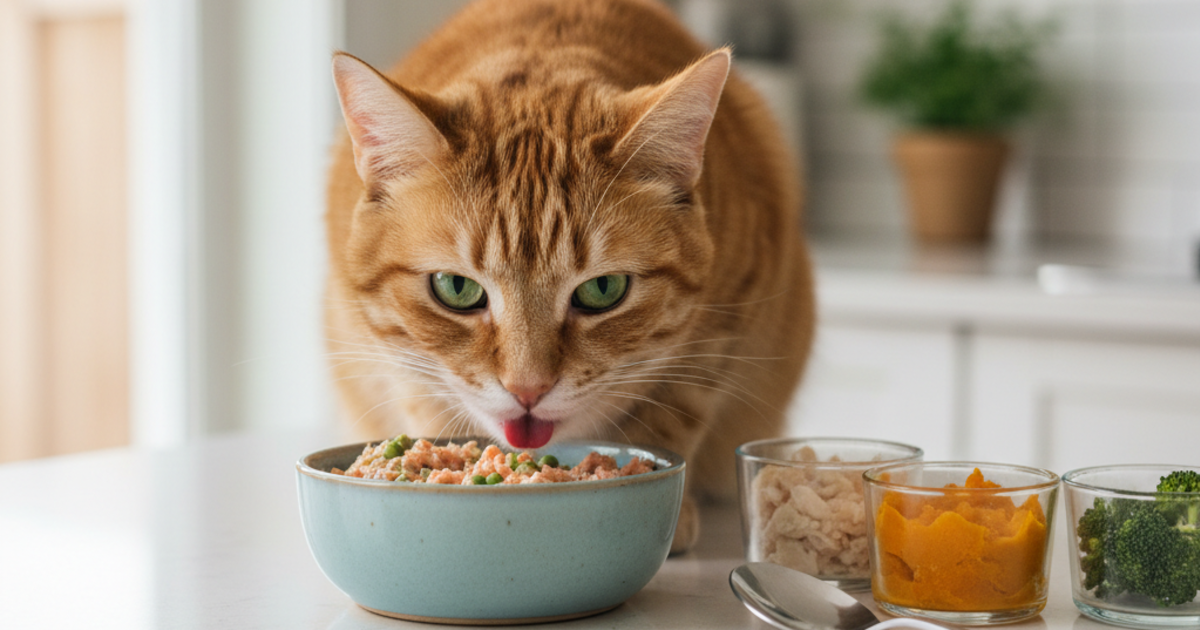
Fresh cat food is gently cooked, refrigerated or frozen food that's often very palatable and high in moisture, but it usually costs more per calorie than canned or dry food. Judge any fresh brand by its AAFCO statement, nutrition expertise, calories and cost per day, then portion it to your cat's calorie target.
Fresh food has become a popular alternative to kibble and cans, and it can be a good fit for picky eaters, cats that need more moisture and owners who want simpler ingredient lists. But "fresh" isn't a nutrition guarantee, and the cost adds up. This guide explains what fresh cat food is, the pros and cons, what to check before you buy, how to compare the cost per day, how to store and serve it safely, and how to fit it into a mixed diet. Set a calorie target with the cat food calculator.
What counts as fresh cat food
Fresh cat foods are typically cooked at lower temperatures than canned food and sold chilled or frozen, often through subscriptions or in store refrigerators. They may contain identifiable meat, organ meat and vegetables, and many have a soft, pâté-like or shredded texture. Some are complete and balanced diets; others are toppers or are labeled for intermittent or supplemental feeding only, which is not enough to feed on its own. Always check the label.
Pros
- High palatability, which helps picky or recovering cats.
- High moisture, which supports hydration and may benefit urinary health.
- Shorter, simpler ingredient lists and recognizable meat.
- Convenient pre-portioned packs from some brands.
- Can suit cats with sensitive digestion, though this varies by cat.
Cons
- Higher cost per calorie than most canned or dry foods.
- Needs fridge or freezer space and careful handling.
- Shorter shelf life once opened or thawed.
- Quality varies: some aren't complete and balanced, and formulation expertise differs by brand.
- Subscription lock-in and delivery timing can be inconvenient.
What to check before you buy
- AAFCO statement: "complete and balanced" for your cat's life stage, ideally backed by feeding trials or full formulation.
- Nutrition credentials: does the brand employ a board-certified veterinary nutritionist?
- Calories per serving, so you can portion accurately.
- Safety practices: testing for pathogens such as Salmonella and Listeria, plus clear handling instructions.
- Cost per day, not cost per pack.
- Taurine and other essential nutrients appear in the nutrient profile for complete diets.
Our guide to WSAVA dog food guidelines lists questions you can ask a cat food maker too.
Worked example: cost per day
The formula is simple: daily cost = (daily kcal ÷ kcal per gram) × price per gram.
A neutered 4 kg cat needs about 240 kcal a day (RER 198 × 1.2). The prices below are illustrative, so swap in the numbers from your own labels.
Fresh food: 1.3 kcal per gram, $12 per 500 g pack ($0.024 per gram).
- Grams per day = 240 ÷ 1.3 = about 185 g.
- Cost per day = 185 × $0.024 = about $4.44.
- Cost per month = about $133.
Canned food: 80 kcal per can at $1.00 a can.
- Cans per day = 240 ÷ 80 = 3 cans.
- Cost per day = 3 × $1.00 = $3.00.
- Cost per month = about $90.
Dry food: 390 kcal per cup at $0.25 per cup.
- Cups per day = 240 ÷ 390 = about 0.62 cup.
- Cost per day = about $0.15.
- Cost per month = about $5.
In this example, fresh costs roughly 1.5 times canned per day. Whether it's worth it depends on your cat's appetite, your budget and how well the food meets the quality checks above.
Safe storage and serving
- Keep refrigerated at or below 40°F (4°C); freeze if you won't use it within the label's window.
- Thaw in the fridge, not on the counter.
- Discard leftovers after the label's time, often a few days refrigerated.
- Serve at room temperature or slightly warmed, and don't leave food out more than about an hour.
- Wash bowls daily and wash hands and surfaces after handling.
- Keep food away from immunocompromised people if the brand isn't pathogen-tested.
Mixing with other foods
Many owners feed fresh food as part of a mixed diet. Count the calories from every source, and adjust other foods down as you add fresh. Use the cat calorie calculator to keep the total on target, and see how much wet and dry food to feed a cat for how to split calories.
Switching to fresh food
Transition gradually over 7-10 days. Cats can be stubborn about texture changes, and a cat that won't eat for more than 24 hours needs a vet check, because fasting can cause a serious liver condition (hepatic lipidosis).
When to call your vet
Talk to your vet before switching if your cat has kidney, urinary, thyroid, diabetes or digestive problems. Call if your cat has vomiting, diarrhea, stops eating, loses weight or strains in the litter box, which is an emergency in male cats.
Frequently asked questions
PawCalculator Editorial
We combine veterinary references, published guidelines, and calculator-grade modeling. This article is for education, not a substitute for an exam.
+ Follow on PawTalk