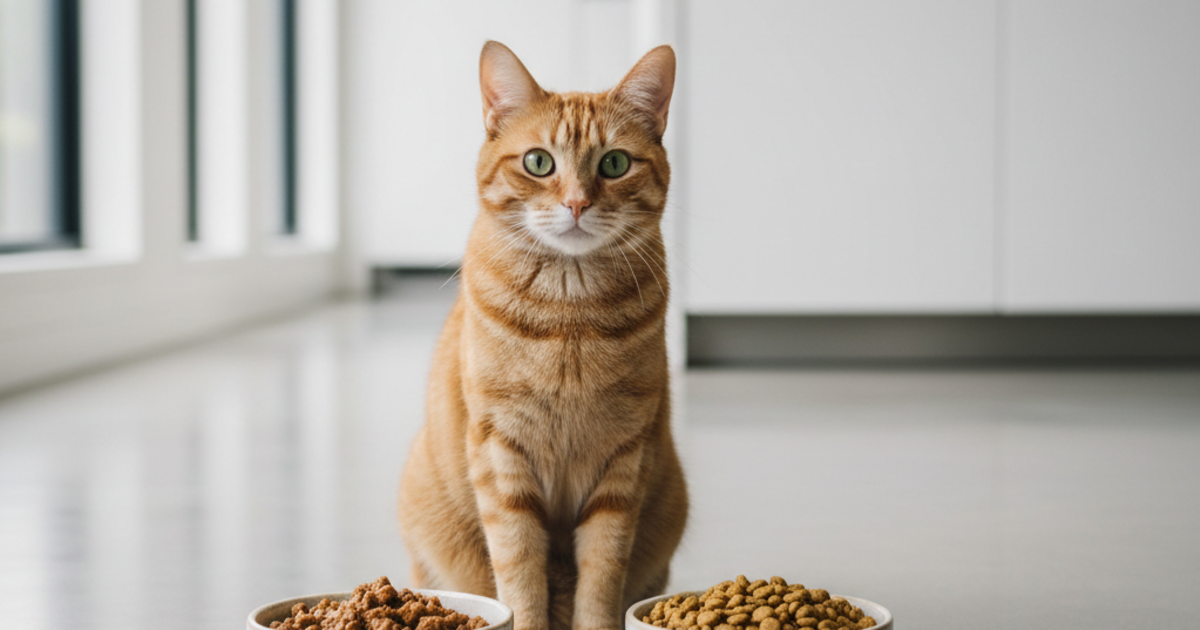
Work out your cat's daily calories (a typical 10 lb/4.5 kg indoor adult needs roughly 200–260 kcal), decide the split (for example half from wet, half from dry), then divide each share by the food's kcal per can or cup. Don't feed a full ration of both.
That last sentence is where most mixed-feeding mistakes happen. If the bag says "1/2 cup a day" and the can says "1 can a day," feeding both means double dinner. This guide shows how to figure out how much wet and dry food to feed a cat so the calories add up to the right total. For a quick answer, plug your cat's weight into our cat food calculator.
How much wet and dry food to feed a cat: the calorie-split method
Cans and cups come in different sizes, and foods vary a lot in calories. So don't measure by volume. Measure by calories.
- Find your cat's daily calorie target. Use resting energy requirement: RER = 70 × body weight in kg^0.75. Then multiply by about 1.2 for a typical neutered indoor adult.
- Choose a split. Half wet, half dry is a common starting point.
- Read the labels. Look for "kcal per can" (or per pouch) and "kcal per cup" (or per kg). These are usually in the guaranteed-analysis section, in small print.
- Divide. Each food's calorie share ÷ its calories per unit = how many cans or cups to feed.
That's it. If you'd like the calorie target done for you, use the cat calorie calculator.
Mixed-feeding chart by cat weight (lb and kg)
This chart assumes a neutered adult at a healthy weight (RER × 1.2), a 50/50 calorie split, an 80 kcal can and a dry food with 400 kcal per cup. Swap in your own foods' numbers.
| Cat weight | Daily kcal | Wet share (50%) | Cans (80 kcal) | Dry share (50%) | Dry cups (400 kcal/cup) |
|---|---|---|---|---|---|
| 6 lb / 2.7 kg | 177 | 88 | 1.1 | 88 | 0.22 |
| 8 lb / 3.6 kg | 220 | 110 | 1.4 | 110 | 0.28 |
| 10 lb / 4.5 kg | 259 | 130 | 1.6 | 130 | 0.32 |
| 12 lb / 5.4 kg | 298 | 149 | 1.9 | 149 | 0.37 |
| 15 lb / 6.8 kg | 354 | 177 | 2.2 | 177 | 0.44 |
If your cat is overweight, use the weight your cat should be, and ask your vet for a target. Feeding to a heavy weight keeps the extra pounds on.
Worked example: a 10 lb indoor cat on one can plus kibble
Meet Pumpkin: 10 lb (4.5 kg), neutered, indoors, eats one can of wet food a day and wants kibble too. How much dry?
- RER. 4.5^0.75 is about 3.09. So RER = 70 × 3.09 = about 216 kcal.
- Daily target. 216 × 1.2 = about 259 kcal, which we'll round to 260.
- Wet food. Pumpkin's can is a 3 oz can with 80 kcal (check yours).
- What's left for dry. 260 − 80 = 180 kcal.
- Cups of dry. Pumpkin's kibble has 400 kcal per cup, so 180 ÷ 400 = 0.45 cup, or a little over 7 tablespoons a day.
Total: 80 + 180 = 260 kcal. Pumpkin gets a full day of food without doubling up.
Try it with your own foods in the cat food calculator. If you'd rather see a portion chart, our cat feeding chart shows amounts by weight.
Quick answer for dry only: if the same cat ate only kibble, it would be 260 ÷ 400 = 0.65 cup a day.
Common splits: 50/50, 75/25, wet meals plus dry grazing
50/50. Balanced, simple to measure, and a good starting point.
75% wet / 25% dry. Many vets like more wet food for hydration, especially for cats prone to urinary problems. For Pumpkin's 260 kcal: 195 kcal wet (about 2.4 cans at 80 kcal) and 65 kcal dry (about 0.16 cup, or 2.6 tablespoons).
25% wet / 75% dry. Cheaper and more convenient, but with less moisture. For Pumpkin: 65 kcal wet (about 0.8 can) and 195 kcal dry (about 0.49 cup).
Wet meals, dry for grazing. Give wet food at set mealtimes, and leave a measured amount of dry out for the day. Measure it in the morning so the total stays fixed.
Is it OK to feed wet in the morning and dry at night? Yes. What matters is the daily calorie total, not the order.
If you want the wet-only or dry-only numbers, see our guides on how much wet food to feed a cat and how much dry food to feed a cat per day.
Adjusting for kittens, seniors and weight loss
- Kittens need more calories per pound to grow, roughly 2 to 2.5 times RER, and they should eat kitten or all-life-stages food. See our guide on how much a kitten or 1-year-old cat should eat.
- Seniors vary. Some lose weight and need more calories, and others slow down and need fewer. Weigh monthly and ask your vet before changing amounts. See what age a cat is senior.
- Weight loss. Never cut food sharply on your own. Cats that stop eating or lose weight too quickly can develop a serious liver condition. Your vet can set a target and a safe pace.
- Activity. A very active cat may need more than the 1.2 multiplier, and a couch potato may need less.
Watch the scale and body shape, not just the math. If your cat is gaining, cut about 10% and reassess in 2–3 weeks.
When to call your vet
Call your vet if you notice:
- Your cat stops eating for 24 hours or more.
- Vomiting or diarrhea lasting more than a day or two.
- Weight loss or gain of more than about 10% over a couple of months.
- Increased thirst or urination.
- Straining or crying in the litter box. In males, this is an emergency.
- Lethargy, hiding or a hunched posture.
- Bloody stool or vomit.
Frequently asked questions
PawCalculator Editorial
We combine veterinary references, published guidelines, and calculator-grade modeling. This article is for education, not a substitute for an exam.
+ Follow on PawTalk