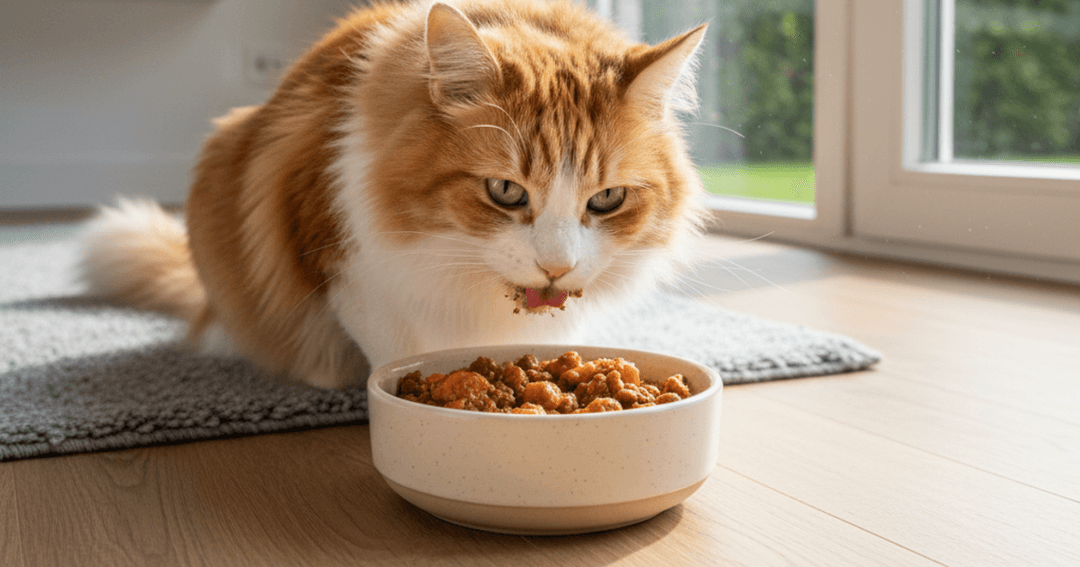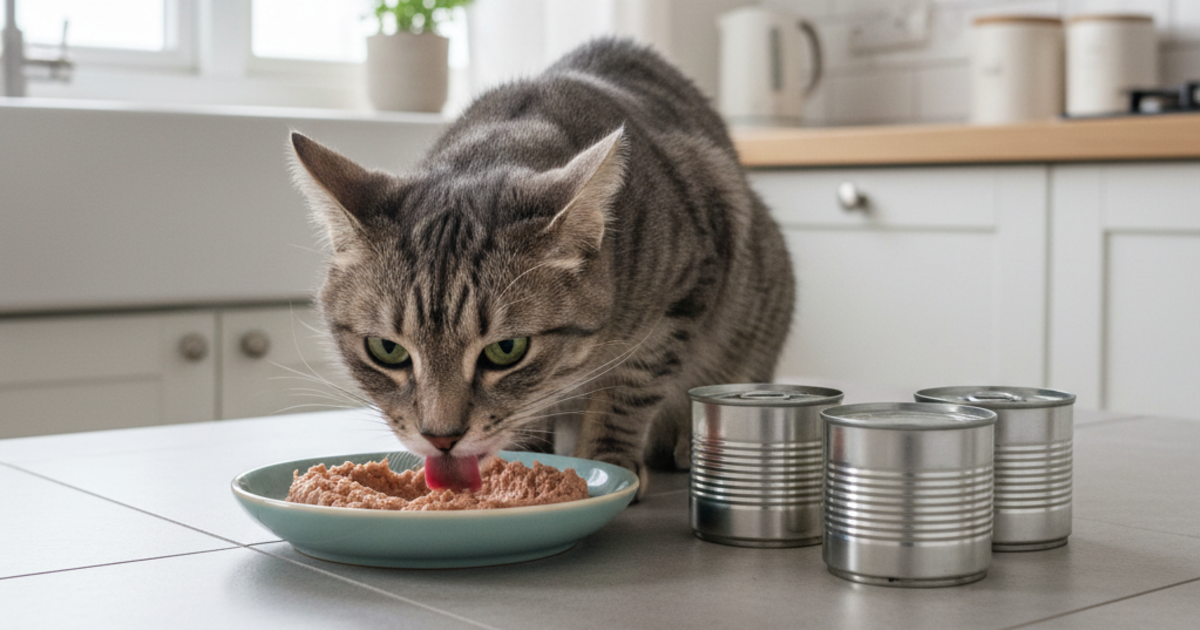
How much wet food to feed a cat comes down to calories. Most healthy, indoor adult cats weighing 4–5 kg (9–11 lb) need about 200–280 kcal a day. With a typical 3 oz (85 g) can at around 80 kcal, that's roughly 2½ to 3½ small cans a day, or about 1¼ to 1¾ of a 5.5 oz (156 g) can. Your cat's label and body condition decide the final number.
The cat food calculator does this for you: enter your cat's weight, age and the calories in your food, and it gives a daily portion.
How Many Cans of Cat Food per Day? Chart by Weight
These numbers use the Resting Energy Requirement (RER) formula from WSAVA guidelines, multiplied by 1.0–1.2 for a neutered indoor adult. Use the lower end for a less active or weight-prone cat.
| Cat weight | Daily calories (1.0–1.2 × RER) | 3 oz cans (~80 kcal) | 5.5 oz cans (~165 kcal) |
|---|---|---|---|
| 3 kg (6.6 lb) | 160–190 kcal | 2–2½ | 1–1¼ |
| 4 kg (8.8 lb) | 200–240 kcal | 2½–3 | 1¼–1½ |
| 4.5 kg (9.9 lb) | 215–260 kcal | 2¾–3¼ | 1⅓–1½ |
| 5 kg (11 lb) | 235–280 kcal | 3–3½ | 1½–1¾ |
| 6 kg (13.2 lb) | 270–320 kcal | 3⅓–4 | 1⅔–2 |
| 7 kg (15.4 lb) | 300–360 kcal | 3¾–4½ | 1¾–2¼ |
Wet food calories vary a lot, from about 60 to over 110 kcal per 3 oz can. Pâtés tend to run higher than chunks in gravy. Always check the "kcal per can" line on the label and adjust.
If your cat is overweight, don't use their current weight. Feed for their ideal weight instead (see below).
Worked Example: How Much Wet Cat Food per Day
A 4.5 kg (9.9 lb) neutered indoor adult cat, eating a food with 80 kcal per 3 oz can.
- RER = 70 × 4.5^0.75 ≈ 216 kcal
- Neutered indoor adult: 216 × 1.2 ≈ 260 kcal/day
- 260 ÷ 80 ≈ 3¼ cans per day
- Split into 2–3 meals, about 1 can each
If the same cat is a couch potato that gains easily, use 1.0 × RER: about 216 kcal, or 2¾ cans. Weigh your cat every 2–4 weeks and nudge portions up or down by 10% as needed. The cat feeding chart shows wet and dry amounts side by side.
How Much Dry Food to Feed a Cat
Dry cat food is much more calorie-dense, often 350–500 kcal per 8 oz cup. At 400 kcal per cup:
| Cat weight | Daily calories | Dry food per day (at 400 kcal/cup) |
|---|---|---|
| 3 kg (6.6 lb) | 160–190 kcal | ~⅖–½ cup |
| 4 kg (8.8 lb) | 200–240 kcal | ~½–⅗ cup |
| 5 kg (11 lb) | 235–280 kcal | ~⅗–⅔ cup |
| 6 kg (13.2 lb) | 270–320 kcal | ~⅔–⅘ cup |
Because dry food is so dense, a few extra kibbles add up fast. A kitchen scale is more accurate than a scoop.
Feeding Wet and Dry Together
Plenty of owners feed both. Split the daily calories, not the portions.
Example: the same 4.5 kg cat needing 260 kcal, fed half and half.
- Wet: 130 kcal ≈ 1⅔ three-ounce cans
- Dry: 130 kcal ≈ ⅓ cup of a 400 kcal/cup food
Does My Cat Need Wet Food?
Not necessarily, but wet food has real advantages. It's about 75–80% water, which helps cats that don't drink much. Vets often recommend more wet food for cats with urinary issues, kidney disease or a weight problem, since it fills the stomach with fewer calories. Dry food is cheaper, keeps longer in the bowl, and is easier for puzzle feeders.
Kittens, Seniors and Cats Losing Weight
- Kittens need about 2–2.5 × RER, and should be fed a kitten food in 3–4 meals a day until around 6 months.
- Seniors vary. Some need fewer calories; others over 12 lose muscle and need more. Weigh them monthly.
- Weight loss: feed about 0.8 × RER of the cat's ideal weight and aim for 0.5–2% of body weight lost per week. Losing weight too fast can cause hepatic lipidosis (fatty liver disease), which can be life-threatening. The cat calorie calculator and cat weight loss calculator set safe targets.
Tips for Feeding Wet Food
- Serve at room temperature. Warm (not hot) food can tempt fussy eaters.
- Throw out wet food left in the bowl after about 4 hours, sooner in hot weather.
- Cover opened cans and refrigerate for up to 3 days.
- Count treats. They should stay under 10% of daily calories.
For more on meal timing, see how often you should feed your cat.
When to Call Your Vet
Call your vet if your cat:
- Eats nothing for more than 24 hours. Cats, especially overweight ones, can develop fatty liver disease quickly when they stop eating.
- Loses or gains weight without a change in food
- Is drinking or peeing much more than usual
- Vomits more than once a week or has ongoing diarrhea
- Seems hungry all the time while losing weight (a possible sign of hyperthyroidism or diabetes)
The Bottom Line
Most average adult cats do well on about 200–280 kcal a day, which is roughly 2½–3½ small cans of wet food or about half a cup of dry. Check your can's calorie count, weigh your cat regularly, and adjust. For a portion made for your cat, run the numbers in the cat food calculator.
Frequently asked questions
PawCalculator Editorial
We combine veterinary references, published guidelines, and calculator-grade modeling. This article is for education, not a substitute for an exam.
+ Follow on PawTalk