How Old Is Your Dog, Really?
Your inputs
Results update live as you type.
Your results
Fill in the form to see your estimate.
Ready when you are
Fill in the form to see your reference estimate
Keep going with a related calculator.
How Old Is Your Dog, Really?
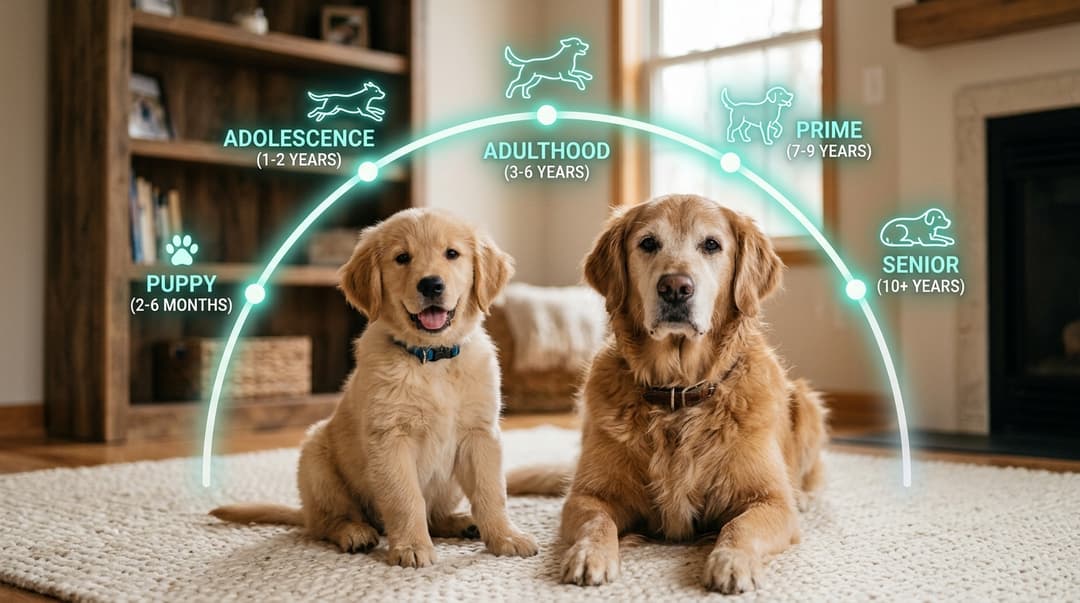
The "1 dog year = 7 human years" rule doesn't hold up — dogs mature far faster than that in year one, then slow down, and how much they slow down depends on size. A Chihuahua and a Great Dane hitting age 8 are not biologically the same age; large breeds age faster in their senior years, which is part of why giant breeds have shorter median lifespans. This calculator uses the size-adjusted curve (small/medium/large/giant weight classes) instead of a flat multiplier, and cross-references it against the logarithmic formula published from the 2020 UC San Diego canine DNA methylation study, which estimated human-equivalent age as roughly 16 × ln(dog age in years) + 31 for the first several years of life before the curve flattens.
How to use this calculator
Enter your dog's weight, age in years, and size category. The calculator blends the DNA-methylation curve with breed weight-class data rather than a flat multiplier, so the human-year figure reflects your dog's actual size bracket.
Human-year equivalents by size (approximate)
| Dog age | Small (under 20 lb) | Medium (20–50 lb) | Large (50–90 lb) | Giant (90+ lb) |
|---|---|---|---|---|
| 1 year | 15 | 15 | 15 | 14 |
| 3 years | 28 | 28 | 29 | 30 |
| 5 years | 36 | 37 | 40 | 42 |
| 8 years | 48 | 51 | 55 | 62 |
| 10 years | 56 | 60 | 66 | 78 |
Senior status by size category
| Size category | Typically "senior" starting around |
|---|---|
| Small (under 20 lb) | 10–11 years |
| Medium (20–50 lb) | 8–9 years |
| Large (50–90 lb) | 7–8 years |
| Giant (90+ lb) | 6–7 years |
Understanding your results
The gap between size categories widens with age, not at the start — a 1-year-old dog of any size is roughly equivalent, but by 10 years old a giant breed has aged noticeably faster in human-equivalent terms than a small breed. This is why the calculator asks for size category rather than applying a single flat curve: it's the mechanism behind giant breeds reaching "senior" status (and shorter median lifespans) years earlier than toy breeds. If your dog is a mixed breed, current weight is a better predictor of the applicable curve than guessing at a primary breed, since aging trajectory tracks size, not ancestry.
Why "senior" is a category, not a switch. Reaching senior status doesn't mean sudden decline — it's a signal to shift preventive care: more frequent wellness exams (often every 6 months instead of annually), bloodwork panels to catch age-related changes early, and closer attention to weight and mobility. Nothing about your dog changes overnight at the threshold; the care approach shifts ahead of visible problems.
The methylation formula's known limitation. The logarithmic DNA-methylation formula this calculator blends in was derived primarily from Labrador Retrievers, so it's a strong approximation for medium-to-large breeds but a rougher fit at the extremes (very small toy breeds, giant breeds) — which is exactly why size-class weighting is layered on top rather than using the raw formula alone.
What the human-year framing actually changes about care
Translating your dog's age into human-equivalent terms is most useful when it reshapes how you think about preventive care timing, not just as an interesting number to share. A dog whose calculated human-year equivalent lands in the 40s or 50s is roughly at the life stage where most people start paying closer attention to routine health screening, and applying that same instinct to your dog's veterinary care — more frequent wellness exams, baseline bloodwork to catch age-related changes early — tends to produce better outcomes than waiting for visible symptoms to prompt a vet visit. This is particularly relevant for large and giant breeds, whose accelerated aging curve means they reach this human-equivalent milestone at a calendar age that can feel surprisingly young — a 6-year-old Great Dane already sitting in a human-equivalent range where proactive screening matters is a common source of surprise for owners used to thinking of 6 as still solidly "middle-aged."
Using breed size to plan years ahead, not just react to the present
Because the size-based aging curve is predictable in its general shape even if not in exact timing for an individual dog, it's a useful tool for planning ahead rather than just describing where your dog is right now. Knowing that a large or giant breed will reach senior status appreciably earlier than a small breed lets you budget for the associated care shift — more frequent vet visits, potential joint support needs, senior-formula food transitions — well before that threshold arrives, rather than being caught off guard by a vet's recommendation to increase visit frequency. For anyone choosing a breed with future planning in mind (rather than already having a specific dog), understanding that giant breeds combine a shorter overall lifespan with an earlier transition into higher-care senior years is a meaningful, often underweighted factor alongside more commonly discussed considerations like size, energy level, and living space.
When to consult a professional
For health, dosage, or nutrition decisions, always confirm calculator output with your veterinarian. This tool provides reference estimates, not medical advice.
Questions about this calculator
That rule came from comparing average human lifespan (~70) to average dog lifespan (~10) and dividing — it ignores that a 1-year-old dog is already sexually mature and physically closer to a human teenager than a 7-year-old child.
The math, openly documented.
Inputs
Enter the details that affect your estimate.
weight · age · breed
Normalize
Validate ranges and convert units when needed.
lbs ↔ kg
Calculate
Veterinary or industry-standard formulas applied.
result = f(inputs)
Results
Clear outputs with context and disclaimers.
display + notes
More from Health
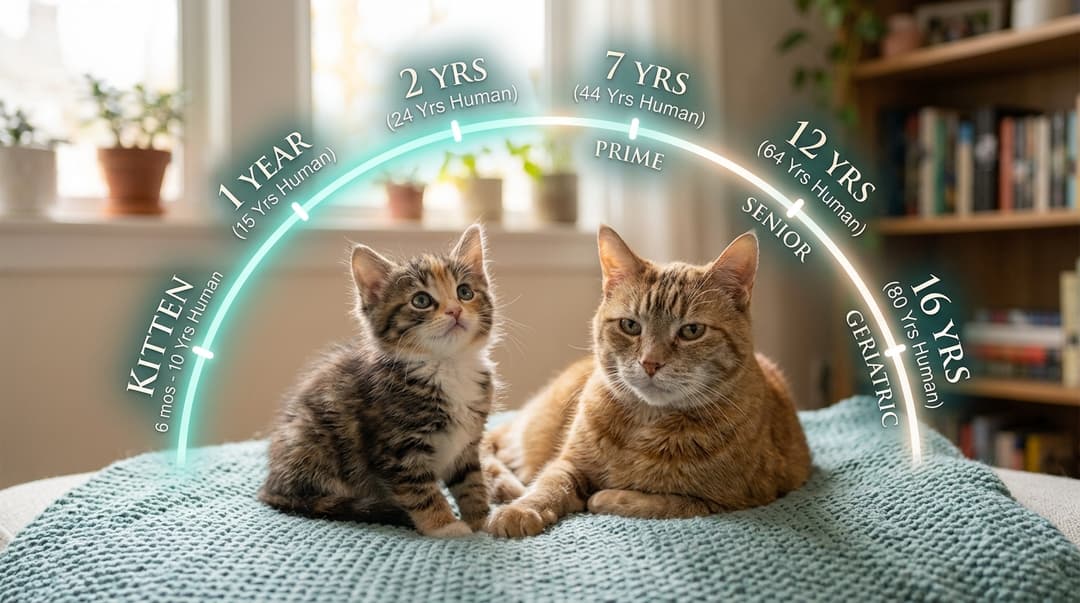
How Old Is Your Cat in Human Years?
cat age calculator: Find out your cat's real human-equivalent age with the vet-referenced formula — not the outdated "mu
Open tool
My Dog Ate Chocolate — How Worried Should I Be?
Theobromine risk by chocolate type and amount.
Open tool
Assessing Your Dog's Quality of Life
dog quality of life calculator: A scored assessment based on the HHHHHMM scale vets use with hospice and senior-care fam
Open toolArticles from Insights



Got an edge case the calculator can't handle?
247 active threads about dog nutrition right now. Verified vets and experienced owners answer within hours.