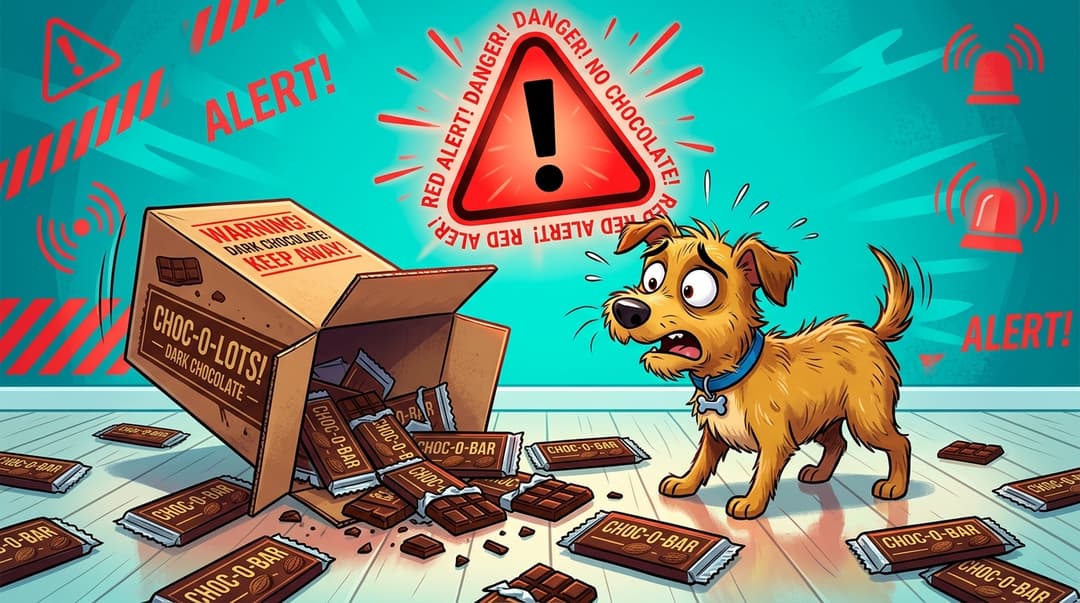
My Dog Ate Chocolate — How Worried Should I Be?
Your inputs
Results update live as you type.
Your results
Fill in the form to see your estimate.
Ready when you are
Fill in the form to see your reference estimate
Veterinary reference only
Not a substitute for your vet or poison control. Include a persistent ASPCA Animal Poison Control click-to-call button, not just text.
Keep going with a related calculator.
My Dog Ate Chocolate — How Worried Should I Be?
Toxicity depends on the type of chocolate, not just the amount — theobromine concentration varies roughly 10-fold between white chocolate (negligible) and baking/cocoa powder (highest). Commonly cited veterinary toxicology thresholds put mild signs (vomiting, diarrhea, restlessness) starting around 20 mg/kg of theobromine, cardiac effects around 40-50 mg/kg, and seizure risk from roughly 60 mg/kg upward — which is why a large dog eating a single milk chocolate bar is often a "monitor at home" case, while a small dog eating baking chocolate or cocoa powder is an emergency-vet case. This calculator factors in chocolate type, estimated amount, and your dog's weight to place the ingestion into a risk tier — it doesn't replace a call to your vet or the ASPCA Animal Poison Control Center, but it tells you how urgently to make that call.
How to use this calculator
Enter your dog's weight, the chocolate type, and roughly how much was eaten. The calculator estimates theobromine intake in mg/kg and maps it to a risk tier — it can't know exact cocoa content (that varies by brand), so treat the tier as a guide to urgency, not a precise medical readout.
Theobromine content by chocolate type (approximate)
| Chocolate type | Theobromine (mg per oz / 28g) |
|---|---|
| White chocolate | ~0.25 mg (negligible) |
| Milk chocolate | ~60 mg |
| Semi-sweet / dark chocolate | ~150 mg |
| Baking chocolate | ~450 mg |
| Cocoa powder | ~800 mg |
Understanding your risk tier
| Estimated intake | Typical signs | What to do |
|---|---|---|
| Under ~20 mg/kg | Usually none, or mild GI upset | Monitor at home; call your vet if signs appear |
| ~20–40 mg/kg | Vomiting, diarrhea, restlessness, increased thirst | Call your vet — daytime guidance is usually enough |
| ~40–60 mg/kg | Rapid heart rate, tremors, elevated temperature | Vet visit same day |
| 60 mg/kg and up | Seizures, cardiac arrhythmia | Emergency vet immediately |
These thresholds come from commonly cited veterinary toxicology references, not a single universal cutoff — smaller dogs and dogs with existing heart conditions can show effects at the lower end of a range. If the calculator returns a moderate-or-higher tier, treat that as "call now," not "wait and see," since theobromine's effects can take several hours to appear after ingestion and are easier to manage the earlier they're caught.
What to do in the minutes after ingestion
How you spend the first several minutes after discovering a chocolate ingestion can meaningfully affect the outcome, so it's worth having a clear sequence in mind rather than improvising under stress. First, secure any remaining chocolate so no more is eaten — this sounds obvious but is easy to skip when the immediate instinct is to check on your dog instead. Next, gather the specifics you'll need for an accurate risk assessment: the type of chocolate (check packaging for "dark," "semi-sweet," "baking," or milk chocolate specifically), the approximate weight or amount eaten, and roughly how long ago it happened. Weigh your dog if you don't have a recent accurate weight, since dosage-based risk genuinely depends on it. With that information in hand, use this calculator for an initial urgency read, then call your vet or the ASPCA Animal Poison Control Center — having the specifics ready before you call makes that conversation faster and the guidance you receive more precise.
Reducing the chance of a repeat incident
Dogs that get into chocolate once are statistically likely to try again given the opportunity, since the underlying behavior (counter-surfing, investigating unattended food, opportunistic scavenging) tends to be a persistent trait rather than a one-time event tied to a specific occasion. The most reliable fix is environmental, not behavioral correction after the fact: store chocolate and baking ingredients in closed cabinets rather than on countertops or open pantry shelves, be especially vigilant during holiday baking seasons when cocoa powder and baking chocolate are more likely to be left out mid-recipe, and brief house guests or visiting family about keeping bags and coat pockets (a common hiding spot for travel-size chocolate) zipped and out of reach. For a dog with a strong food-motivated personality, some owners also invest in basic "leave it" training as a supplementary layer, though this should never be relied on as the primary safeguard in place of simply removing access to the hazard.
When to consult a professional
For health, dosage, or nutrition decisions, always confirm calculator output with your veterinarian. This tool provides reference estimates, not medical advice.
Emergency or unsure?
Call your vet or ASPCA Animal Poison Control — available 24/7.
Questions about this calculator
No — by weight, baking chocolate and unsweetened cocoa powder contain roughly 5-10x more theobromine than milk chocolate, and white chocolate contains almost none.
The math, openly documented.
Weight & exposure
Pet weight and amount/product determine dose.
weight_kg · amount
Dose estimate
Compare with published veterinary thresholds.
dose = amount ÷ kg
Risk band
Map to call-vet / urgent / emergency actions.
band = tier(dose)
Action
Call vet or poison control — do not wait for symptoms.
ASPCA · Pet Poison Helpline
More from Health

Assessing Your Dog's Quality of Life
dog quality of life calculator: A scored assessment based on the HHHHHMM scale vets use with hospice and senior-care fam
Open tool
Estimating Your Dog's Body Condition
dog bmi calculator: Dogs don't have an official BMI formula — here's the body condition scoring approach vets use instea
Open tool
Is Your Cat Overweight? Here's the Real Way to Check
cat bmi calculator: Cats don't have a true BMI formula like humans — here's the body condition method vets actually use,
Open toolArticles from Insights



Got an edge case the calculator can't handle?
247 active threads about dog nutrition right now. Verified vets and experienced owners answer within hours.