How Old Is Your Cat in Human Years?
Your inputs
Results update live as you type.
Your results
Live — updates as you change inputs.
Cat age conversion
0 years
Human-equivalent age
Keep going with a related calculator.
How Old Is Your Cat in Human Years?
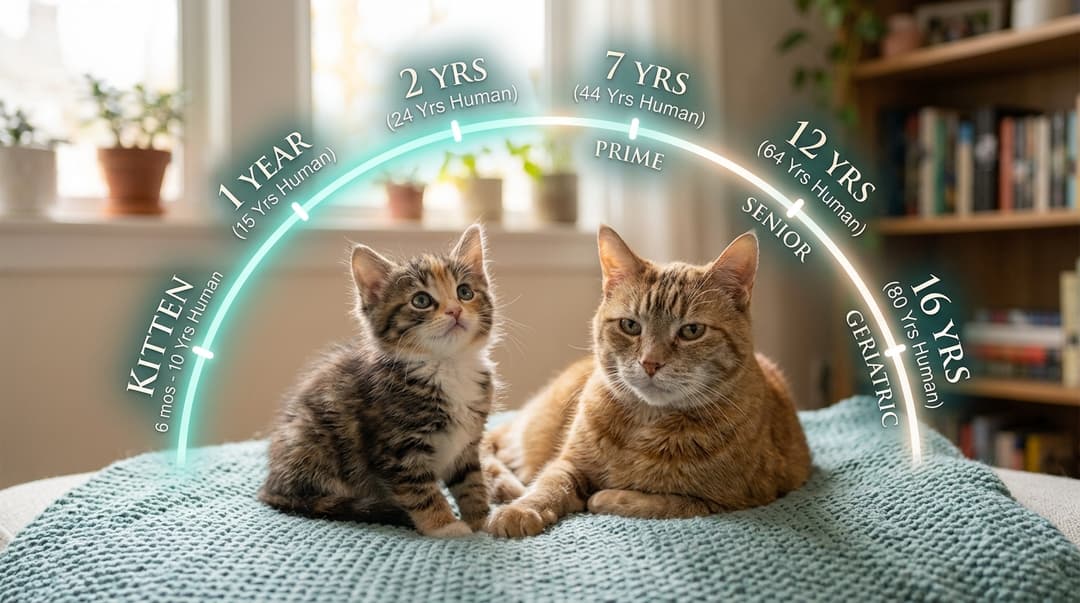
Cats age on a similar front-loaded curve to dogs but with different milestones — a cat is considered roughly 15 human-years old at 1 year, adds about 9 more by year 2, then roughly 4 human years for every year after that as an adult. Unlike dogs, cat aging doesn't vary dramatically by breed size the way canine aging does, since the weight range across cat breeds is much narrower than across dog breeds — a 6 lb cat and an 18 lb Maine Coon still age on a broadly similar curve, though genuinely large, slow-maturing breeds like Maine Coons and Ragdolls take longer to reach physical maturity in their first 2-3 years. This calculator applies the standard veterinary age-conversion curve and adjusts slightly for known slow-maturing breeds.
How to use this calculator
Enter your cat's age (and breed, if known — slow-maturing breeds get a small adjustment). Cat aging doesn't split by size the way dog aging does, so the curve here is more universal than the dog calculator's.
Human-year equivalents
| Cat age | Human-year equivalent |
|---|---|
| 6 months | ~10 |
| 1 year | ~15 |
| 2 years | ~24 |
| 4 years | ~32 |
| 7 years | ~44 |
| 10 years | ~56 |
| 15 years | ~76 |
Understanding your results
The steep jump in year one (15 human-years) reflects that a 1-year-old cat is already sexually and physically mature; after year two, aging settles into a steadier pace of roughly 4 human years per calendar year. If your cat is a slow-maturing large breed (Maine Coon, Ragdoll), the calculator nudges the early-life figure slightly, since these breeds can take 3–4 years to reach full physical maturity versus about one year for an average domestic cat — the difference is modest and mostly matters in years 1–3, not later in life.
Why cat aging doesn't split by size the way dog aging does. The size range across cat breeds (roughly 6–20 lb) is far narrower than across dog breeds (a few pounds to well over 100), so the biological mechanism that makes large dogs age faster than small ones doesn't have much room to operate in cats. That's the core reason this calculator uses one curve with a breed-based nudge rather than dog-style size-class weighting.
What "senior" actually changes for a cat. Reaching senior age (commonly around 11) is a good trigger to start more frequent wellness exams and bloodwork — particularly for kidney function and thyroid levels, since both hyperthyroidism and chronic kidney disease become meaningfully more common in cats from this age onward and are far easier to manage when caught early.
What each life stage actually means for care
Translating a human-year equivalent into practical care guidance is where this calculator becomes more than a curiosity. A young adult cat (roughly the 24-32 human-year range, corresponding to about 2-4 calendar years) is generally at its lowest lifetime health-risk point, making this a good window to establish baseline bloodwork values with your vet — having a healthy baseline on record makes it much easier to spot a meaningful change later, since "normal" varies somewhat between individual cats. As a cat moves into the mature and senior ranges (roughly 7 years and older by calendar age), the case for more frequent wellness exams strengthens considerably — many vets shift from annual to twice-yearly exams around this point specifically because early-stage kidney disease and hyperthyroidism, two of the most common senior-cat conditions, are far more manageable when caught before symptoms become obvious.
Why the human-year framing is useful beyond curiosity
It's worth being direct about why converting cat age into human-year equivalents matters practically, not just as an engaging number to share. Owners intuitively understand human aging milestones — what a 60-something person's healthcare priorities look like, or why a 15-year-old is done growing — in a way that "my cat is 8" doesn't automatically translate to on its own. Framing an 8-year-old cat as roughly 48 in human terms makes it more intuitive that this is a reasonable point to start paying closer attention to weight trends and energy level changes, the same way most people would for a person entering their late 40s. This translation is imperfect and shouldn't be over-relied upon (a cat's actual health trajectory depends on individual factors a single number can't capture), but as a mental model for calibrating "how seriously should I be tracking changes at this age," it's genuinely more actionable than the raw calendar-year figure alone.
When to consult a professional
For health, dosage, or nutrition decisions, always confirm calculator output with your veterinarian. This tool provides reference estimates, not medical advice.
Questions about this calculator
A 1-year-old cat is already sexually and physically mature, comparable developmentally to a 15-year-old human — the "slow, steady" aging most owners picture only starts after that first rapid year.
The math, openly documented.
Inputs
Enter the details that affect your estimate.
weight · age · breed
Normalize
Validate ranges and convert units when needed.
lbs ↔ kg
Calculate
Veterinary or industry-standard formulas applied.
result = f(inputs)
Results
Clear outputs with context and disclaimers.
display + notes
More from Health

My Dog Ate Chocolate — How Worried Should I Be?
Theobromine risk by chocolate type and amount.
Open tool
Assessing Your Dog's Quality of Life
dog quality of life calculator: A scored assessment based on the HHHHHMM scale vets use with hospice and senior-care fam
Open tool
Estimating Your Dog's Body Condition
dog bmi calculator: Dogs don't have an official BMI formula — here's the body condition scoring approach vets use instea
Open toolArticles from Insights



Got an edge case the calculator can't handle?
247 active threads about dog nutrition right now. Verified vets and experienced owners answer within hours.