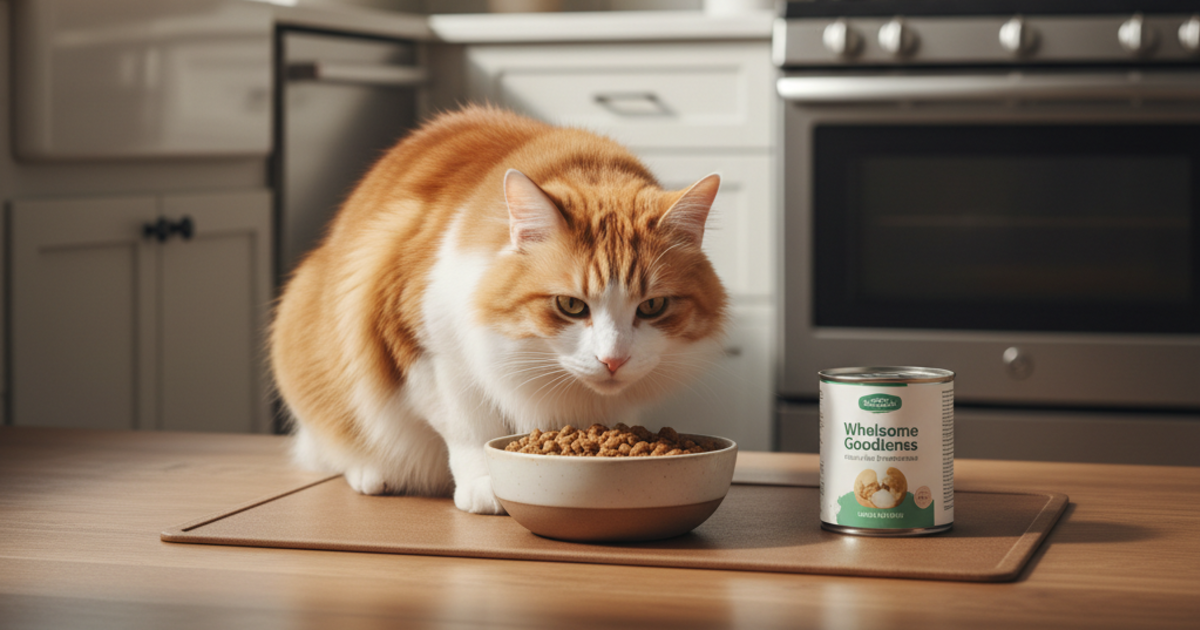
Cheap cat food can be a perfectly good choice if it is complete and balanced for your cat's life stage and you compare it by cost per 1,000 calories. Dry food is usually cheapest per calorie, wet food adds moisture, and a mix often gives the best balance of value and health.
Cat food prices swing wildly, and the cheapest option is not always the best value. Some bargain foods are nutritionally complete and well tolerated, while others skimp on quality or fall short for kittens, seniors and cats with health problems. This guide shows how to judge budget cat food, how to calculate the true daily cost of wet, dry and mixed feeding, what to look for on a label, what you should never cut corners on and practical ways to save without risking your cat's health. Use the cat cost calculator to plan your monthly budget.
What "good" means for a budget cat food
- A complete-and-balanced statement from AAFCO for your cat's life stage (growth, adult maintenance or all life stages). This confirms that essential nutrients such as taurine are included.
- Named animal protein in the ingredients. Cats are obligate carnivores and need animal-sourced nutrients.
- Calories listed per cup or can so you can portion accurately.
- A reputable manufacturer with quality control and a recall record you can check.
- Suitability for your cat, including age, weight, and any medical conditions.
Never feed dog food to a cat as a main diet. Dog food lacks enough taurine and other nutrients that cats need.
Compare cost per 1,000 calories
A cheap bag or can can still be expensive per calorie. Compare foods on cost per 1,000 kcal.
Cost per 1,000 kcal = price ÷ (total kcal ÷ 1,000)
| Food | Package | Calories | Price | Cost per 1,000 kcal |
|---|---|---|---|---|
| Dry food | 20 lb (9.07 kg) bag at about 3,900 kcal/kg | about 35,400 kcal | $25 | about $0.71 |
| Wet food | 3 oz can at about 80 kcal | 80 kcal | $0.90 | about $11.25 |
These numbers are illustrative. Dry food is usually far cheaper per calorie than canned, though wet food provides moisture.
Worked example: daily and monthly cost
A 4 kg (8.8 lb) neutered adult cat.
- Resting energy: RER = 70 × 4^0.75 = 70 × 2.83 = about 198 kcal.
- Daily need: 198 × 1.2 = about 238 kcal.
- All dry food: 238 ÷ 1,000 × $0.71 = about $0.17 per day, roughly $5 a month.
- All wet food: 238 ÷ 80 = about 3 cans, at $0.90 each, which is about $2.68 per day, roughly $80 a month.
- Mixed feeding: one can (80 kcal, $0.90) plus dry food for the remaining 158 kcal (about $0.11) is about $1.01 per day, roughly $30 a month.
- Pick what fits your budget and your cat's needs, and recheck weight every few weeks.
Adjust these illustrative prices to your own local costs.
Wet vs dry: value and health
| Factor | Dry food | Wet food |
|---|---|---|
| Cost per calorie | Lower | Higher |
| Moisture | About 10% | About 75-80% |
| Convenience | Easy to store and measure | Needs refrigeration once opened |
| Dental claims | Not a substitute for tooth brushing | None |
| Weight control | Easy to overfeed | Often easier to portion |
| Hydration and urinary health | Cats must drink more | Helps hydration |
Cats are not great drinkers, so wet food can help with hydration and may help cats prone to urinary problems. A mix, such as dry as the base with one wet meal a day, can balance cost and moisture. If your cat has a medical condition, ask your vet which format is best.
What not to cut
- A complete-and-balanced diet. Never feed treats or table scraps as the main food.
- The right life stage. Kittens, pregnant or nursing cats need food made for growth.
- Prescription diets. If your vet prescribed a diet for kidney disease, urinary issues, diabetes or allergies, do not swap it to save money without asking.
- Clean water. Provide fresh water at all times.
- Veterinary care. Skipping vet visits can cost far more later.
Ways to save without risking health
- Measure portions. Overfeeding wastes money and causes obesity.
- Compare cost per 1,000 calories instead of price per bag.
- Buy larger bags of dry food if you can use them within about 6 weeks, and store them airtight.
- Buy cases of wet food when on sale, and use auto-ship discounts or coupons.
- Mix dry and wet food to balance cost and moisture.
- Look at store brands that carry complete-and-balanced statements.
- Avoid constant switching, which can cause digestive upset and waste unfinished bags.
- Keep treats small, at no more than 10% of daily calories.
- Ask your vet or local shelter about food assistance programs or pet pantries if money is tight.
Watch out for false economy
A cheaper food that your cat will not eat is not a bargain. A food that causes vomiting, diarrhea, itching or weight problems can cost you more in vet bills. Look for signs your cat is doing well: steady weight, good energy, normal stools, a glossy coat and regular litter box habits.
Special life stages
- Kittens: use a food labeled for growth, since kittens need more calories and nutrients.
- Seniors: may need calorie, kidney or joint support. Ask your vet before switching.
- Overweight cats: measure portions and ask your vet about a weight-management plan.
- Cats with medical conditions: always follow veterinary guidance.
Switching foods safely
Transition over 7-10 days by mixing increasing amounts of the new food with the old. Cats can be stubborn, so go slowly, and watch for vomiting, diarrhea and appetite changes. If your cat refuses to eat for more than a day, call your vet, because cats can develop a serious liver problem if they go without food.
When to call your vet
Contact your vet if your cat stops eating for more than 24 hours, vomits repeatedly, has diarrhea lasting more than a day, loses weight, drinks or urinates much more than usual or strains in the litter box. Male cats that cannot urinate are an emergency. For suspected poisoning, call the ASPCA Animal Poison Control Center at 888-426-4435 or the Pet Poison Helpline at 855-764-7661 (fees may apply).
The bottom line
Good cat nutrition does not require the most expensive food, but it does require a complete-and-balanced diet, correct portions and attention to your cat's health. Compare cost per calorie, mix wet and dry for value and plan your budget with the cat cost calculator.
Frequently asked questions
PawCalculator Editorial
We combine veterinary references, published guidelines, and calculator-grade modeling. This article is for education, not a substitute for an exam.
+ Follow on PawTalk