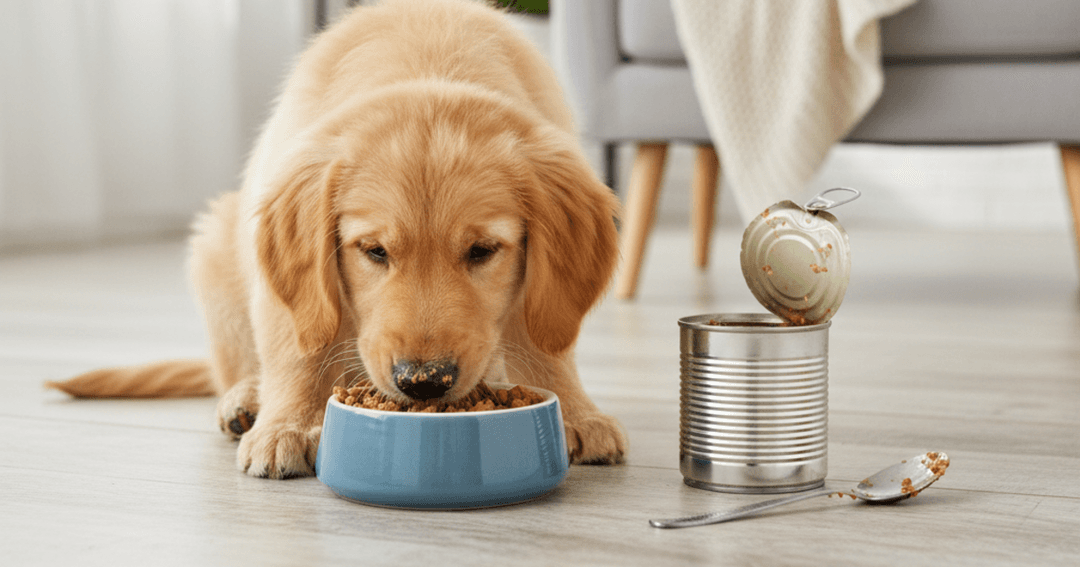
Cheap dog food can still be good if it is complete and balanced for your dog's life stage and you compare it by cost per calorie rather than price per bag. Correct portions, buying in sensible sizes and avoiding waste are often the biggest savings.
Feeding a dog is one of the largest ongoing pet costs, and the shelf is full of options at wildly different prices. A higher price does not guarantee better nutrition, and a low price does not guarantee poor quality. This guide shows how to judge budget foods, calculate real cost per day, read the label, compare dry, wet and fresh options, plan by dog size and lower your bill without short-changing your dog. Start with the dog food calculator to find out how much your dog actually needs.
What "good" means on a budget
Look for the basics before the marketing:
- A complete-and-balanced statement from AAFCO for your dog's life stage (growth, adult maintenance or all life stages). Large-breed puppies need a food approved for large-breed growth.
- Calories listed per cup or per kilogram, so you can compare and portion.
- A named protein source such as chicken, beef or lamb in the first ingredients.
- A manufacturer with quality control, such as a qualified nutritionist and published nutrient information. Ask the company.
- No major recall pattern in recent years. Check FDA recall listings.
You do not need exotic proteins, grain-free recipes or fancy packaging to meet these.
How to read a budget dog food label
- Statement of nutritional adequacy: the line saying the food is "complete and balanced" and for which life stage.
- Guaranteed analysis: minimum protein and fat, maximum fiber and moisture. Compare foods on a dry-matter basis if you mix wet and dry.
- Ingredient list: sorted by weight before cooking. Named meats, whole grains and vegetables are good signs. Vague terms such as "meat" can mean less transparency.
- Calorie statement: in kcal per kg and per cup. This lets you work out the daily cost.
- Feeding guide: a starting point, not a rule. Adjust to your dog's body condition.
Compare cost per 1,000 calories
Bag price alone is misleading, because foods differ in calorie density. A cheaper bag of low-calorie food can cost more per day than a pricier energy-dense one.
Cost per 1,000 kcal = bag price ÷ (total kcal in bag ÷ 1,000)
| Food | Bag | Calories | Price | Cost per 1,000 kcal |
|---|---|---|---|---|
| Food A | 40 lb (18.1 kg) | about 3,600 kcal/kg = 65,300 kcal | $55 | about $0.84 |
| Food B | 30 lb (13.6 kg) | about 4,000 kcal/kg = 54,400 kcal | $75 | about $1.38 |
Worked example
A 10 kg (22 lb) neutered adult dog.
- Resting energy: RER = 70 × 10^0.75 = 70 × 5.62 = about 394 kcal.
- Daily need: 394 × 1.6 = about 630 kcal.
- Food A daily cost: 0.63 × $0.84 = roughly $0.53 per day, about $16 a month.
- Food B daily cost: 0.63 × $1.38 = roughly $0.87 per day, about $26 a month.
- Difference: around $10 a month, or about $120 a year, for a dog this size.
Both examples are illustrative. Plug in your own bag size, price and calories to compare real options.
A second example: a large dog
A 30 kg (66 lb) neutered adult dog.
- Resting energy: RER = 70 × 30^0.75 = 70 × 12.8 = about 897 kcal.
- Daily need: 897 × 1.6 = about 1,435 kcal.
- Food A: 1.435 × $0.84 = about $1.21 per day, roughly $36 a month.
- Food B: 1.435 × $1.38 = about $1.98 per day, roughly $59 a month.
- Yearly difference: about $280.
The bigger the dog, the more cost per calorie matters.
Dry, wet or fresh: cost comparison
| Type | Typical cost per 1,000 kcal | Pros | Cons |
|---|---|---|---|
| Dry kibble | Lowest | Convenient, stores well, good for dental scrubbing myths aside | Lower moisture |
| Canned wet food | Often 3-6 times kibble | Palatable, high moisture | Expensive for large dogs |
| Fresh or frozen | Often highest | Very palatable | Cost and storage |
A budget strategy many owners use is kibble as the base with a spoonful of wet food on top for taste.
Budget by dog size
| Dog size | Daily calories (neutered adult, typical) | Approx. monthly kibble cost at $0.84 per 1,000 kcal |
|---|---|---|
| 5 kg (11 lb) | about 375 kcal | about $9 |
| 10 kg (22 lb) | about 630 kcal | about $16 |
| 20 kg (44 lb) | about 1,060 kcal | about $27 |
| 30 kg (66 lb) | about 1,435 kcal | about $36 |
| 40 kg (88 lb) | about 1,780 kcal | about $45 |
These are estimates. Active, intact, growing or senior dogs differ.
Ways to save without cutting corners
- Buy the right bag size. Larger bags usually cost less per pound, but only buy what your dog will finish within 6-8 weeks, since fat in kibble can go stale.
- Store food in a cool, dry, airtight container to prevent spoilage.
- Measure portions with a scale or a proper cup. Overfeeding by 20% wastes money and adds weight.
- Keep treats to 10% of calories. Use part of the daily kibble as training treats.
- Use coupons, auto-ship discounts and store loyalty programs where available.
- Compare store brands that carry AAFCO statements. Some are made by well-known manufacturers.
- Use cheap healthy extras such as green beans or plain carrots in place of some calories, instead of pricey toppers.
- Avoid constant switching, which can cause stomach upset and waste unfinished bags.
- Ask your vet clinic about sample bags and manufacturer rebates.
What not to cut
Do not dilute food, skip life-stage formulas or feed an unbalanced homemade diet to save money. Puppies, seniors and dogs with medical conditions have specific needs. Prescription diets are for medical reasons, so ask your vet before changing them.
Switching to a cheaper food safely
- Check that the new food is complete and balanced for your dog's life stage.
- Mix over 7-10 days: 25% new on days 1-2, 50% on days 3-5, 75% on days 6-8, then 100%.
- Watch stools, appetite and itching. Slow down if you see soft stool.
- Recalculate the portion, since calories per cup may differ.
- Weigh your dog every two weeks for the first two months.
Spotting false economy
A food that is cheap but low in digestibility may lead to larger stools, poor coat or upset stomach. If your dog does well, with steady weight, good energy, normal stool and a shiny coat, the food is working, whatever the price.
Common mistakes
- Choosing by bag price instead of cost per 1,000 calories
- Buying a huge bag that goes stale
- Overfeeding because the cup scoop is too big
- Feeding adult food to a puppy or the reverse
- Skipping the label statement
When to call your vet
Contact your vet if your dog has ongoing diarrhea, vomiting, itching, weight changes or low energy after a food switch. If you are struggling to afford food, ask about assistance programs and local pet pantries. For suspected poisoning, call the ASPCA Animal Poison Control Center at 888-426-4435 or the Pet Poison Helpline at 855-764-7661 (fees may apply).
The bottom line
Judge dog food by completeness, calories and cost per day, not marketing or bag price. Measure portions with the dog food calculator and your budget will go further.
Frequently asked questions
PawCalculator Editorial
We combine veterinary references, published guidelines, and calculator-grade modeling. This article is for education, not a substitute for an exam.
+ Follow on PawTalk