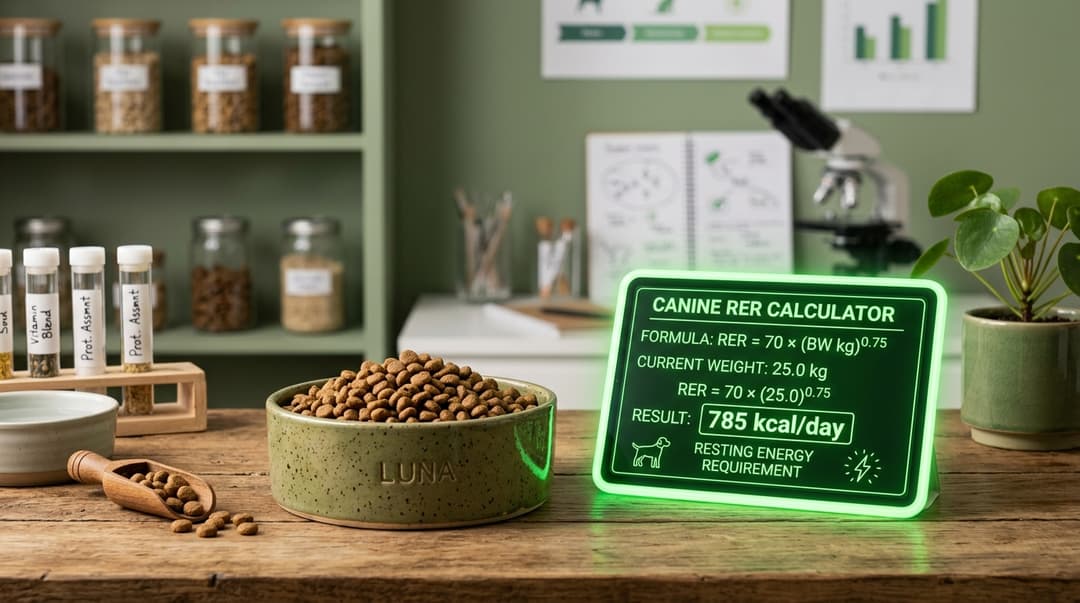
Calculate Your Dog's RER (Resting Energy Requirement)
Your inputs
Results update live as you type.
Your results
Live — updates as you change inputs.
Resting Energy Requirement
366 kcal/day
RER
RER is baseline resting energy — multiply by life-stage factor for DER.
Keep going with a related calculator.
Calculate Your Dog's RER (Resting Energy Requirement)
RER — Resting Energy Requirement — is the foundational number in veterinary nutrition, representing the calories a dog burns at complete rest, calculated as 70 × (body weight in kg)^0.75. It's the base figure that DER (Daily Energy Requirement) multiplies by a life-stage/activity factor to get an actual feeding target, and it's also the number veterinary nutritionists reference when calculating specific nutrient targets for therapeutic diets. This advanced-mode calculator shows the raw RER output alongside the underlying math, for owners and vet techs who want the base figure rather than a pre-multiplied recommendation.
How to use this calculator
Enter body weight in kilograms. The calculator returns RER directly, along with the exponentiation step shown, for anyone who wants the base figure rather than a pre-multiplied recommendation.
RER reference by weight
| Weight | RER (kcal/day) |
|---|---|
| 5 kg (11 lb) | ~185 |
| 10 kg (22 lb) | ~316 |
| 20 kg (44 lb) | ~532 |
| 30 kg (66 lb) | ~730 |
| 40 kg (88 lb) | ~913 |
Understanding your results
RER on its own isn't a feeding target — it's the baseline that DER multiplies to get there, and it's most useful when you need the raw figure for a downstream calculation (formulating a therapeutic diet's nutrient targets as a percentage of intake, cross-checking a vet tech's worksheet, or building your own DER multiplier for a case that doesn't fit a standard life-stage category). If you just want a daily feeding number, the Dog Calorie Calculator applies the DER multiplier for you and is the faster path to an actual target.
Why the exponent matters. The 0.75 exponent (rather than a simple linear multiplier) reflects metabolic scaling — smaller animals have a higher surface-area-to-volume ratio and lose heat faster relative to their mass, so they burn more calories per kilogram of body weight than larger animals. This is why doubling a dog's weight doesn't double its RER.
A simplified linear formula exists too, with limits. For dogs in the roughly 2–45 kg range, a simpler linear approximation (30 × weight in kg + 70) is sometimes used and gives a close estimate — but it becomes noticeably less accurate outside that weight range, which is why the exponential formula is the more broadly reliable standard.
Worked examples across the weight spectrum
Seeing the formula applied across a range of weights makes the non-linear scaling concrete in a way the abstract exponent explanation doesn't always convey. A 5 kg dog's RER of roughly 185 kcal/day works out to about 37 kcal per kilogram of body weight — but a 40 kg dog's RER of roughly 913 kcal/day works out to only about 23 kcal per kilogram, despite weighing eight times as much. This is the practical meaning of the 0.75 exponent: metabolic demand grows slower than body mass, so a linear "kcal per pound" rule of thumb that works reasonably well for a medium dog will meaningfully overestimate needs for a giant breed and underestimate them for a toy breed if applied uniformly across sizes. This is also part of why toy-breed food formulas tend to be calorie-dense relative to their volume — a small dog needs more calories per unit of body weight than a large dog, not less, which surprises some owners who assume smaller means proportionally less food across the board.
How RER fits into building a full nutrition plan
RER is deliberately the most stripped-down number in this calculator family — everything else (DER, weight-loss portions, life-stage-adjusted targets) is built from this baseline by applying a multiplier appropriate to the specific situation. Thinking of it as the foundation of a layered calculation helps explain why so many of the site's other dog nutrition tools reference RER internally even though most owners never need to see the raw figure directly: a healthy adult dog's DER is typically RER × 1.6, a weight-loss target trims that multiplier down, a growing puppy's target multiplies it up, and a therapeutic diet's specific nutrient restrictions are often expressed as an amount per unit of RER rather than a flat daily gram target. Understanding this baseline-and-multiplier structure is mostly useful context — for actual day-to-day feeding decisions, the Dog Calorie Calculator applies the right multiplier automatically and is the faster path to a usable number.
When to consult a professional
For health, dosage, or nutrition decisions, always confirm calculator output with your veterinarian. This tool provides reference estimates, not medical advice.
Questions about this calculator
RER = 70 × (body weight in kg)^0.75 — the exponential (rather than linear) relationship reflects that metabolic rate doesn't scale directly with body weight; smaller animals burn more calories per kilogram than larger ones.
The math, openly documented.
Inputs
Enter the details that affect your estimate.
weight · age · breed
Normalize
Validate ranges and convert units when needed.
lbs ↔ kg
Calculate
Veterinary or industry-standard formulas applied.
result = f(inputs)
Results
Clear outputs with context and disclaimers.
display + notes
More from Nutrition

Dog Food Portions by Weight and Age
dog food calculator by weight and age: Enter your dog's exact weight and age for a portion recommendation that adjusts a
Open tool
A Safe Weight-Loss Plan for Your Cat
cat weight loss calculator: Calculate a safe weight-loss calorie target for your cat — rapid weight loss carries real he
Open tool
Safe Feeding Portions for Dog Weight Loss
dog weight loss calculator: A weight-loss-specific portion calculator using a conservative calorie deficit — because cra
Open toolArticles from Insights

Got an edge case the calculator can't handle?
247 active threads about dog nutrition right now. Verified vets and experienced owners answer within hours.