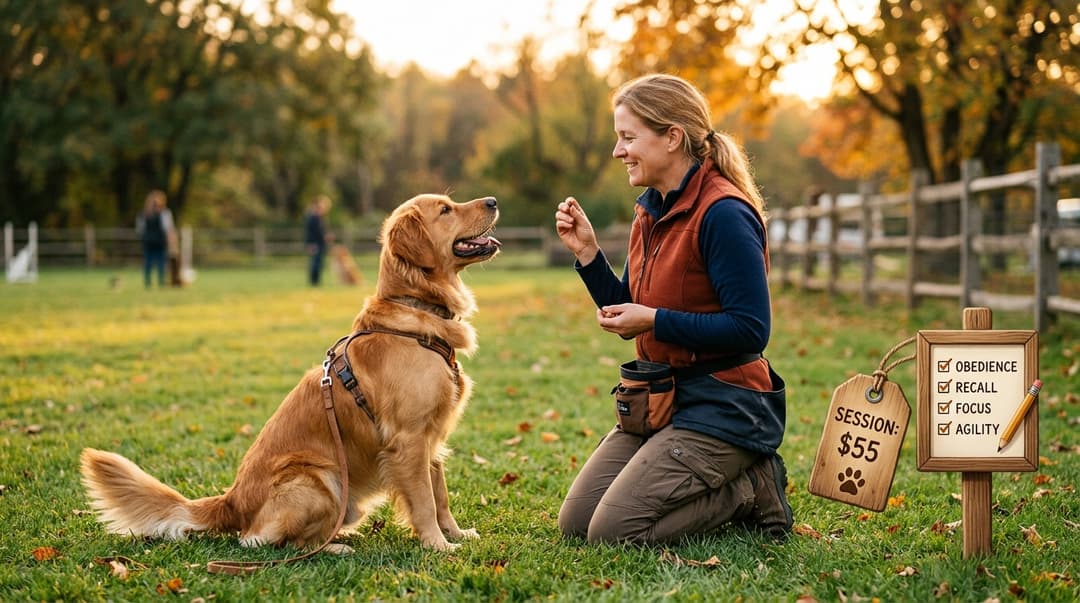
How Much Does Dog Training Cost?
Your inputs
Results update live as you type.
Your results
Live — updates as you change inputs.
Training cost estimate
$216–$276
Estimated cost
Veterinary reference only
Estimates vary by trainer and location.
Keep going with a related calculator.
How Much Does Dog Training Cost?
Training cost varies enormously by format — group obedience classes are typically the most affordable option (often running as a multi-week package), private in-home sessions cost considerably more per hour due to the trainer's individualized time and travel, and board-and-train programs (where the dog stays with the trainer for an intensive period) are usually the most expensive option but compress the training timeline significantly. Specialized training (service dog preparation, aggressive behavior rehabilitation) commands a premium over basic obedience work due to the additional expertise required. This calculator estimates a cost range based on format, session count, and your general regional cost tier.
How to use this calculator
Select training format, number of sessions, and your regional cost tier. Format is the biggest cost driver by far — pick it based on what your dog actually needs, not just budget, since the cheapest option isn't the best value if it doesn't fit the situation.
Relative cost by format
| Format | Relative cost per hour of trainer time | Best fit |
|---|---|---|
| Group classes | Lowest | Basic obedience, socialization |
| Private in-home | Moderate-high | Specific behavior issues, dogs that struggle in groups |
| Board-and-train | Highest total, but compressed timeline | Owners needing a faster result, or issues needing consistency the owner can't provide daily |
| Specialized (service prep, aggression rehab) | Highest | Needs that require dedicated expertise |
Understanding your results
The session-count input matters as much as format — a single private session for a specific problem costs far less than a multi-week group package, even though the per-hour rate is higher, so don't assume "private is always the pricier choice" without comparing total program cost. If board-and-train's total looks steep, remember it bundles training with full-time care for that period — comparing it purely against per-session group class pricing understates what's actually included. Whatever format you choose, ask specifically what happens after the formal program ends: training that isn't reinforced at home tends to fade, so ongoing owner involvement affects real-world value more than the format itself.
Trainer credentials affect price and quality both. Certified trainers (through recognized certifying bodies) and those specializing in a specific issue (like reactivity or aggression) typically charge more than general obedience trainers — for a straightforward puppy class, this premium matters less; for a specific behavioral problem, it often matters a lot.
Group class value depends on class size. A "group class" with 3 dogs offers meaningfully more individual attention than one with 12 — if comparing group options at similar price points, ask about typical class size before assuming they're equivalent value.
Vetting a trainer beyond price and format alone
Once you've settled on a format and rough budget using this calculator, the actual trainer you choose matters more to your outcome than the format itself, and price alone is a weak signal for quality. Ask specifically about the training methodology used — positive-reinforcement-based approaches are the modern standard recommended by most veterinary behaviorists, while methods relying heavily on aversive tools or techniques carry a documented risk of increasing fear or aggression rather than resolving the underlying issue, particularly for dogs with existing anxiety or reactivity. Request to observe part of a class or session before committing to a full program if the trainer allows it — watching how a trainer handles a dog that's struggling or overwhelmed tells you more about their actual approach than a website description ever will. For any issue involving aggression or significant fear, specifically seek a trainer with documented experience in that area (or ask your vet for a referral to a veterinary behaviorist) rather than a general obedience trainer, since these cases benefit from specialized approaches that general puppy-class experience doesn't necessarily prepare a trainer for.
Making training stick after the formal program ends
The most common reason a training investment doesn't produce lasting results isn't a bad trainer or the wrong format — it's a lack of reinforcement once the formal sessions or program conclude. Dogs generalize new skills slowly, meaning a behavior reliably performed in the training environment (a quiet room, a familiar trainer, minimal distractions) often needs deliberate practice in new environments and with new distractions before it holds up in the situations that actually matter, like a busy sidewalk or a visitor at the door. Building 5-10 minutes of daily practice into your existing routine — reinforcing cues during normal walks and at home rather than treating training as something that only happens during scheduled sessions — is what actually cements a new behavior long-term. Many trainers offer a lower-cost refresher session or check-in a few weeks after a program ends specifically because owners often need a second round of guidance once they've had time to practice independently and run into real-world snags the formal sessions didn't cover.
When to consult a professional
For health, dosage, or nutrition decisions, always confirm calculator output with your veterinarian. This tool provides reference estimates, not medical advice.
Questions about this calculator
Group classes are typically the lowest cost per session since the trainer's time is split across multiple dogs/owners, though they offer less individualized attention than private sessions.
The math, openly documented.
Inputs
Enter the details that affect your estimate.
weight · age · breed
Normalize
Validate ranges and convert units when needed.
lbs ↔ kg
Calculate
Veterinary or industry-standard formulas applied.
result = f(inputs)
Results
Clear outputs with context and disclaimers.
display + notes
More from Lifestyle

What Does It Really Cost to Own a Cat?
cost of owning a cat: Estimate the real lifetime cost of cat ownership — food, litter, vet care, and the occasional emer
Open tool
How Much Should Dog Grooming Cost — And How Often?
dog grooming cost: Estimate what professional grooming should cost for your dog's coat type and size, plus how often you
Open tool
How Much Does Cat Litter Really Cost?
cat litter cost: Compare monthly litter costs across clumping clay, crystal, and natural litter types, adjusted for numb
Open toolArticles from Insights



Got an edge case the calculator can't handle?
247 active threads about dog nutrition right now. Verified vets and experienced owners answer within hours.