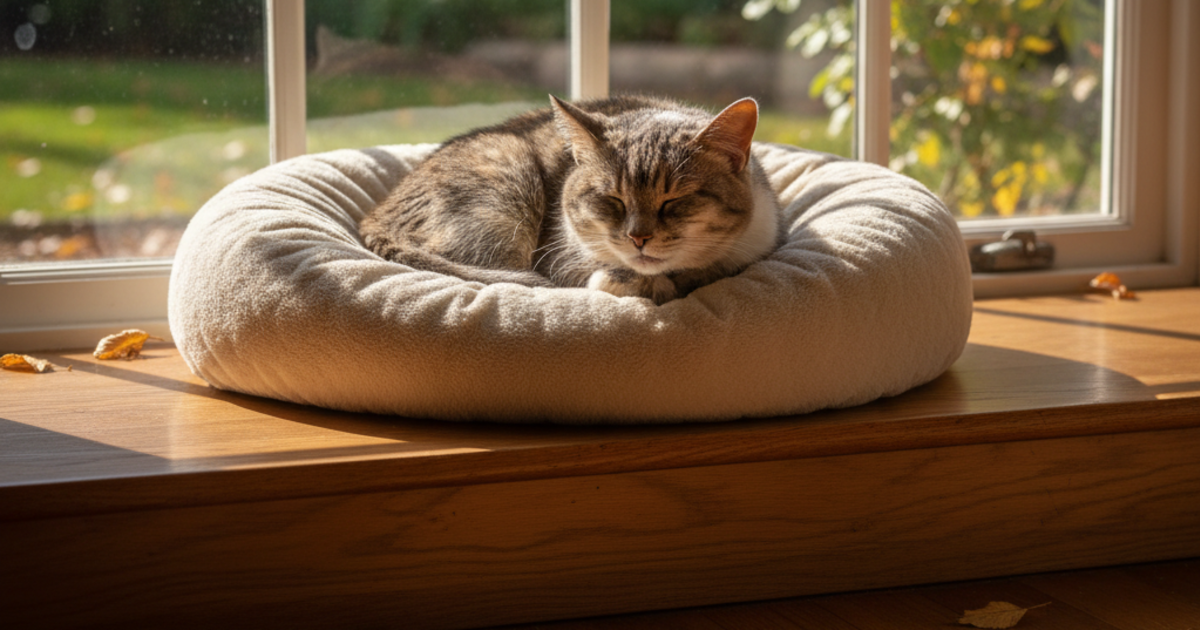
Most vets consider a cat senior from about 10 years old (the AAHA/AAFP Feline Life Stage Guidelines use over 10). That's roughly 56 in human years, and it's when twice-yearly checkups and routine bloodwork usually start.
So, what age is a senior cat, exactly? Ten is the line vets draw. But cats don't wake up on their tenth birthday with gray whiskers and a new personality. It's a gradual shift, and knowing the stages helps you catch changes early. To see your own cat's age in human years, use our cat years to human years calculator.
What age is a cat considered a senior?
The American Association of Feline Practitioners (AAFP) and the American Animal Hospital Association (AAHA) publish life stage guidelines for cats. They call a cat a senior once it's older than 10. Some other sources start "senior" earlier, around 7, but the AAHA/AAFP guidelines call that stage "mature adult" instead.
Why does the label matter? Because it changes what your vet recommends: more frequent exams, routine bloodwork and closer tracking of weight. Those checks catch problems, like kidney or thyroid disease, before they're obvious at home.
Cat life stages: kitten, young adult, mature adult and senior
Here are the stages as laid out in the AAHA/AAFP guidelines:
| Life stage | Age | What it means |
|---|---|---|
| Kitten | Birth to 1 year | Fast growth, vaccines, spay/neuter |
| Young adult | 1–6 years | Prime of life, stable weight and routine |
| Mature adult | 7–10 years | Slowing down a little, weight gain is common |
| Senior | Over 10 years | More frequent vet care, screening for age-related disease |
Keep in mind that these are guidelines. A cat's genetics, diet, dental health and lifestyle all shape how well it ages. If you're curious about the youngest stage, see when cats stop growing.
Senior cat age in human years (chart)
Cat-to-human age charts are approximations, but they give a feel for where your cat is in life. A common rule: the first year equals about 15 human years, the second brings you to about 24, and each year after that adds about 4.
| Cat age | Approx. human age |
|---|---|
| 1 | 15 |
| 2 | 24 |
| 4 | 32 |
| 6 | 40 |
| 8 | 48 |
| 10 | 56 |
| 12 | 64 |
| 14 | 72 |
| 16 | 80 |
| 18 | 88 |
| 20 | 96 |
Worked example: How old is a 12-year-old cat in human years?
- First two years: 24 human years.
- Remaining years: 12 − 2 = 10 years × 4 = 40.
- Total: 24 + 40 = 64 human years.
Now try your own cat's age in the cat age calculator or compare pets with the pet age calculator. To see how cats compare to dogs, the pet age calculator handles both.
Signs your cat is getting older
Aging shows up quietly. Watch for:
- Sleeping more, or being less playful.
- Stiffness. Hesitating before jumping onto the couch, or using the stairs instead of leaping.
- Weight changes. Some senior cats gain weight. Many lose it, and unexplained weight loss is worth a vet visit.
- Grooming changes. A greasy, matted or scruffy coat can mean your cat can't reach or doesn't feel like grooming.
- Cloudy eyes. A slight bluish haze is common with age, but sudden changes aren't.
- Dental trouble. Bad breath, drooling or dropping food.
- More vocalizing, especially at night, or seeming confused.
- Litter box changes. Missing the box, or drinking and urinating more.
Don't write all of this off as "just old age." Many of these signs point to conditions your vet can treat.
How senior care changes: vet visits, bloodwork, diet and weight
Vet visits. The AAHA/AAFP guidelines suggest that senior cats visit the vet at least twice a year. Cats hide illness well, and problems can move fast.
Bloodwork and screening. Your vet may recommend bloodwork, a urinalysis and a blood pressure check at these visits. They help catch kidney disease, an overactive thyroid and diabetes, all of which are more common in older cats.
Diet. Senior cats don't all need "senior" food. Some need more calories because they lose muscle, and others need fewer because they've slowed down. Ask your vet before switching. Our cat feeding chart can help you check portions.
Weight. Weigh your cat monthly at home. Hold your cat and step on the scale, then subtract your own weight, or use a baby scale. A drop of even half a pound can matter in a 10 lb cat.
Comfort. Add a low-sided litter box, a step to the couch and soft bedding. Arthritis is very common in older cats, and it's often missed because cats don't limp the way dogs do.
If you're not sure how old your cat is, see how to tell the age of a cat.
Health issues that become more common in senior cats
Knowing what to watch for makes those twice-a-year visits more useful. Conditions that vets see more often in older cats include kidney disease, an overactive thyroid, diabetes, arthritis, dental disease and high blood pressure. Some cats also develop age-related changes in thinking, such as night-time yowling or getting lost in familiar rooms.
None of these is a given, and many can be managed well when they're caught early. That's the whole point of senior screening: bloodwork and a urine test can pick up changes before your cat looks sick.
Small changes that make life easier
A few simple tweaks help an older cat stay comfortable:
- Low-sided litter boxes that are easy to step into, placed on every level of your home.
- Steps or ramps to favorite perches and the bed.
- Warm, soft bedding in quiet spots away from drafts.
- Food and water close together, with shallow bowls if your cat's mouth is sore.
- Regular brushing, since older cats often groom less.
When to call your vet
Any of these in a senior cat deserves a prompt call:
- Drinking and urinating much more than usual.
- Weight loss despite a normal or increased appetite.
- Not eating for 24 hours or more.
- Vomiting more than once a week, or diarrhea that lasts more than a couple of days.
- Straining in the litter box or crying while urinating. For male cats, this is an emergency.
- Difficulty breathing, open-mouth breathing or rapid breathing at rest.
- Sudden blindness, disorientation, circling or weakness in the back legs.
- Hiding, or a sudden change in personality.
Frequently asked questions
PawCalculator Editorial
We combine veterinary references, published guidelines, and calculator-grade modeling. This article is for education, not a substitute for an exam.
+ Follow on PawTalk