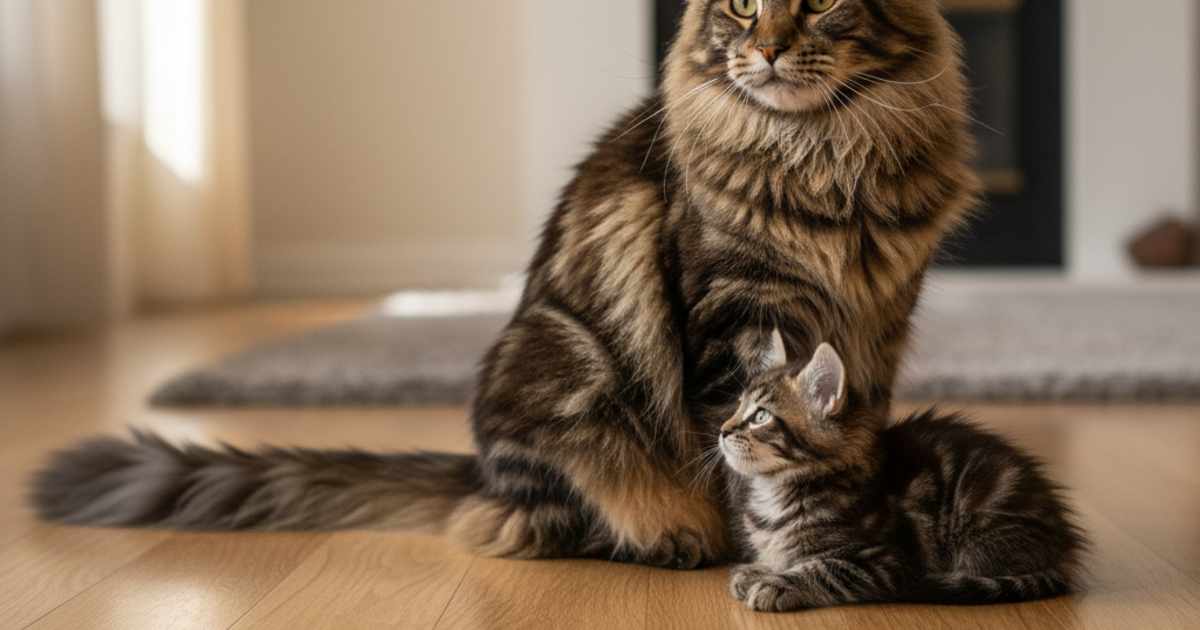
Most cats are fully grown at about 12 months, reaching adult height around then and filling out by 18 months. Large, slow-maturing breeds such as Maine Coons can keep growing until they're 3–5 years old.
So, at what age is a cat fully grown? For a typical domestic shorthair, the answer is "about a year, give or take." For a giant breed, it's more like "wait a few years." Here's how it plays out, and how to tell if your kitten still has growing to do. If you'd like to see your cat's age in human years as you read, try our cat age chart.
At what age is a cat fully grown? (short answer)
For most cats:
- By about 12 months: adult height and length.
- By about 18 months: muscle and chest fill out, so your cat looks (and weighs) like a grown-up.
That's true for most domestic cats, which is what most of us have at home. Some finish a little sooner, some a little later. Our cat age calculator can also help you estimate what age your cat is fully grown in human terms. Keep reading for the exceptions.
Cat growth stages: newborn, kitten, adolescent, adult
| Stage | Age | What's happening |
|---|---|---|
| Newborn | 0–4 weeks | Kittens double their birth weight in about 10 days and gain roughly 10–15 g a day |
| Kitten | 1–6 months | Fast growth. A common rule of thumb is about a pound a month for the first 4 months |
| Adolescent | 6–12 months | Growth slows. Legs and body reach adult proportions |
| Young adult | 12–18 months | Height is done. Chest and muscle fill out |
| Large breeds | 18 months–5 years | Slow "filling out" continues in some breeds |
The newborn and early-kitten figures come from veterinary neonatal guidance summarized by dvm360. They're averages, so a healthy kitten can land a bit above or below.
Do big breeds grow longer? Maine Coon, Ragdoll, Norwegian Forest Cat
Yes. Bigger cats need longer to build all that bone and muscle.
Maine Coons are the classic example. Breed-focused sources say they grow fast in the first year, then slow down and keep growing until about 3 to 5 years of age. Some sources note males may keep adding body depth right up to year 5. Their coat and mane also take years to fully develop.
Ragdolls and Norwegian Forest Cats are also known as slow-maturing breeds, and owners commonly report they keep filling out well past their first birthday, into their third or fourth year. There's less formal data on these, so if you have one, your breeder is the best source for what to expect.
Here's the takeaway: a Maine Coon at 18 months can look nearly full-size and still have a lot of growing to do. Don't panic if a large-breed kitten seems "small for its age" at a year. Track the trend, not just the number.
Does spaying or neutering affect growth?
Possibly a little. Cats that are spayed or neutered very young may keep growing longer, since sex hormones help close the growth plates in the bones. The practical effect is usually small: slightly longer legs, or a slightly leaner frame. Cats altered later don't change.
Neutering also changes metabolism. Fixed cats burn fewer calories, so weight gain is common afterward. That's a feeding issue, not a growth issue. Watch portions, and see how much a 1-year-old cat should eat.
Is my cat still growing? Signs and a quick check
Try these checks:
- Weigh monthly. If weight has been flat for 2–3 months at a healthy body condition, growth is probably done.
- Look at proportions. A young cat often has big paws and ears relative to its body, and a lanky shape. That evens out.
- Check the teeth. All permanent teeth are in by about 6 months. That's the "not a baby anymore" line. See our guide on how to tell the age of a cat.
- Feel the body. You should feel ribs under a thin layer of padding. If not, it's fat, not growth.
- Ask your vet. A vet can compare your cat to its breed and check for growth issues.
A cat that keeps gaining weight after 18 months is usually gaining fat. For a body-condition check, our cat BMI calculator is a handy starting point.
How to track your cat's growth at home
You don't need fancy gear to see whether your kitten is on track:
- Weigh every 1–2 weeks while it's a kitten, using a kitchen scale for small kittens or a baby scale. For an older kitten, weigh yourself holding your cat and subtract your own weight.
- Write the numbers down, or log them in a weight tracker, so you can see the trend rather than one day's reading.
- Take a few photos from the side and above at the same spot each month. It's easier to see filling out in pictures.
- Check the body shape, not just the scale. Ribs should be easy to feel, with a waist visible from above.
Healthy growth is steady, with a few quick spurts. Stalls, losses or sudden jumps are worth a call to your vet. For the feeding side, our cat feeding chart shows portions by weight.
Convert your cat's age to human years (worked example)
It's fun to compare growth to human milestones. A common rule: 1 year = 15 human years, 2 years = 24, and +4 for each year after.
Worked example: a Maine Coon at 3 years and at 5 years.
- At 2 years: 24 human years.
- At 3 years: 24 + 4 = 28 human years.
- At 5 years: 24 + (3 × 4) = 36 human years.
So a 3-to-5-year-old Maine Coon finishing its growth is roughly 28 to 36 in human terms, a "late bloomer" indeed.
Try your own cat's age in our cat age calculator, or compare species with the pet age calculator.
When to call your vet
Growth should be steady. Call your vet if:
- A kitten isn't gaining weight week to week, or is losing weight.
- Belly looks swollen and pot-bellied with a thin body (worms are common).
- Vomiting or diarrhea lasts more than 24 hours in a kitten. Kittens dehydrate fast.
- Lethargy, not eating or hiding.
- Limping, or trouble jumping in a growing cat.
- Very rapid weight gain in an adult.
- A sudden drop in energy or breathing trouble at any age.
Frequently asked questions
PawCalculator Editorial
We combine veterinary references, published guidelines, and calculator-grade modeling. This article is for education, not a substitute for an exam.
+ Follow on PawTalk