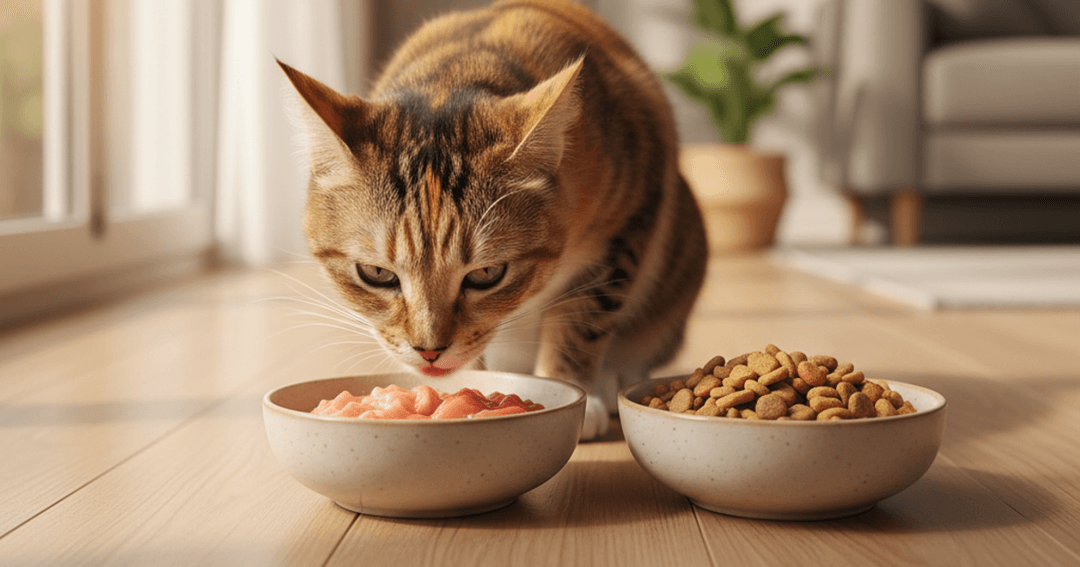
Kittens need about 2–2.5 × their resting energy requirement to grow, while a 1-year-old neutered cat is on adult portions: about 1.2 × RER, or roughly 200–250 kcal a day for a 4 kg (9 lb) cat. Convert that to cans or cups using your food's label.
The first year is when a cat's appetite goes through a big change. Kittens eat a lot for their size, and then, right around the first birthday, the calorie needs drop. If you're asking how much food a 1 year old cat should eat, that shift is the reason the answer isn't "the same as last month." For a quick answer, try our cat feeding chart by age.
How much should a 1-year-old cat eat? (short answer)
A typical neutered 1-year-old weighing 4 kg (9 lb) needs about 240 kcal a day. That's about three 80-kcal cans, or about 0.6 cup of a 400 kcal-per-cup dry food, or some mix of the two. Your cat's weight, activity and whether it's fixed all move that number.
If you're feeding a mix of wet and dry, see our guide to how much wet and dry food to feed a cat.
Kitten feeding by age: 8 weeks, 3 months, 6 months, 12 months
Kittens grow fast. A common rule of thumb from veterinary neonatal guidance is about a pound a month for the first four months. Because ages and weights don't line up perfectly, this chart is organized by weight, with rough age labels.
Kitten calories = RER × 2 to 2.5, where RER = 70 × body weight in kg^0.75.
| Kitten weight | Rough age | RER | Daily kcal (×2 to ×2.5) | Wet-only cans (80 kcal) |
|---|---|---|---|---|
| 1 kg / 2.2 lb | about 2 months | 70 | 140–175 | 1.8–2.2 |
| 2 kg / 4.4 lb | about 4 months | 118 | 235–294 | 2.9–3.7 |
| 3 kg / 6.6 lb | about 6–8 months | 160 | 319–399 | 4.0–5.0 |
| 4 kg / 8.8 lb | about 9–12 months | 198 | 396–495 (until adult size) | see below |
The age labels are approximate, since kittens vary by breed and sex. A 4 kg cat at 12 months is usually already an adult in calorie terms, so use the adult number in the next section.
How often should a kitten eat? Small, frequent meals work best:
- 8 weeks to 6 months: 3–4 meals a day.
- 6 to 12 months: 2–3 meals a day.
Feed a kitten or "all life stages" food, since it's formulated for growth. See how much protein is in cat food for why kitten diets have higher minimums.
How much wet food a kitten should eat (cans per day)
Cans vary from about 70 to 100 kcal for a 3 oz can, so check the label. Using an 80 kcal can:
- A 2 kg kitten needing 235–294 kcal a day: about 3–3.7 cans if wet-only.
- A 3 kg kitten needing 319–399 kcal: about 4–5 cans if wet-only.
Most people don't feed only wet, so split the calories. For example, a 2 kg kitten on half wet and half dry: about 130 kcal from wet (1.6 cans) and 130 kcal from dry (a little under 1/3 cup at 400 kcal per cup).
If your kitten is a healthy weight and energetic, you're probably feeding the right amount. If the belly looks round and you can't feel ribs, cut back.
Worked example: calories for a 4 kg 1-year-old neutered cat
Meet Mochi: 4 kg (9 lb), neutered, 12 months old, indoors.
- RER. 4^0.75 is about 2.83. So RER = 70 × 2.83 = about 198 kcal.
- Adult factor. For a neutered adult, use about 1.2. So 198 × 1.2 = about 238 kcal a day.
- Turn it into food.
- All wet, 80 kcal per can: 238 ÷ 80 = about 3 cans.
- All dry, 400 kcal per cup: 238 ÷ 400 = about 0.6 cup.
- Half and half: 119 kcal wet (about 1.5 cans) and 119 kcal dry (about 0.3 cup).
Two notes. An intact (unfixed) adult may need more, closer to 1.4 × RER. And a very active cat may need more while a couch cat needs less. Weigh monthly, and adjust by about 10% if the scale moves the wrong way.
Try your own cat in the cat calorie calculator and the cat feeding chart.
Moving from kitten to adult portions
Most cats move to adult food around 12 months. Large, slow-growing breeds may stay on kitten or all-life-stages food longer. (For more on this, see when cats stop growing.) Ask your vet, since the right time depends on your cat's body condition.
Here's a simple switch plan:
- Days 1–3: 75% kitten food, 25% adult.
- Days 4–6: 50/50.
- Days 7–9: 25% kitten, 75% adult.
- Day 10: 100% adult.
Slow down if you see loose stools. Also recalculate portions when you switch, because adult food and kitten food have different calorie counts per cup.
Spay/neuter matters here. Fixed cats burn fewer calories and gain weight easily, so the drop from kitten to adult portions is bigger than it looks. For the age side of things, see our cat age calculator.
Scheduled meals or free feeding?
Both can work, as long as the daily calories are right.
- Scheduled meals let you measure exactly, see appetite changes quickly and avoid overeating. They're a good fit for kittens, since you can fit in 3–4 small meals.
- Free feeding dry food is convenient, but it's easy to overshoot calories, especially after neutering. If you free-feed, measure the day's ration each morning and stop when it's gone.
- Wet food shouldn't sit out for hours. Throw away leftovers after about 30 minutes to an hour, and use fresh food for the next meal.
- Multi-cat homes. Watch that a fast eater isn't finishing the kitten's bowl too. Feeding in separate rooms helps.
Whatever you choose, weigh your cat monthly. The scale will tell you sooner than your eyes.
When to call your vet
Call your vet if you notice:
- Not eating for 24 hours (kittens can crash faster, so call sooner).
- Vomiting or diarrhea lasting more than a day, or any blood.
- Weight loss, or no gain in a growing kitten.
- A swollen, pot-bellied look on a thin kitten (worms).
- Lethargy, weakness or hiding.
- Rapid weight gain or a cat that's become round after neutering.
- Straining in the litter box. In male cats, that's an emergency.
Frequently asked questions
PawCalculator Editorial
We combine veterinary references, published guidelines, and calculator-grade modeling. This article is for education, not a substitute for an exam.
+ Follow on PawTalk