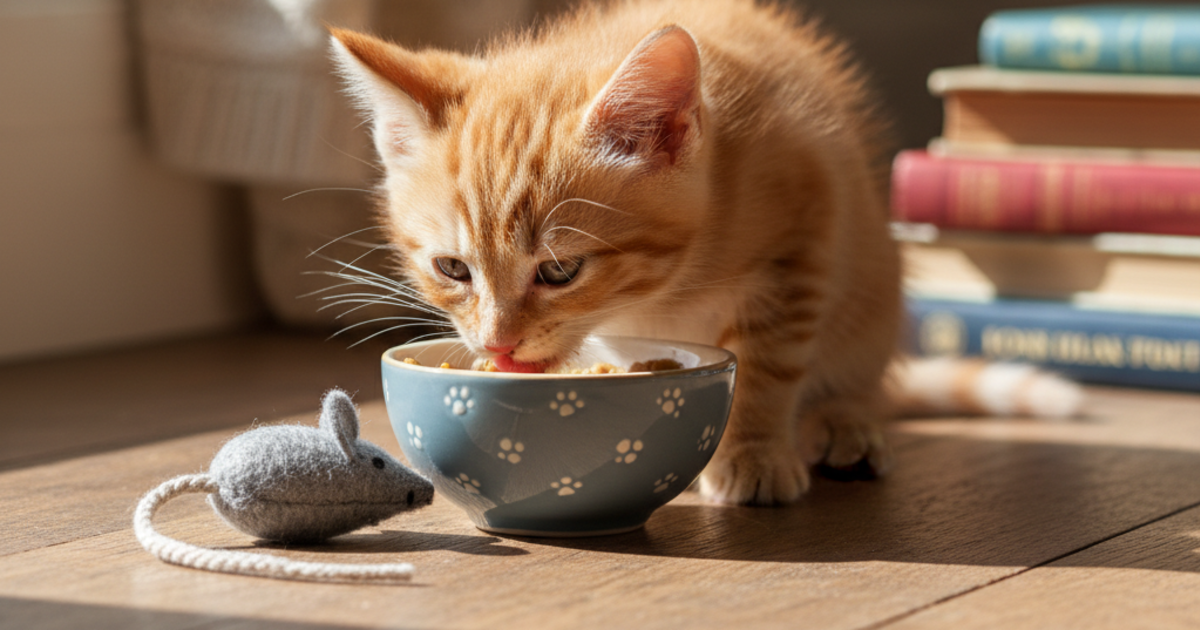
A 10 week old kitten typically weighs about 2-3 lb (0.9-1.4 kg), needs three to four small meals a day of complete-and-balanced kitten food, sleeps 16-20 hours, plays hard and bites and scratches while learning limits. It is due for its second round of vaccines, so keep up with vet visits and use toys, not hands, for play.
Ten weeks is a fun stage. Your kitten has settled in, its personality is showing and its energy seems limitless. It is also a time of rapid growth and important health milestones: the second FVRCP vaccine, continued deworming and early habits around litter, scratching and play. This guide explains what to expect at 10 weeks, typical weight and development, how much and how often to feed, the right food, litter and sleep habits, play biting and scratching, vaccines and vet care, safety and warning signs. To match meals to your kitten's weight, use the cat feeding chart.
What a 10 week old kitten is like
| Feature | Typical at 10 weeks |
|---|---|
| Weight | About 2-3 lb (0.9-1.4 kg), gaining roughly 2-4 oz per week |
| Teeth | Baby teeth are in, adult teeth start coming in around 3-4 months |
| Eyes | Eye color is changing from baby blue toward the adult color |
| Energy | Very high, with bursts of play and sleep |
| Litter box | Usually reliable if introduced properly |
| Coordination | Good, with climbing, pouncing and jumping |
| Social skills | Learning bite inhibition and boundaries from play |
| Sleep | 16-20 hours a day |
Feeding a 10 week old kitten
Kittens need more calories, protein and fat per pound than adult cats, so feed a food labeled complete and balanced for growth (or all life stages).
- Meals per day: three to four small meals.
- Food type: wet food, dry food or a mix. Wet food adds hydration, and dry food is convenient.
- Water: always available, in a shallow bowl or a fountain.
- Treats: under 10% of daily calories.
- No cow's milk, which can cause diarrhea.
- Avoid free-feeding unlimited kibble if your kitten is gaining too fast.
Worked example: how much to feed
A 10 week old kitten weighing 1.2 kg (2.6 lb).
- Resting energy: RER = 70 × 1.2^0.75 = 70 × 1.15 = about 80 kcal.
- Kitten factor of about 2.5: 80 × 2.5 = about 200 kcal per day.
- If feeding only wet food at 80 kcal per can: 200 ÷ 80 = about 2.5 cans per day.
- If feeding only dry food at 400 kcal per cup: 200 ÷ 400 = about 1/2 cup per day.
- If feeding half and half: 100 kcal wet (about 1.25 cans) and 100 kcal dry (about 1/4 cup).
- Divide into three or four meals across the day.
- Weigh weekly and adjust. Growing kittens' needs change quickly, so recalculate every 2-3 weeks.
Use the cat feeding chart and your food's label to double-check amounts.
Wet vs dry kitten food
| Feature | Wet | Dry |
|---|---|---|
| Moisture | High, helps hydration and urinary health | Low |
| Palatability | Usually high | Good |
| Cost | Higher | Lower |
| Convenience | Needs refrigeration after opening | Easy to store and use in puzzle feeders |
| Dental effect | None, though kibble does not clean teeth well either | Minimal |
| Calorie control | Easy with measured cans | Easy to overfeed if free-fed |
A mix is a popular compromise. Whatever you choose, keep the diet complete and balanced and transition gradually when changing foods over 7-10 days.
Litter box habits
Most kittens use the litter box reliably by 10 weeks.
- Keep the box clean. Scoop daily.
- Use unscented litter and a low-sided box.
- Provide one box per cat plus one extra as your household grows.
- Place boxes in quiet, accessible locations, away from food and water.
- If accidents happen, clean with an enzymatic cleaner, and check for medical issues such as parasites or urinary problems. Never punish.
Sleep and routine
Kittens sleep a lot, but when they are awake they are very active. A calm bedtime routine, play before a meal and quiet time at night helps prevent 3am zoomies. Provide a warm, safe bed and some safe hiding spots.
Play, biting and scratching
At ten weeks, your kitten is learning how hard it can bite and scratch. Play is how it learns.
- Use toys, not hands or feet, as play targets. Wand toys, balls and soft toys work well.
- Stop play if teeth or claws hit skin, and walk away briefly. Resume with a toy.
- Provide scratching posts (sisal, cardboard, carpet) in several locations, and reward use.
- Schedule play sessions two to four times a day, 10-15 minutes each, ideally before meals.
- Do not hit, shout or use spray bottles, which can create fear and worsen behavior.
- Rotate toys to keep things interesting.
- Offer puzzle feeders for mental stimulation.
- Trim claws every couple of weeks, starting early so your kitten gets used to it.
Socialization
Kittens are still in a sensitive window for learning about the world.
- Handle gently every day, including paws, ears and mouth.
- Introduce new people, sounds and surfaces gradually with treats.
- Get your kitten comfortable with the carrier, by leaving it open with treats.
- Introduce other pets slowly, with scent swapping and short supervised visits.
- Keep experiences positive and stop if your kitten seems scared.
Vaccines and vet care at 10 weeks
Typical kitten schedule (your vet may adjust it):
| Age | Typical care |
|---|---|
| 6-8 weeks | First FVRCP vaccine, deworming, exam |
| 10-12 weeks | FVRCP booster, FeLV vaccine if recommended, continued deworming |
| 12-16 weeks | Final FVRCP booster, rabies |
| 4-6 months | Spay or neuter, microchip |
Ask your vet about flea and parasite prevention that is safe for kittens, and test for feline leukemia and FIV if not already done. Keep your kitten indoors until fully vaccinated and ideally for life, since indoor cats are generally safer.
Spay and neuter planning
Many vets recommend spaying or neutering at about 4-6 months, and some shelters do it earlier. Plan ahead for the appointment and for any needed pre-surgical care. Calorie needs often drop after surgery, so monitor weight.
Kitten-proofing
- Secure cords, blind cords and small objects.
- Remove toxic plants, especially lilies, which are extremely toxic to cats.
- Store medications, cleaning products and chemicals securely.
- Check appliances such as dryers and recliners before use.
- Close windows or use sturdy screens.
- Keep human foods out of reach, including chocolate, onions, garlic, grapes and anything with xylitol.
- Pick up string, ribbon, hair ties and rubber bands. Swallowed string can be a life-threatening emergency.
Common issues at 10 weeks
- Sneezing and eye discharge: possible upper respiratory infection.
- Diarrhea: from parasites, diet changes or stress.
- Fleas and ear mites: common in young kittens.
- Not eating or low energy: can be serious in kittens.
- Litter box accidents: check health and box setup.
- Overweight or underweight: compare with growth guides and ask your vet.
Red flags: call your vet
- Not eating for more than a few hours
- Lethargy, weakness or hiding
- Vomiting or diarrhea, especially repeated or bloody
- Trouble breathing, open-mouth breathing or constant coughing
- Straining in the litter box or no urine
- Swollen belly, pale gums or cold body
- Swallowed string or foreign object
- Eye problems, squinting or heavy discharge
- Limping or inability to jump
For suspected poisoning, call the ASPCA Animal Poison Control Center at 888-426-4435 or the Pet Poison Helpline at 855-764-7661 (fees may apply).
What comes next
- 12-16 weeks: final vaccines, rabies and increased independence.
- 3-4 months: teething, with adult teeth coming in. Offer safe chew toys.
- 4-6 months: spay or neuter, adolescent behavior may begin.
- 6-12 months: continue kitten food, then transition to adult food at about 12 months, as your vet advises.
When to call your vet
Contact your vet right away for any warning sign above, and schedule the booster vaccine on time. Kittens can deteriorate quickly, so do not wait if something seems off.
The bottom line
A 10 week old kitten needs three to four measured meals of kitten food, plenty of play with toys, a clean litter box, safe kitten-proofed spaces and on-time vaccine boosters. Keep an eye on weight and watch for signs of illness. Match portions to growth with the cat feeding chart.
Frequently asked questions
PawCalculator Editorial
We combine veterinary references, published guidelines, and calculator-grade modeling. This article is for education, not a substitute for an exam.
+ Follow on PawTalk