A 2 week old kitten needs to be kept warm, fed kitten milk replacer (KMR) about every 3-4 hours if it has no mother, helped to pee and poop after meals and weighed daily. Never feed cow's milk, never feed a cold kitten and contact a vet or rescue right away for any kitten that is weak, not gaining weight or not eating.
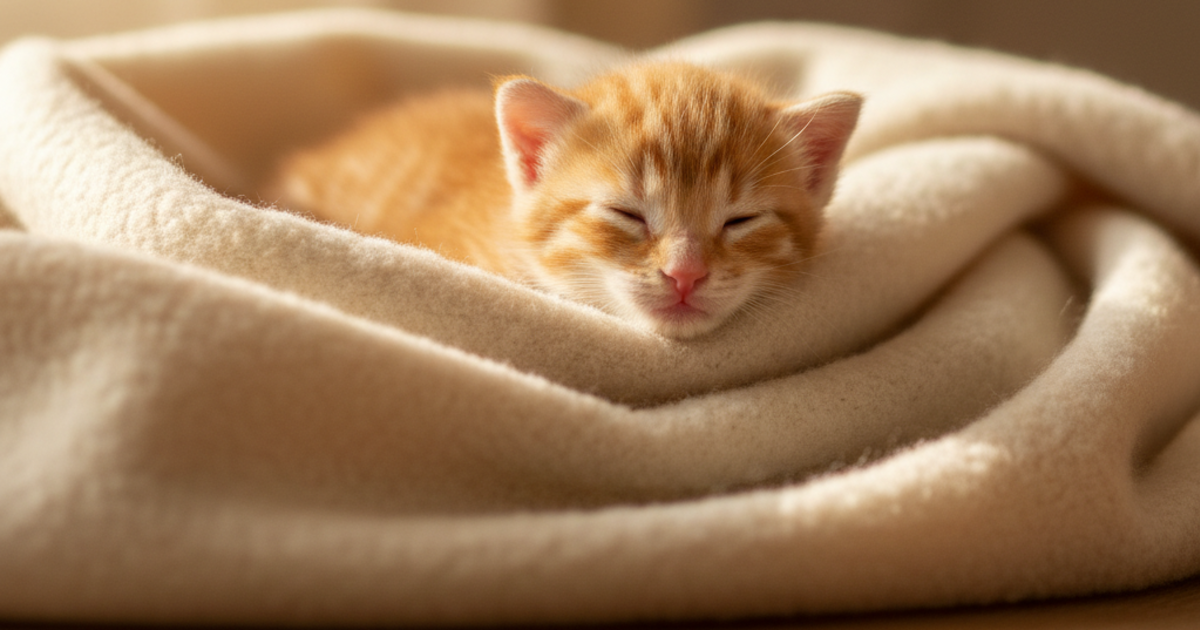
At two weeks old a kitten is still very fragile. Its eyes are just opening, it cannot regulate its own body temperature and, without a mother cat, it depends entirely on you for warmth, food and toileting. The good news is that two weeks is also a hopeful milestone: the kitten has survived the riskiest first days and is starting to develop quickly. This guide explains what to expect at this age, how to keep the kitten warm, what and how often to feed, how to bottle feed safely, how to stimulate elimination, what milestones to watch, how to spot trouble and when to get professional help. If the mother cat is present, she does most of this work, and your job is to support her. Use the cat feeding chart to match feedings to your kitten's weight as it grows.
What a 2 week old kitten is like
| Feature | Typical at 2 weeks |
|---|---|
| Weight | About 8-14 oz (225-400 g), gaining roughly 0.5 oz (10-15 g) a day |
| Eyes | Beginning to open (around 7-14 days), blue and cloudy |
| Ears | Starting to unfold and open, sound awareness begins |
| Teeth | Not yet visible, baby teeth start around 2-4 weeks |
| Movement | Wobbly crawling, may begin to try to stand |
| Temperature control | Cannot regulate body heat, relies on mother or heat source |
| Toileting | Needs stimulation to urinate and defecate if orphaned |
| Sleep | Sleeps most of the day, wakes to feed |
First: is the mother around?
If a healthy mother cat is caring for the kittens, the best thing you can do is leave them with her. She feeds, warms and cleans them better than any human can. Provide her with a quiet, warm nesting area, plenty of high-quality kitten or all-life-stages food and fresh water, and monitor the kittens from a distance. If you find kittens that appear abandoned, wait and watch from a distance for several hours to see if the mother returns before intervening, unless they are in danger, cold or obviously sick. Contact a local rescue or vet for advice.
Keeping a 2 week old kitten warm
Warmth comes before food. A cold kitten cannot digest milk and can become dangerously ill if fed.
- Target nest temperature: about 85-90°F (29-32°C) for kittens under 2 weeks, easing to about 80°F (27°C) by 3-4 weeks.
- Use a safe heat source: a heating pad set on low under half of a box or carrier, so the kitten can move away, or a microwavable heat disc. Cover it with a blanket so it is not touching skin directly.
- Avoid hot water bottles that cool quickly, and avoid anything that can overheat or burn.
- Provide soft bedding that is washable.
- Check often: a kitten that is cool to the touch, limp or lethargic needs gentle warming before feeding.
- Warm a cold kitten slowly over an hour or so, using your body heat or a warm blanket.
What to feed
Feed kitten milk replacer (KMR), which is formulated to match queen's milk. It comes as powder or liquid at pet stores and vet clinics.
Never feed:
- Cow's milk, which can cause diarrhea and dehydration
- Goat's milk or plant milks unless a vet advises
- Homemade formulas, except as a short-term emergency measure with veterinary guidance
- Solid food at this age
How much and how often
Guidelines vary by product, so follow the label and your vet's advice. As a rough guide:
| Age | Feeding frequency | Typical amount per feeding |
|---|---|---|
| 0-1 week | Every 2 hours | 2-6 mL |
| 1-2 weeks | Every 2-3 hours | 6-10 mL |
| 2-3 weeks | Every 3-4 hours | 10-14 mL |
| 3-4 weeks | Every 4-5 hours | 14-18 mL |
| 4-6 weeks | Every 5-6 hours, start weaning | Increasing |
A common rule of thumb is about 8 mL of formula per ounce of body weight per day, divided into feedings.
Worked example: feeding a 2 week old kitten
A kitten weighing 10 oz (about 283 g).
- Daily total: 10 oz × 8 mL = about 80 mL per day.
- At every 3 hours (8 feedings per day): 80 ÷ 8 = about 10 mL per feeding.
- If feeding every 4 hours (6 feedings per day): 80 ÷ 6 = about 13 mL per feeding.
- Weigh the kitten every day at the same time, ideally with a kitchen scale, and record it.
- Expected gain: about 0.5 oz (10-15 g) per day. Little or no gain over 24 hours is a reason to call a vet.
- Adjust the amount as weight increases, and use the cat feeding chart as the kitten grows.
How to bottle feed safely
- Wash your hands and sterilize bottles and nipples between feedings.
- Warm the formula to about body temperature (around 100°F, 38°C). Test a drop on your wrist; it should feel warm, not hot.
- Position the kitten on its stomach, like nursing, with the head level or slightly raised. Never feed on its back, which can cause the milk to enter the lungs.
- Offer the bottle and let the kitten suckle at its own pace. Do not squeeze the bottle.
- Stop if milk comes out of the nose or the kitten coughs. Tilt the head down, wipe, and let it rest.
- Burp gently by holding the kitten upright against your shoulder and patting its back.
- Do not force-feed. If the kitten refuses, check warmth first, then call your vet.
- Clean up. Wipe the face and bottom with a warm damp cloth, then dry.
- Discard unused mixed formula after the time on the label, usually 24 hours refrigerated.
Choose a kitten-sized nipple. Cut or make the hole just large enough for a slow drip when you hold the bottle upside down.
Helping the kitten pee and poop
Kittens this age cannot eliminate on their own. The mother cat normally licks them to stimulate this, so you need to imitate it.
- After each feeding, hold the kitten over a paper towel.
- Gently rub the genital and anal area with a warm, damp cotton ball or soft cloth, in light strokes.
- Continue until the kitten finishes urinating, which usually takes up to a minute, and defecates if it needs to.
- Expect: urine pale yellow and mild-smelling, stool yellowish-brown and formed like toothpaste. Kittens typically poop once or twice a day, and pee at every feeding.
- Dry the area afterward.
Contact a vet if the kitten has not pooped in 24-48 hours, has hard stools, diarrhea, very dark urine or does not urinate.
Milestones this week
- Eyes opening, sometimes slowly and unevenly. All kittens have blue eyes at first, with permanent color developing later.
- Ears unfolding and beginning to respond to sounds.
- Starting to crawl and wobble with more control.
- More alert and vocal during feeding time.
- Doubling birth weight by around 2 weeks if birth weight was about 3.5 oz.
- Gentle handling for short periods is okay, and early, calm human contact helps with socialization.
Do not pry eyes open. If the eyes are swollen, bulging or oozing pus, contact a vet.
What not to do
- Do not overfeed or tube-feed without training. Aspiration can be fatal.
- Do not give water, milk or food from a dish at this age.
- Do not bathe the kitten unless a vet advises. Spot clean only, and keep the kitten warm and dry.
- Do not use flea products not labeled for very young kittens. Many are unsafe under 8 weeks. Ask your vet.
- Do not overhandle or pass the kitten around.
- Do not leave the kitten unattended near pets or children.
Health checks and red flags
Check daily for:
- Weight gain: steady daily gain is the best sign of health.
- Warm body: cool or cold means danger.
- Good suckle and alertness.
- Pink, moist gums.
- Soft, formed stools and pale urine.
Call a vet right away if you see:
- No weight gain or weight loss
- Weakness, limpness or crying constantly
- Cold body temperature
- Not eating or refusing the bottle
- Milk coming from the nose, coughing or labored breathing
- Diarrhea, constipation or a swollen, hard belly
- Fleas, which can cause fatal anemia in tiny kittens
- Eyes swollen, discharging or still sealed after about 14 days
- Pale or blue gums
- Sneezing, discharge or breathing noises
Orphaned kittens: reach out for help
Raising neonatal kittens is demanding, with feedings around the clock, and survival rates can be lower than with a mother. Contact a vet, shelter or rescue with a kitten-nursing or foster program. They can provide supplies, guidance and sometimes a nursing mother cat to adopt the kittens. Your vet can also check for parasites and start a deworming and vaccine plan on the right schedule.
Vaccines and deworming
Kittens typically start deworming at about 2 weeks old, since roundworms are common, and vaccines at about 6-8 weeks. Do not give any medication without vet guidance, because dosing depends on weight.
What comes next
- 3-4 weeks: teeth begin to emerge, kittens become steadier, and they may start to lap formula from a shallow dish.
- 4-5 weeks: weaning begins, with gruel made of formula and wet kitten food.
- 5-6 weeks: more solid food, litter box training starts.
- 8 weeks: first vaccines, usually fully weaned.
When to call your vet
Contact a vet immediately for any kitten that is cold, weak, not eating, not gaining weight, struggling to breathe, or has diarrhea or fleas. Kittens at this age can deteriorate in hours, so do not wait. If you cannot reach your regular vet, find an emergency clinic or local rescue.
The bottom line
A 2 week old kitten needs warmth first, then KMR every 3-4 hours, help to pee and poop and daily weigh-ins. Leave kittens with their mother whenever possible, never feed cow's milk and get veterinary help quickly for any warning sign. Match feedings to growth with the cat feeding chart.
Frequently asked questions
PawCalculator Editorial
We combine veterinary references, published guidelines, and calculator-grade modeling. This article is for education, not a substitute for an exam.
+ Follow on PawTalk