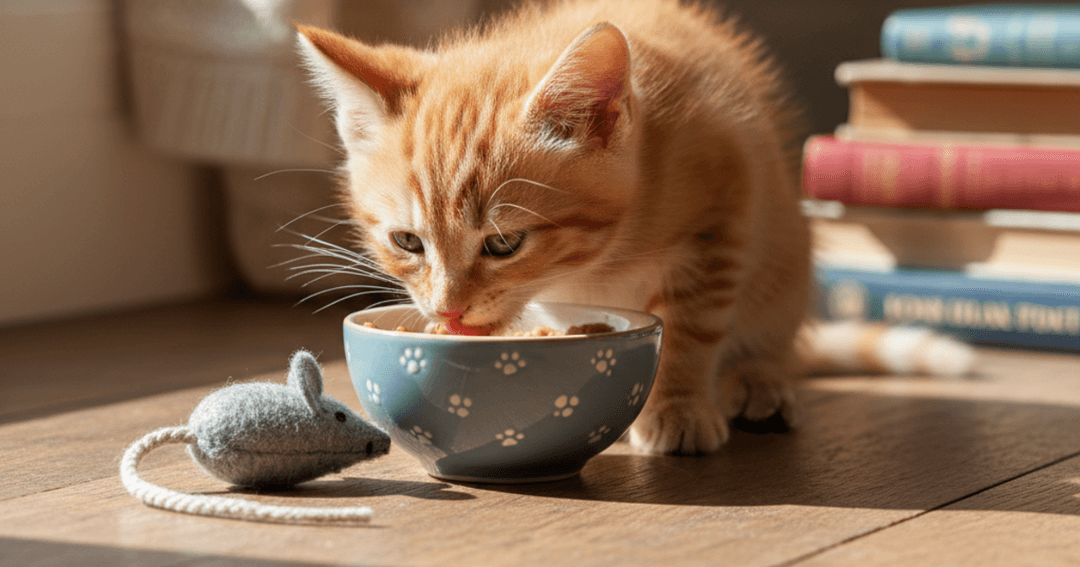
A 6 week old kitten should be mostly weaned, eating wet or softened kitten food about four times a day, using a litter box and starting its first vaccines and deworming. Typical weight is about 1-1.5 lb (450-700 g), and play is how it learns.
At six weeks a kitten goes from fragile baby to curious explorer. If it is with its mother, she still helps with warmth, grooming and teaching. If you have an orphan or a very young foundling, extra care is needed. This guide covers growth, feeding amounts, the weaning process, litter training, health care, a sample daily routine, socialization, orphan care and warning signs. Use the cat feeding chart to match meals to your kitten's weight.
How big is a 6 week old kitten?
Most kittens weigh around 1-1.5 lb (450-700 g) at six weeks. They gain roughly half an ounce to an ounce (15-30 g) a day. The eyes are open, the blue eye color is typical and the ears are upright. Weigh your kitten every few days on a kitchen scale and keep notes, since steady gain is the best sign of health.
| Age | Typical weight | What is happening |
|---|---|---|
| 2 weeks | 8-12 oz (230-340 g) | Eyes opening, nursing every 2-3 hours |
| 4 weeks | 12-16 oz (340-450 g) | Walking, first teeth, starting gruel |
| 6 weeks | 1-1.5 lb (450-700 g) | Eating solid food, playing, using litter |
| 8 weeks | 1.5-2 lb (700-900 g) | Fully weaned, ready for first vaccines if not started |
| 12 weeks | 2.5-3.5 lb (1.1-1.6 kg) | Confident, active, boosters due |
What should a 6 week old kitten eat?
By six weeks most kittens are eating solid food in addition to nursing, and many are fully weaned between 6 and 8 weeks. Offer:
- Wet kitten food formulated for growth, moistened or mashed if needed
- Softened dry kitten food (soaked in warm water) as a second option
- Fresh water in a shallow dish
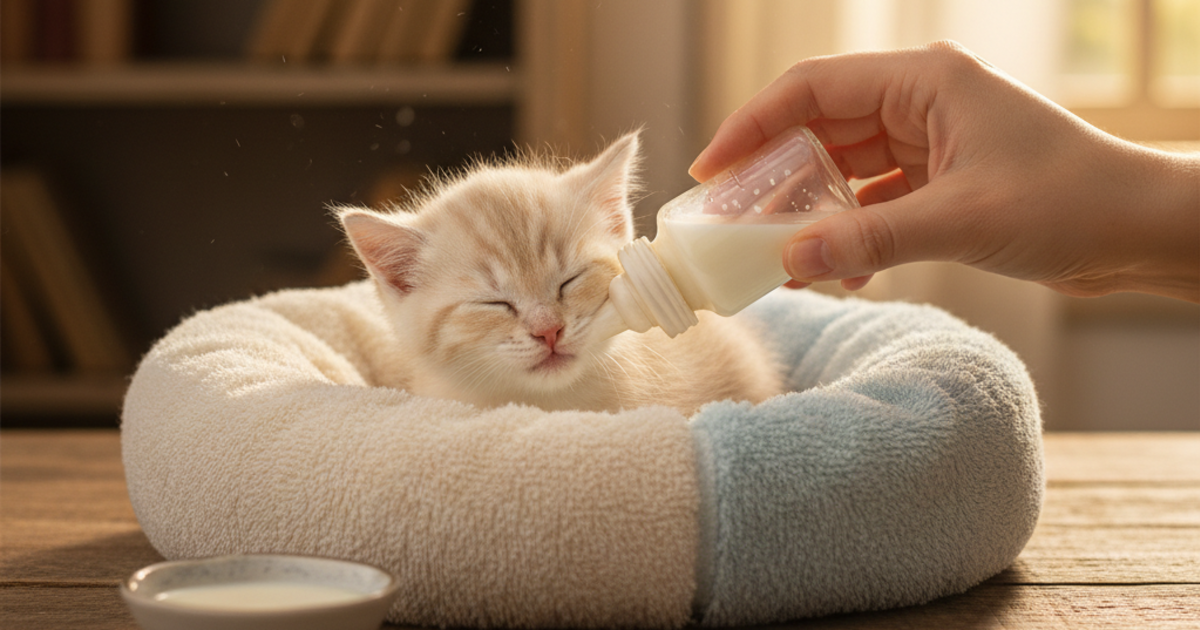
If the kitten is an orphan, use a kitten milk replacer (KMR) alongside solid food, following the label and your vet's guidance. Never feed cow's milk, which can cause diarrhea.
| Age | Meals per day | Food |
|---|---|---|
| 4-5 weeks | 4-6 | Gruel plus milk replacer if orphaned |
| 6-8 weeks | 4 | Wet or softened kitten food |
| 8-12 weeks | 3-4 | Wet and dry kitten food |
The weaning process step by step
- Start with gruel: mix wet kitten food with warm kitten milk replacer into a thin paste.
- Offer on a saucer or flat dish, and guide the kitten's nose gently toward it. Do not push the face in.
- Thicken over several days by adding less liquid until it is a soft mash.
- Add softened dry food once the kitten is eating mash confidently.
- Reduce bottle or nursing sessions gradually as solid meals increase.
- Keep water available in a shallow bowl.
Expect mess. Wipe the face and paws after meals with a warm, damp cloth. Some kittens wean slowly, and that is normal as long as weight keeps going up.
Worked example
A 0.6 kg (1.3 lb) kitten at six weeks.
- Resting energy: RER = 70 × 0.6^0.75 = 70 × 0.68 = about 48 kcal.
- Daily need: 48 × 2.5 (young kitten multiplier) = about 119 kcal.
- If the food is 80 kcal per can: 119 ÷ 80 = about 1.5 cans per day.
- Four meals: about 30 kcal each, roughly 0.37 can per meal.
- Weigh every few days. If weight is flat or dropping, call your vet.
Growth needs change quickly, so recalculate every week or two as your kitten gains.
A sample day for a 6 week old kitten
| Time | Activity |
|---|---|
| 7:00 am | Meal 1, litter box, short play |
| 11:00 am | Meal 2, litter box, nap |
| 3:00 pm | Meal 3, play and gentle handling |
| 7:00 pm | Meal 4, litter box, quiet cuddle |
| Bedtime | Warm bed, water, litter available |
Kittens sleep up to 18-20 hours a day. That is normal and part of growing.
Litter box training
Provide a shallow, low-sided box with unscented, non-clumping litter for very young kittens, since small kittens may eat clumping litter. Place the kitten in the box after meals and naps, and praise when it goes. Keep the box away from food and water and clean it daily. If the kitten has an accident, clean with an enzymatic cleaner and do not punish. Kittens with their mother often copy her and learn quickly.
Health care
- First vet visit: book it now. Vets often begin FVRCP vaccines at 6-8 weeks.
- Deworming: kittens commonly need deworming every couple of weeks from about 2-3 weeks of age, as your vet directs.
- Fleas: use only kitten-safe products approved for this age. Never use dog flea products on cats.
- Warmth: kittens this age still chill easily. Provide a warm, draft-free bed.
- Hygiene: wash hands and keep newcomers separate from resident cats until your vet clears them.
- Eyes and nose: gently wipe discharge with a damp cloth and tell your vet if it continues.
- Testing: ask about FeLV and FIV testing for foundlings.
| Care item | Typical timing |
|---|---|
| First deworming | From 2-3 weeks, repeated every 2 weeks |
| First FVRCP vaccine | 6-8 weeks |
| Boosters | Every 3-4 weeks until about 16 weeks |
| Rabies | 12-16 weeks depending on local law |
| Spay or neuter | Often 4-6 months, earlier at some shelters |
Caring for an orphaned 6 week old kitten
If the mother is not around, you are the mother. Keep the kitten warm first, since cold kittens cannot digest food. Feed kitten milk replacer by bottle or syringe as directed, then offer gruel. Stimulate urination and defecation only if the kitten is still young enough to need it and your vet shows you how. At six weeks most kittens can go by themselves. Book a vet visit right away, and never leave an orphan alone for long periods.
Play and socialization
This is a key socialization window. Handle your kitten gently for short, positive sessions, introduce a variety of people and sounds, and offer toys that mimic prey, such as wands and soft balls. Avoid hands as toys so you do not teach biting. Supervise play and keep it short, since kittens tire fast. Let the kitten explore one room first, then expand its territory slowly.
Kitten-proofing
Secure cords, window screens, small objects and houseplants. Lilies are extremely toxic to cats. Block gaps behind appliances and check the dryer and washing machine before closing. Keep string, rubber bands and hair ties away, since swallowing them can be an emergency.
Common mistakes
- Feeding cow's milk instead of kitten milk replacer
- Skipping the vet until the kitten seems sick
- Using dog flea products on kittens
- Adopting too early when the kitten could still be with its mother
- Using clumping litter for very young kittens
- Not weighing and missing slow growth
When to call your vet
Call your vet if your kitten is cold, limp or not eating, has diarrhea, vomiting, discharge from the eyes or nose, fleas, a swollen belly or fails to gain weight. Kittens decline fast. For suspected poisoning, call the ASPCA Animal Poison Control Center at 888-426-4435 or the Pet Poison Helpline at 855-764-7661 (fees may apply).
The bottom line
Feed four small meals of kitten food, keep the kitten warm, start vet care and socialize through play. Use the cat feeding chart to check portions as your kitten grows.
Frequently asked questions
PawCalculator Editorial
We combine veterinary references, published guidelines, and calculator-grade modeling. This article is for education, not a substitute for an exam.
+ Follow on PawTalk