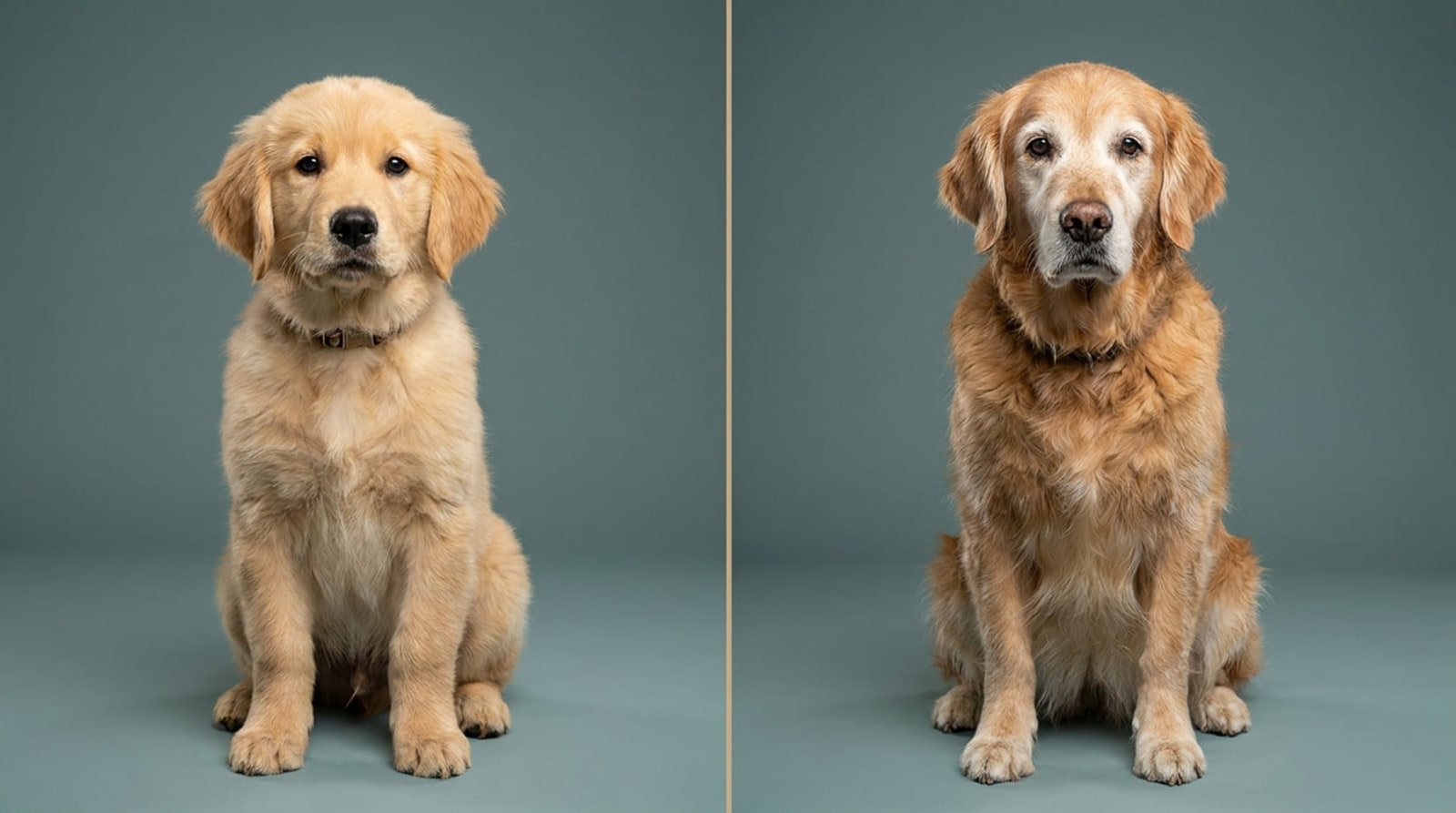
Why the Times-7 Rule Is Wrong
You've probably heard it your whole life: multiply your dog's age by 7 to get their age in human years. It's simple, memorable, and almost entirely wrong.
The 1:7 rule was never based on biology. It was a rough marketing shortcut — divide an average human lifespan of 70 by an average dog lifespan of 10, and you get 7. It ignores everything we now know about how dogs actually age: the explosive developmental sprint in year one, the breed-size effect on lifespan, and the logarithmic slowdown in aging rate as dogs get older.
A one-year-old dog is not equivalent to a 7-year-old child. By 12 months, most dogs have reached sexual maturity, completed the majority of their skeletal growth, and in many cases already delivered a litter. Developmentally, a 1-year-old dog is closer to a 15-year-old human.
The Science-Backed Formula: DNA Methylation Model
In 2020, researchers at UC San Diego published a landmark study in Cell Systems that mapped dog aging against human aging using epigenetic clocks — specifically, DNA methylation patterns that change predictably with age in both species.
Their formula:
Human Age = 16 × ln(dog age) + 31
Where ln is the natural logarithm.
This formula captures the non-linear reality of dog aging. Dogs sprint through developmental milestones early, then age progressively more slowly relative to humans as they get older.
Worked Examples
| Dog Age | Human Equivalent (DNA Formula) |
|---|
| 1 year | 31 years |
| 2 years | 42 years |
| 3 years | 49 years |
| 4 years | 54 years |
| 5 years | 57 years |
| 7 years | 62 years |
| 10 years | 68 years |
| 12 years | 71 years |
| 15 years | 74 years |
Notice how the gap between years compresses as the dog ages. The jump from year 1 to year 2 adds 11 human years. The jump from year 10 to year 12 adds only 3.
The Size and Breed Correction
The DNA methylation formula is a strong foundation, but it does not account for one of the most significant variables in canine longevity: body size.
Large and giant breeds age faster and die younger than small breeds. A Great Dane is elderly at 8. A Toy Poodle at 8 is middle-aged. This is one of the most consistent findings in veterinary gerontology.
AAHA Life Stage Framework by Size
Small breeds (under 20 lbs): Senior from age 8–11, Geriatric from 11+
Medium breeds (20–50 lbs): Senior from age 7–10, Geriatric from 10+
Large breeds (50–90 lbs): Senior from age 6–9, Geriatric from 9+
Giant breeds (90+ lbs): Senior from age 5–8, Geriatric from 8+
If you'd rather work from this size-adjusted framework specifically for a dog rather than the general pet formula above, the Dog Age Calculator applies the same breed-size logic in a dog-only version.
Size-Adjusted Human Year Conversion Table
| Dog Age | Small (<20 lbs) | Medium (20–50 lbs) | Large (50–90 lbs) | Giant (90+ lbs) |
|---|
| 1 | 15 | 15 | 15 | 15 |
| 2 | 24 | 24 | 24 | 24 |
| 4 | 32 | 32 | 32 | 32 |
| 6 | 40 | 42 | 45 | 49 |
| 7 | 44 | 47 | 50 | 56 |
| 8 | 48 | 51 | 55 | 64 |
| 10 | 56 | 60 | 66 | 78 |
| 12 | 64 | 69 | 77 | — |
| 15 | 76 | 83 | — | — |
What About Cats?
Cat aging follows a different curve. Year one equals roughly 15 human years, year two adds 9 more (total 24), then each additional year equals approximately 4 human years.
| Cat Age | Human Equivalent |
|---|
| 1 | 15 |
| 2 | 24 |
| 5 | 36 |
| 10 | 56 |
| 15 | 76 |
| 20 | 96 |
The AAFP designates cats as senior from age 11 and geriatric from age 15.
Why Biological Age Matters for Health Decisions
Understanding your dog's true biological age has direct implications for health management.
Screening schedules: Senior dogs should be seen every 6 months rather than annually, with baseline bloodwork, urinalysis, and blood pressure monitoring. Knowing your dog is biologically 62, not just '7 years old,' makes acting on these recommendations more intuitive. Estimate those senior visit costs with our Vet Cost Estimator.
Nutrition: Senior dogs need 20–30% fewer calories than mature adults. Use our Dog Food Calculator with your dog's correct life stage to ensure daily portions match their biological age.
Exercise: A 7-year-old Border Collie (biologically ~62) still needs significant daily exercise. A 7-year-old Saint Bernard needs gentler, joint-friendly activity. See our Dog Walking Calculator for breed and age-adjusted recommendations.
Insurance timing: Pet insurance premiums rise steeply as dogs enter senior years, and many policies cap enrollment at age 8–10. Our Pet Insurance Calculator factors in age and breed to help you time this decision correctly.
For dogs well into their senior years, our Dog Quality of Life Calculator can help you track comfort and wellbeing trends over time, not just chronological milestones.
The Puppy Year: Most Misunderstood
The first 12 months represent the most compressed aging period in a dog's entire lifespan.
| Puppy Age | Approximate Human Equivalent |
|---|
| 1 month | 1 year |
| 3 months | 5 years |
| 6 months | 10 years |
| 9 months | 13–14 years |
| 12 months | ~15 years |
This is why socialization windows are so narrow — the critical period closes around 12–16 weeks, equivalent to early childhood. For exact-to-the-day tracking during this stretch, the Birthday Calculator converts your puppy's precise age in weeks into the human-year equivalent shown above. It's also why puppy nutrition is so critical: caloric needs per pound are 2–3× those of an adult.
Alongside their human-year equivalent, our Dog Growth Calculator lets you plot your puppy's actual weight against expected growth curves for their breed size.
See the Dog Food Calculator for puppy-specific portion guidance.
Lifespan by Breed Size
| Size Category | Average Lifespan |
|---|
| Toy / Small (<20 lbs) | 14–18 years |
| Medium (20–50 lbs) | 11–14 years |
| Large (50–90 lbs) | 9–12 years |
| Giant (90+ lbs) | 6–10 years |
Use our Dog Breed Selector to filter breeds by expected lifespan and size alongside your lifestyle needs. And if you're budgeting for a new dog, the Adoption Cost Calculator covers first-year costs including age-adjusted vet care.
Recommended Tools
- Pet Age Calculator — DNA methylation formula with AAHA size adjustments. Works for dogs and cats.
- Dog Food Calculator — Life stage-adjusted daily portions for every age group.
- Raw Dog Food Calculator — BARF portions adjusted by age and ideal body weight.
- Vet Cost Estimator — Budget for senior care's more frequent visit schedule.
- Pet Insurance Calculator — Time your enrollment decision using biological age.
- Dog Walking Calculator — Age and breed-adjusted daily exercise targets.
- Dog Breed Selector — Filter by lifespan, size, and activity level.
- Adoption Cost Calculator — Full first-year budget including age-adjusted care.
Calculate Your Pet's Real Age
The times-7 rule has had a long run. It's time to retire it.
→ Use the Pet Age Calculator to get your dog or cat's human-year equivalent based on the DNA methylation formula, adjusted for size and breed category. Takes 10 seconds.