The myth: homemade means healthier, and portions work like store-bought food
Cooking for your dog feels like the safer, more controlled option: you know exactly what's in the bowl. But "homemade" doesn't automatically mean "balanced," and portion math for homemade meals doesn't work the same way it does for commercial kibble. Bagged dog food lists calories per cup because the recipe and density are fixed. A home-cooked meal's calorie density changes with every batch depending on the ratio of meat, fat, starch, and vegetables you used, which means a cup-based portion from a commercial feeding chart doesn't transfer over.
Why calories, not cups, are the real unit
The starting point for any homemade dog food plan is your dog's daily calorie need, not a cup measurement. Vets commonly calculate this using Resting Energy Requirement (RER), a formula referenced in veterinary nutrition guidelines: RER = 70 × (body weight in kg)^0.75. That gives you the calories a dog burns at rest. From there, RER gets multiplied by an activity and life-stage factor (higher for active or growing dogs, lower for seniors or dogs needing weight loss) to get the actual daily calorie target.
Once you know the daily calorie target, you work backward to portion size using the actual calorie density of your specific homemade recipe, which depends on the ingredients you used that week. This is the step that trips people up: a recipe heavier in fat can pack noticeably more calories into the same volume than a leaner one, so "the same size bowl as last time" doesn't mean "the same calories as last time" if the recipe changed.
The bigger issue: nutritional completeness
Serving size is only half the problem. The other half is whether the recipe itself meets a dog's actual nutrient needs, and this is where a lot of homemade diets fall short even when portions are calculated correctly. AAFCO (the Association of American Feed Control Officials) publishes nutrient profiles that commercial pet foods are formulated to meet, covering not just calories but calcium-to-phosphorus ratio, specific amino acids, and vitamin and mineral levels that are easy to get wrong without lab-tested recipes.
A homemade diet built around "meat, a starch, and some vegetables" can look complete and still fall short on calcium, certain vitamins, or the right fatty acid balance over time. This matters most for puppies, whose skeletal development is sensitive to calcium and phosphorus ratios, and for dogs on a homemade diet long-term rather than as an occasional meal. A board-certified veterinary nutritionist (look for the ACVN credential) can formulate or review a recipe against AAFCO's standards, which is the safest way to go homemade long-term rather than guessing.
A general starting framework
This isn't a substitute for a vet-reviewed recipe, but it's the shape a homemade meal plan typically follows once calorie needs are set:
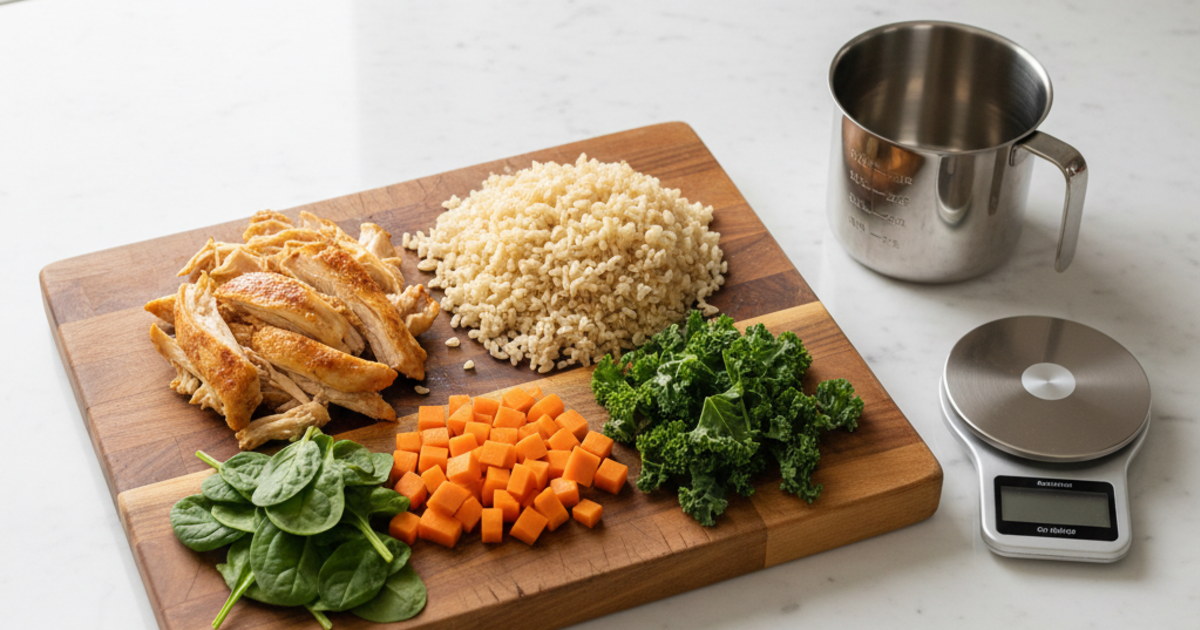
| Component | Typical share of the meal (by weight, cooked) | Notes |
|---|---|---|
| Protein (meat, poultry, fish, eggs) | Roughly 40–50% | The main calorie and amino acid source |
| Carbohydrate (rice, oats, sweet potato) | Roughly 25–35% | Energy and fiber, adjust down for weight loss |
| Vegetables | Roughly 10–15% | Fiber and micronutrients, not a calorie driver |
| Fat and supplements | Small remainder | Calcium source, fish oil, and any vet-recommended additions go here |
The exact ratios shift based on your dog's life stage, activity, and any health conditions, which is exactly why a generic ratio chart isn't a substitute for a formulated recipe.
Common mistakes with homemade feeding
Measuring by volume instead of calories. A cup of a fatty recipe and a cup of a lean recipe are not nutritionally equivalent, even though they look the same in the bowl.
Skipping the calcium source. Meat alone is calcium-poor relative to what a dog needs; commercial food already accounts for this, but a homemade recipe has to add it deliberately, often through ground bone, a calcium supplement, or another vet-recommended source.
Keeping portions fixed as the dog's weight changes. A calorie target that's right for a growing puppy or a dog mid-weight-loss becomes wrong within weeks. Portions need to be recalculated as weight and life stage change, not set once and left alone.
Assuming "vet-approved ingredients" means "vet-approved recipe." Individual ingredients being safe for dogs doesn't mean the overall recipe hits the right nutrient balance. Completeness is a property of the whole formulation, not the ingredient list.
Free-feeding a homemade diet. Without a fixed portion, calorie control (the entire point of doing the math in the first place) goes out the window.
Never re-checking after a recipe change. Swapping the protein source, the starch, or the fat content changes the calorie density of the whole recipe, which means the old portion size no longer delivers the same calorie total.
Recommended tools
- Dog Food Calculator: get daily portion targets in cups and grams using vet-referenced RER/DER formulas as your starting point.
- Dog Calorie Calculator: calculate your dog's daily calorie need adjusted for age, activity, and spay/neuter status before you portion out a homemade recipe.
- Dog RER / Kcal Calculator: see the exact WSAVA-referenced Resting Energy Requirement formula and math behind the calorie target.
- Dog Weight Calculator: confirm your dog's healthy weight range so the calorie target you're portioning for is actually the right one.
- Raw Diet Planner: a related option if you're weighing homemade cooked food against a raw feeding approach.
The bottom line
Homemade dog food isn't automatically healthier or automatically harder to get wrong; it's just a different kind of math than reading a bag label. Start from your dog's actual calorie need, not a cup measurement, recalculate portions whenever the recipe or your dog's weight changes, and get a long-term recipe checked against AAFCO nutrient profiles by a vet or veterinary nutritionist rather than assembling one from instinct. Use the Dog Calorie Calculator to set the target before you portion out the bowl.
Frequently asked questions
PawCalculator Editorial
We combine veterinary references, published guidelines, and calculator-grade modeling. This article is for education, not a substitute for an exam.
+ Follow on PawTalk