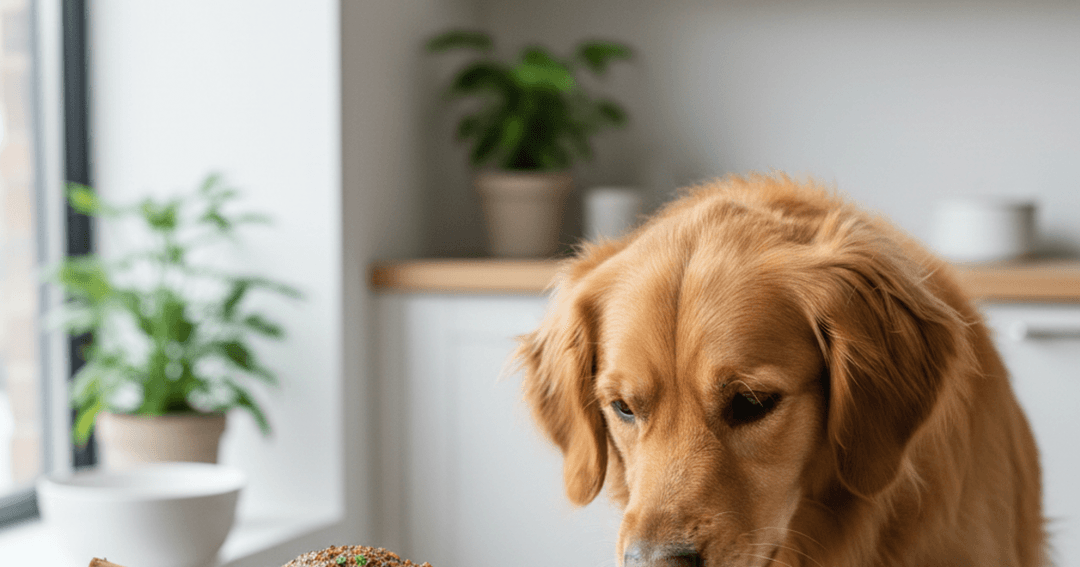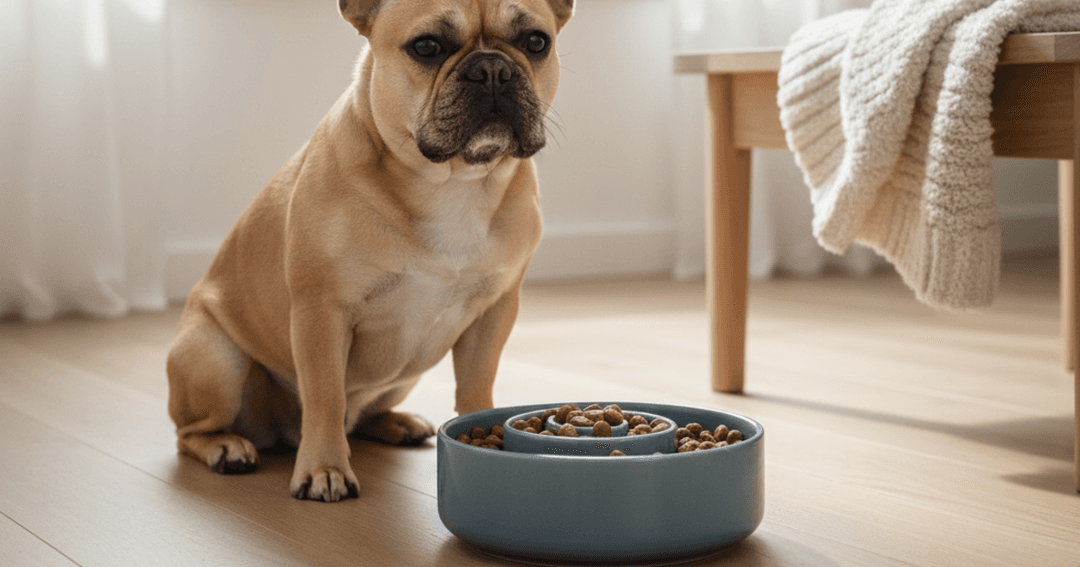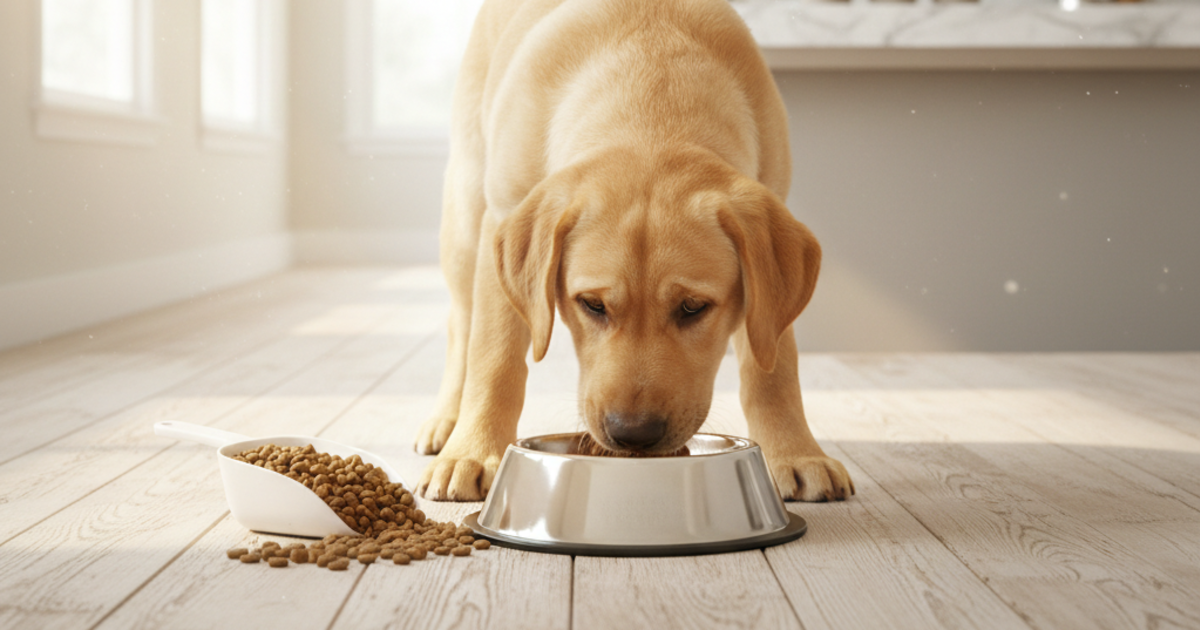
Large breed puppy food has controlled calcium and calories so big puppies grow steadily, which helps protect developing joints. Choose a food labeled for the growth of large-size dogs, keep your puppy lean, feed measured meals and switch to adult food at about 12-18 months as your vet advises.
Large and giant breeds (adults over about 50 lb / 23 kg) grow fast but mature slowly, so nutrition mistakes during growth can show up later as joint and bone problems. Feeding a regular puppy food, free-feeding or adding calcium supplements are common errors. This guide explains why large-breed puppies need special food, what to look for on the label, how long to feed it, how much to feed, the feeding habits and exercise rules that protect joints, and warning signs. Track your puppy's curve with the dog growth calculator.
Why large breed puppies need special food
Growth that's too fast, or too much calcium, is linked to developmental orthopedic disease (DOD), which includes hip dysplasia contributions, osteochondrosis and other bone and joint problems. Large-breed puppy foods address this by:
- Limiting calcium and keeping a proper calcium-to-phosphorus ratio
- Moderating calories and fat to slow the growth rate
- Keeping protein adequate for muscle and organ development
- Including DHA in many formulas for brain and eye development
Regular puppy food is often too calorie- and calcium-dense for large breeds, so it can push growth faster than their skeleton can handle. Genetics matter too, so nutrition helps but doesn't guarantee healthy joints.
What counts as a large breed?
Breeds expected to weigh over about 50-70 lb as adults, including Labradors, Golden Retrievers, German Shepherds, Rottweilers, Great Danes, Mastiffs and Bernese Mountain Dogs. Giant breeds, over about 100 lb, are the most sensitive. Medium breeds near the cutoff are a gray area, so ask your vet.
What to look for on the label
- AAFCO statement: "formulated to meet the nutritional levels established by the AAFCO Dog Food Nutrient Profiles for growth, including growth of large-size dogs (70 lb or more as an adult)," or an all-life-stages food that specifically includes large breeds.
- Calories: kcal per cup, so you can measure precisely.
- Calcium: large-breed formulas usually keep calcium in a moderate range. Ask the company for the exact dry-matter figure.
- Quality control: nutritionist on staff, feeding trials and transparent nutrient data.
Avoid adding calcium supplements unless your vet specifically recommends them. A complete and balanced growth diet already contains what your puppy needs.
How long to feed it
Most large breeds stay on large-breed puppy food until about 12-18 months, and giants may stay on it until 18-24 months. Ask your vet to judge your puppy's growth and body condition before switching. Spayed and neutered dogs may need fewer calories sooner.
Worked example: feeding a 4-month-old
Bruno, a 4-month-old expected to reach about 35 kg (77 lb), weighs 15 kg.
- RER: 70 × 15^0.75 = about 534 kcal.
- Puppy factor for over 4 months: about 2 × RER = about 1,070 kcal a day.
- On a food with 3,600 kcal per kg: 1,070 ÷ 3.6 = about 297 g a day.
- Split into three meals: about 99 g each.
- Weigh every two weeks and adjust to keep the body condition lean: ribs easy to feel, visible waist.
- Reduce portions if Bruno gains faster than the growth curve.
Try the dog food calculator by weight and age for your puppy.
Feeding habits that protect joints
- Measure meals; don't free-feed.
- Feed 3 meals a day until about 6 months, then 2.
- Keep treats to about 10% of calories, and count training treats.
- Keep your puppy lean; a slightly thin puppy is healthier than a chubby one.
- Rest after meals to lower bloat risk in deep-chested breeds.
- Avoid raised bowls unless your vet recommends them.
Exercise rules for growing joints
- Avoid intense, repetitive exercise such as long runs and jumping on hard ground while growth plates are open.
- Short, frequent walks and free play on soft surfaces are best.
- Don't let a large puppy jump from heights or climb many stairs.
- Use the dog exercise calculator as a guide.
Signs to watch
Limping, stiffness, "bunny-hopping," reluctance to climb stairs, swollen joints, sitting awkwardly or a sudden slowdown deserve a vet visit.
When to call your vet
Call for lameness, a swollen belly, retching without vomiting (possible bloat, an emergency), rapid weight gain that hides the waist, or poor growth.
Frequently asked questions
PawCalculator Editorial
We combine veterinary references, published guidelines, and calculator-grade modeling. This article is for education, not a substitute for an exam.
+ Follow on PawTalk