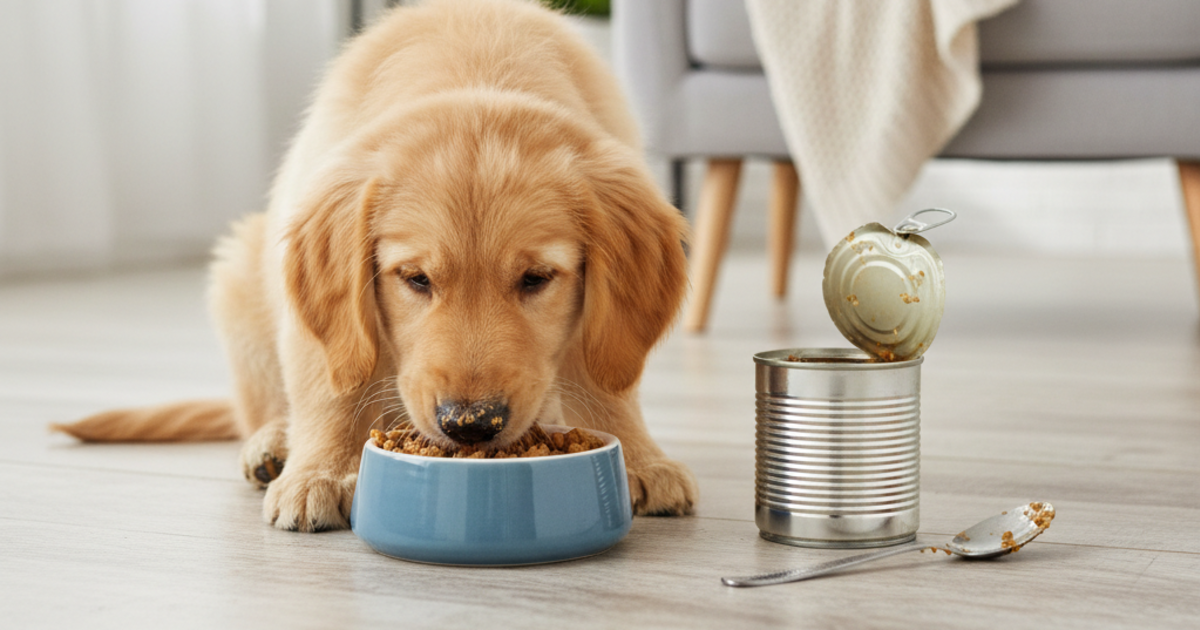
Wet (canned) puppy food is a perfectly good way to feed a growing puppy as long as it is labeled complete and balanced for growth, and it is portioned by calories. It is tasty, soft and hydrating, which helps picky or very young puppies, but it costs more per calorie and does not clean teeth, so many owners mix it with dry food.
Puppies grow faster in their first year than at any other time in their lives, so what goes in the bowl matters. Dry kibble is the most common choice, but wet food has real advantages for some puppies, particularly those who are weaning, picky, small or recovering from illness. The key questions are whether the food is nutritionally complete, how many calories your puppy actually needs and how to avoid overfeeding when wet and dry food are combined. This guide explains the pros and cons, how wet and dry compare, what to look for on the label, how to calculate portions, how to mix and transition and common mistakes. To work out portions for your puppy's weight and age, use the dog food calculator by weight and age.
Wet vs dry puppy food at a glance
| Feature | Wet (canned) | Dry (kibble) |
|---|---|---|
| Moisture | About 75-80% | About 10% |
| Calories per cup | Lower | Higher |
| Calories per gram of dry matter | Similar when compared on a dry-matter basis | Similar |
| Palatability | Usually very high | Good but variable |
| Texture | Soft, easy for tiny mouths and weaning puppies | Crunchy |
| Cost per day | Higher | Lower |
| Storage | Refrigerate after opening | Easy, long shelf life |
| Dental effect | Does not clean teeth | Mild abrasion, but not a substitute for brushing |
| Convenience | Messier, needs measuring | Easy to scoop and use in toys |
Pros of wet puppy food
- Highly palatable. Helpful for picky eaters or puppies adjusting to new homes.
- Soft texture. Easier for very young puppies, small breeds or puppies with dental problems.
- High moisture. Adds hydration, which supports digestion and urinary health.
- Helps with weaning. Mixed with a little water or formula, it makes a good gruel at about 3-4 weeks.
- Often higher in animal protein and lower in carbohydrates than kibble.
- Can help with satiety. The volume feels like more food, which can help dogs that gulp.
- Useful for medication. Hide pills in a small amount.
Cons of wet puppy food
- Cost. Feeding a growing medium or large-breed puppy only canned food can get very expensive.
- Storage and mess. Cans must be refrigerated and used within a few days.
- Dental health. Soft food does not scrub teeth, so brush your puppy's teeth regularly.
- Loose stools in some puppies, particularly if the transition is rapid or the portion is too large.
- Overfeeding risk if you add wet food on top of a full kibble ration.
- Environmental waste from cans and packaging.
- Possible fussiness if your puppy learns to refuse kibble.
Is wet food better or worse than dry?
Neither is inherently better. A complete-and-balanced food, wet or dry, can meet a puppy's needs. Compare on a dry-matter basis, since the water in canned food makes the label percentages look lower. For example, a can with 8% protein and 78% moisture has about 36% protein on a dry-matter basis (8 ÷ 22).
What to look for on the label
- AAFCO statement for growth or "all life stages." For large-breed puppies (adult weight over about 70 lb), look for a statement that it is suitable for growth of large-size dogs.
- A named animal protein such as chicken, beef, lamb or fish as the first ingredient.
- DHA from fish oil or other sources for brain and eye development.
- Calcium and phosphorus in balanced amounts, especially for large breeds. Too much calcium can harm bone growth in large puppies.
- Calories per can (kcal per can or per kg) so you can portion accurately.
- Complete-and-balanced, not "for intermittent or supplemental feeding only." Some canned foods and toppers are not complete.
- A reputable manufacturer with nutritionists and quality control.
How much wet puppy food to feed
Calories matter more than volume. Puppies need more calories per pound than adults, and needs depend on age, expected adult size and activity.
A common starting estimate:
- Resting energy requirement: RER = 70 × (body weight in kg)^0.75.
- Puppies up to 4 months: about 3 × RER.
- Puppies 4 months to adulthood: about 2 × RER.
Worked example: feeding a 3 month old puppy
A 6 kg (13 lb) puppy.
- Resting energy: 70 × 6^0.75 = 70 × 3.83 = about 268 kcal.
- Puppy factor of 3: 268 × 3 = about 804 kcal per day.
- If feeding only wet food at 380 kcal per 13 oz can (about 29 kcal per oz): 804 ÷ 380 = about 2.1 cans per day.
- Split into 4 meals of about half a can each.
- If mixing half wet and half dry: 402 kcal from wet (about 1 can) and 402 kcal from kibble. If the kibble is 400 kcal per cup, that is about 1 cup.
- Weigh your puppy every week or two and adjust, since growth rates vary.
Use the dog food calculator by weight and age for a starting point, and check the feeding guide on your specific food.
Meal frequency
| Age | Meals per day |
|---|---|
| 6-12 weeks | 4 |
| 3-6 months | 3 |
| 6-12 months | 2 |
Small and toy breeds may need more frequent meals to avoid low blood sugar, so ask your vet.
Mixing wet and dry food
Many owners combine both for variety and cost control.
- Decide the total daily calories first.
- Assign calories to each food, for example 25-50% wet and the rest dry.
- Measure each portion and mix or serve together.
- Reduce the dry portion when adding wet. Adding wet food on top of a full dry ration will cause weight gain.
- Choose products from the same line if possible, to keep nutrient balance consistent.
- Do not mix an incomplete topper in large quantities, because it can dilute nutrients.
Transitioning to wet food
Any food change should be gradual to avoid stomach upset.
- Days 1-2: 25% new, 75% old
- Days 3-4: 50% new, 50% old
- Days 5-6: 75% new, 25% old
- Day 7: 100% new
Keep your puppy on the same type of growth-appropriate food, and slow down if stools become loose.
Storage and safety
- Refrigerate opened cans in an airtight container for up to 3 days.
- Do not leave wet food out for more than 20-30 minutes, especially in warm weather.
- Wash bowls after each meal.
- Warm slightly to bring out aroma, but test the temperature, and never microwave in the can.
- Check expiry dates and dents or bulges in cans.
- Keep pouches and cans out of reach of puppies.
Teeth and wet food
Wet food does not clean teeth, but neither does most kibble. Dental health depends on brushing, appropriate chews and vet checkups. Start brushing early with a puppy-safe toothpaste, and ask your vet about dental care as adult teeth come in at 4-6 months.
Stools and wet food
Wet food often produces softer stools than kibble. If stools are very loose, reduce the portion or slow the transition, and check with your vet if diarrhea lasts more than a day or two, or if your puppy is lethargic or vomiting.
Special cases
Weaning puppies: a mix of puppy food and warm water or milk replacer makes an easy gruel.
Picky puppies: a spoonful of wet food on kibble can encourage eating, but keep calories in check.
Small and toy breeds: soft food can be easier on tiny mouths, and frequent small meals help blood sugar.
Large and giant breeds: choose a large-breed puppy formula, with controlled calcium and calories, to support steady growth and joint health.
Puppies with medical conditions: follow your vet's dietary recommendations.
Common mistakes
- Feeding by volume instead of calories
- Adding wet food on top of a full kibble meal
- Using adult or supplemental-only food as the main diet
- Switching foods abruptly
- Leaving wet food out
- Overfeeding large-breed puppies, which can increase the risk of joint problems
- Giving too many toppers and treats
When to call your vet
Call your vet if your puppy refuses food for more than a day, has persistent diarrhea or vomiting, is lethargic, loses weight, has a swollen belly or is growing too fast or too slowly. Puppies and toy breeds can become ill quickly, so do not wait.
The bottom line
Wet puppy food is a safe, appealing choice if it is complete and balanced for growth, and mixing it with kibble can add variety without overspending. Measure calories rather than cups, transition gradually and keep up with dental care. Find your puppy's portion with the dog food calculator by weight and age.
Frequently asked questions
PawCalculator Editorial
We combine veterinary references, published guidelines, and calculator-grade modeling. This article is for education, not a substitute for an exam.
+ Follow on PawTalk