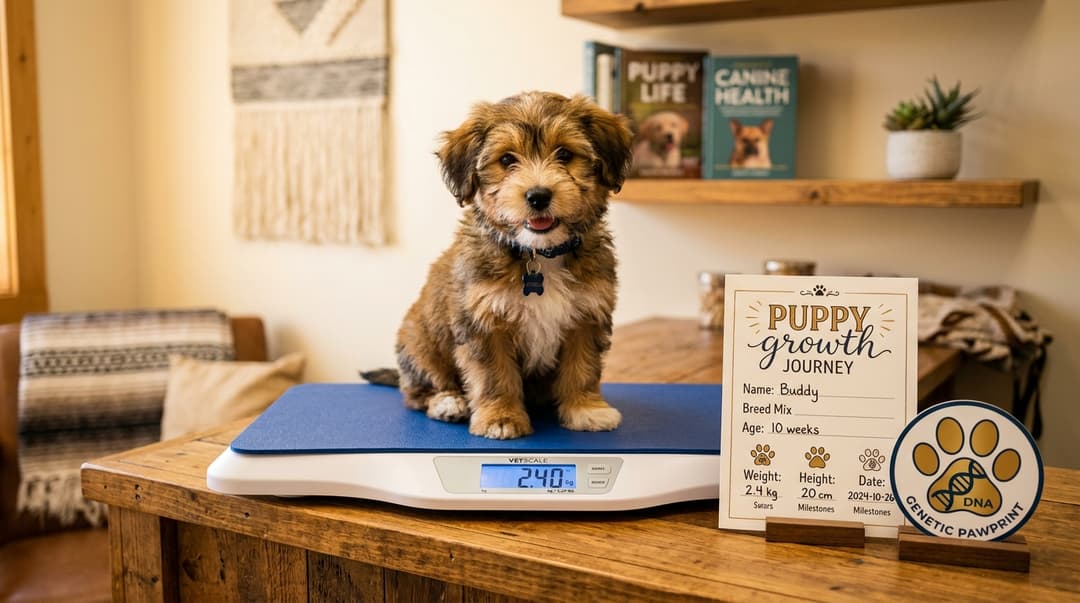
How Big Will Your Mixed-Breed Puppy Get?
Your inputs
Results update live as you type.
Your results
Fill in the form to see your estimate.
Ready when you are
Fill in the form to see your reference estimate
Veterinary reference only
Accuracy is lower without a known breed — treat as a broad range.
Keep going with a related calculator.
How Big Will Your Mixed-Breed Puppy Get?
Without a single breed standard to anchor a prediction, mixed-breed adult weight estimates rely on a different method — current weight-for-age trajectory and paw-to-leg proportion (oversized paws relative to current body size often signal more growth ahead) tend to be more reliable indicators than guessing at a "primary breed." This is a distinct tool from our standard Puppy Weight Calculator, built specifically for cases where breed is unknown or mixed enough that no single reference curve applies.
How to use this calculator
Enter your puppy's current weight, age in weeks, and how the paws look relative to the body — proportionally sized, noticeably large, or small. Without a breed standard to anchor against, this proportion signal does real work in the estimate.
Understanding your results
Treat this as a wider range than a purebred prediction, not a tighter one — without known parentage, the calculator is reading growth trajectory and body proportion rather than matching against a specific breed curve, so precision is inherently lower. Large paws relative to current leg and body length is a commonly used informal signal for more growth ahead, but it's not a precise measurement on its own, which is why it's combined with the age/weight trajectory rather than used alone. If you want a tighter estimate, a DNA test that identifies likely breed ancestry lets you cross-reference known size ranges for those breeds specifically — narrowing the estimate considerably compared to proportion-based guessing.
Re-checking as your puppy ages narrows the range. Each additional age/weight data point tightens the trajectory-based estimate, so a prediction made at 8 weeks should be treated as much rougher than one made at 4–5 months — this tool is meant to be revisited, not used once and trusted as final.
What "proportional paws" actually looks like. A rough field check: if the paws look noticeably larger than what the current leg length and body frame would suggest is proportional, that's the "large paws" signal — if they look sized appropriately for the current frame, that's proportional, regardless of the puppy's overall size right now.
Planning purchases around a range instead of a single number
Because a mixed-breed estimate is inherently a wider range than a purebred prediction, it's worth planning big-ticket purchases (crate, bed, eventual food budget) around the upper end of the range rather than the midpoint, especially early on when the estimate carries the most uncertainty. An adjustable wire crate with a divider panel is a practical hedge here — it lets you size the crate down for a small puppy and expand it as they grow, rather than committing to a fixed-size crate based on an 8-week estimate that might shift considerably by 4 months. The same logic applies to a collar and harness: buying a single "right-sized" set early in a mixed litter's life often means replacing it within weeks, so many owners of unknown-mix puppies buy a size up initially and expect at least one more size change as the trajectory becomes clearer.
What breed-typical traits can (and can't) tell you
Even without a confirmed pedigree, visible traits in a young puppy can offer loose hints about likely ancestry that complement the size estimate here — a longer snout and prick ears might suggest herding or hound ancestry, while a blocky head and shorter muzzle might suggest a bully-breed influence — but these visual guesses are notoriously unreliable even for experienced breeders and shelter staff, and studies comparing visual breed guesses to DNA results have found frequent mismatches. Treat any visual breed guess as background curiosity rather than something to base size predictions or care decisions on; the weight-and-proportion trajectory this calculator uses is a more grounded signal than appearance-based guessing, precisely because it's tracking your specific puppy's actual growth rather than pattern-matching to a breed stereotype that may not even be accurate.
When to consult a professional
For health, dosage, or nutrition decisions, always confirm calculator output with your veterinarian. This tool provides reference estimates, not medical advice.
Questions about this calculator
The standard calculator can use a known breed's growth curve as a reference; this tool is built for when that reference doesn't exist, relying instead on growth trajectory and body proportion signals.
The math, openly documented.
Inputs
Enter the details that affect your estimate.
weight · age · breed
Normalize
Validate ranges and convert units when needed.
lbs ↔ kg
Calculate
Veterinary or industry-standard formulas applied.
result = f(inputs)
Results
Clear outputs with context and disclaimers.
display + notes
More from Lifestyle

How Much Exercise Does Your Dog Actually Need?
how much exercise does a dog need: Get a daily exercise time recommendation based on breed energy level, age, and health
Open tool
How Much Will It Cost to Transport Your Pet?
fedex pet shipping cost: Compare estimated costs for airline cargo, in-cabin flying, and professional ground transport s
Open tool
How Much Does Dog Training Cost?
how much does dog training cost: Compare estimated costs across group classes, private in-home training, and board-and-t
Open toolArticles from Insights



Got an edge case the calculator can't handle?
247 active threads about dog nutrition right now. Verified vets and experienced owners answer within hours.