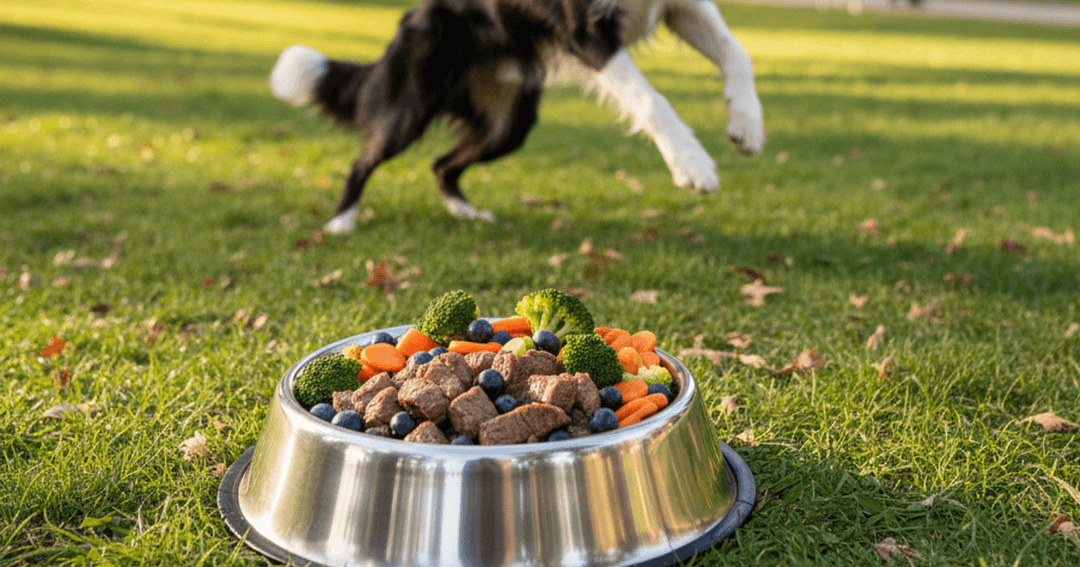
The honest answer is that this is the wrong question - but it's worth asking properly anyway, because the reasoning behind most wet-vs-dry advice online is either oversimplified or driven by what sells rather than what the evidence actually shows.
Here's what's true: wet food and dry food are not interchangeable. They have genuinely different nutritional profiles, different practical tradeoffs, and different effects on specific health conditions. For a healthy adult dog with no particular medical needs, either works. For a dog with kidney disease, urinary crystals, severe dental disease, or obesity, the choice matters a lot more than most owners realise.
This isn't a "both sides" article. Where one option is meaningfully better for a specific situation, that's what you'll find below.
The Moisture Gap - and Why It's a Bigger Deal Than It Looks
Dry kibble contains roughly 8-10% moisture. Wet food sits at 75-85%. That gap is enormous, and it has downstream effects that run through almost every other comparison in this article.
Dogs are descended from animals that got most of their hydration from prey, not from standing water. A wild canid eating whole prey gets adequate moisture from the food itself. A domestic dog eating dry kibble must compensate by drinking - and many don't drink enough, either because they're not particularly motivated to or because the water source is inconvenient.
The consequences of chronic low-level dehydration in dogs are subtle and slow: concentrated urine, increased stress on kidneys, higher risk of crystal formation in the bladder. None of this shows up obviously until there's a problem.
Wet food partially solves this without requiring any behavioural change from the dog. For dogs that are poor drinkers, senior dogs with aging kidneys, or dogs that have had urinary issues, this alone is a meaningful argument for wet food or mixed feeding.
Dental Health: The Dry Food Myth That Needs Retiring
The idea that dry food cleans teeth has been repeated so often that most owners accept it as settled fact. It isn't.
The mechanical argument - that kibble scrapes plaque from the tooth surface as the dog chews - has some basis in theory. In practice, most dogs don't actually chew kibble. They crack it and swallow. Even dogs that do chew don't reach the gumline, which is where periodontal disease actually develops.
The research on kibble as a dental health tool is weak. Studies comparing wet-fed and dry-fed dogs do not consistently show better dental outcomes in the dry-fed group. What does show consistent benefit: tooth brushing, enzymatic dental chews (specifically those with the VOHC seal), and professional cleanings.
Wet food doesn't clean teeth either. But it also isn't meaningfully worse for dental health than dry food in dogs that receive proper dental care. The idea that switching to wet food will cause dental disease is a marketing position, not a clinical one.
The practical takeaway: if you're feeding dry food specifically for dental health and not brushing your dog's teeth, you're not getting the benefit you think you are.
Cost and Convenience: Dry Food Wins, Clearly
This one isn't close. Feeding a medium-sized dog on wet food exclusively costs roughly two to four times more per month than a comparable quality dry food. For a large breed dog, the gap is even wider.
Beyond cost:
Dry food doesn't spoil in the bowl, which matters for dogs that graze. It travels easily, stores compactly, and doesn't require refrigeration after opening. For households with unpredictable schedules, multiple dogs, or boarding situations, dry food is significantly more practical.
Wet food, once opened, lasts 24-48 hours in the fridge. It's messier, heavier to buy in bulk, and creates more packaging waste. Uneaten wet food sitting in a bowl in warm weather becomes a food safety issue within hours.
If budget or practicality is a genuine constraint, a quality dry food is not a compromise - it's a reasonable choice for a healthy dog. Fed consistently and in appropriate amounts, a well-formulated dry food meets nutritional requirements fully.
Where Wet Food Has a Real Advantage
Weight management. Wet food is less calorically dense by volume. A dog eating wet food consumes more physical food mass for the same or fewer calories, which supports satiety. Dogs that are perpetually hungry on a calorie-restricted dry food diet often do better on wet food.
Picky eaters and appetite stimulation. Wet food is more palatable to most dogs - stronger smell, richer taste, texture closer to actual meat. Dogs recovering from illness, underweight dogs needing calorie loading, and seniors with declining appetite often eat wet food more reliably.
Senior dogs specifically. Three things converge in older dogs that make wet food more appropriate: dental pain or tooth loss can make kibble harder to eat, kidney function decline benefits from increased moisture intake, and reduced sense of smell means wet food's stronger aroma compensates for sensory loss.
Dogs with urinary tract issues. Any dog that has had bladder stones, urinary crystals, or UTIs benefits from higher water intake. Wet food is the simplest way to increase it without relying on the dog to drink more.
Where Dry Food Has a Real Advantage
Diabetes management. Prescription diabetic dry foods allow precise carbohydrate control in a way that's harder to achieve with wet food. For diabetic dogs requiring consistent meal composition and timing, dry food can be more practical.
Precise portion control for weight loss. For owners who are disciplined about measurement, dry food's caloric density is predictable and easy to calculate.
Free-feeding situations. Some dogs do fine with food available throughout the day. Wet food cannot be free-fed safely for long periods.
Medical Conditions Where the Choice Is Not Optional
For healthy dogs, this is a preference conversation. For dogs with specific diagnoses, it's a clinical one.
| Condition | Recommendation |
|---|---|
| Chronic kidney disease | Wet food strongly preferred - moisture is protective |
| Urinary crystals / bladder stones | Wet food preferred - dilutes urine |
| Dental disease with tooth loss | Wet food - kibble may be painful |
| Obesity | Wet food often better for satiety |
| Diabetes | Dry food often preferred for precision protocols |
| Pancreatitis | Low-fat dry formulas are often easier to source and portion |
| Poor water intake | Wet food directly increases intake |
If your dog has a diagnosed condition, ask your vet directly: "Given this diagnosis, does food format matter, and which do you recommend?"
Ingredient Quality Cuts Across Both
The wet-vs-dry framing can obscure a more important variable: the quality of what's actually in the food, regardless of format.
A low-quality wet food is not better than a high-quality dry food with clearly named proteins and fats.
When reading labels on either format, the things that matter:
- First ingredient should be a named protein source
- Fat source should be named
- Avoid unnecessary artificial colours
- Guaranteed analysis should match life stage needs
A mediocre wet food is not a nutritional upgrade over an excellent dry food.
Mixed Feeding: The Practical Middle Ground
Most dogs don't need a binary choice, and mixed feeding - dry food as the base with wet food added - captures practical advantages of both formats without the full cost of an all-wet diet.
A workable approach for many healthy adult dogs:
- Morning meal: measured dry food, optional added water
- Evening meal: wet food with a smaller dry portion
If you go this route, account for total daily calories across both formats. Use the PawCalculator Dog Food Calculator to set a daily calorie target and back-calculate portions for each food's caloric density.
Transitioning Between Formats
Switching formats suddenly - dry to wet or wet to dry - often causes digestive upset. Transition over 7-10 days:
- Days 1-3: 75% current food, 25% new food
- Days 4-6: 50/50
- Days 7-9: 25% current food, 75% new food
- Day 10+: new food only
Softer stools in the first week of switching to wet food are common. If digestive issues are severe or persist past day 10, slow the transition and consult your vet.
Can I feed only dry food for my dog's entire life?
Yes, for most healthy dogs, as long as water intake is adequate and routine health monitoring continues.
Can I feed only wet food for my dog's entire life?
Yes, with attention to dental care and calorie tracking.
My dog has bad teeth. Should I switch to wet food?
If chewing is painful, wet food is often more comfortable while dental disease is being treated.
Is wet food better for puppies?
Not inherently. What matters most is using a complete puppy-appropriate formulation.
Does adding water to dry food give the same benefits as wet food?
Partially. It helps hydration, but doesn't fully match wet food palatability or texture differences.
Use the Dog Food Calculator to get a daily calorie target for your specific dog and back-calculate correct portions for whichever format you choose.
Partner picks for this guide
As an Awin affiliate, Paw Calculator may earn a commission from qualifying purchases. Prices and availability can change.

Frequently asked questions
PawCalculator Editorial
We combine veterinary references, published guidelines, and calculator-grade modeling. This article is for education, not a substitute for an exam.
+ Follow on PawTalk