What Is BARF? What Is Prey Model?
There are two dominant frameworks for raw feeding. Understanding which one you're following matters because the ratios and ingredients differ.
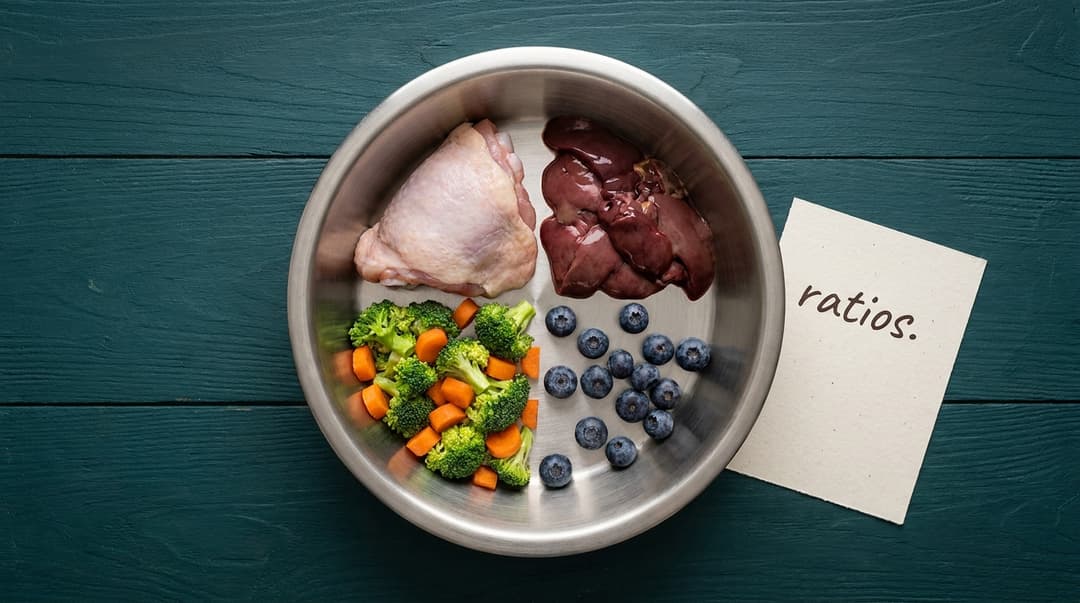
BARF (Biologically Appropriate Raw Food) — developed by Australian veterinarian Dr. Ian Billinghurst — includes muscle meat, raw meaty bones, organ meat, and a small percentage of vegetables, fruit, eggs, and dairy. The philosophy is that dogs are omnivores who benefit from plant matter as it would appear in a prey animal's stomach contents.
Prey Model Raw (PMR) — takes a stricter approach, arguing dogs are carnivores and should eat only what a whole prey animal provides: muscle meat, organ meat, and raw meaty bones. No vegetables, no fruit, no plant matter at all.
Both approaches work when properly balanced.
The Foundation: Percentage of Body Weight
Unlike kibble, which is calculated in kcal/cup, raw feeding is calculated as a percentage of your dog's body weight per day. The standard starting point is:
2–3% of ideal body weight per day
| Dog Profile | Starting % of Body Weight |
|---|---|
| Typical adult, moderate activity | 2–2.5% |
| Highly active / working dog | 3–4% |
| Overweight dog (use ideal weight) | 1.5–2% |
| Underweight dog | 3–3.5% |
| Puppy (under 6 months) | 8–10% of current body weight |
| Puppy (6–12 months) | 5–6% of current body weight |
| Senior dog (low activity) | 1.5–2% |
| Pregnant dog | 4–5% |
| Lactating dog | 6–8%+ |
Critical rule for overweight dogs: always calculate against ideal body weight, not current weight.
Daily Portion by Weight: Quick Reference
| Dog Weight | 2% Daily (grams) | 2% Daily (oz) | 2.5% Daily (grams) | 2.5% Daily (oz) |
|---|---|---|---|---|
| 5 lbs (2.3 kg) | 46g | 1.6 oz | 57g | 2.0 oz |
| 10 lbs (4.5 kg) | 91g | 3.2 oz | 114g | 4.0 oz |
| 20 lbs (9.1 kg) | 182g | 6.4 oz | 227g | 8.0 oz |
| 30 lbs (13.6 kg) | 272g | 9.6 oz | 340g | 12.0 oz |
| 40 lbs (18.1 kg) | 363g | 12.8 oz | 454g | 16.0 oz |
| 50 lbs (22.7 kg) | 454g | 16.0 oz | 567g | 20.0 oz |
| 60 lbs (27.2 kg) | 544g | 19.2 oz | 680g | 24.0 oz |
| 75 lbs (34.0 kg) | 680g | 24.0 oz | 850g | 30.0 oz |
| 100 lbs (45.4 kg) | 907g | 32.0 oz | 1134g | 40.0 oz |
Use our Raw Dog Food Calculator to get your dog's exact daily amount without doing the math manually.
BARF Ratios: What Goes in the Bowl
| Component | BARF % |
|---|---|
| Muscle meat (boneless) | 70% |
| Raw meaty bones (RMB) | 10% |
| Liver | 5% |
| Secreting organs (kidney, spleen, pancreas) | 5% |
| Vegetables and fruit | 7% |
| Seeds, nuts, dairy, eggs | 3% |
For a 50 lb dog at 2% body weight (454g/day): Muscle meat 318g · RMB 45g · Liver 23g · Organs 23g · Veg/fruit 32g · Extras 14g.
Prey Model Raw (PMR) Ratios
| Component | PMR % |
|---|---|
| Muscle meat (boneless) | 80% |
| Raw meaty bones (RMB) | 10% |
| Liver | 5% |
| Other secreting organs | 5% |
For a 50 lb dog at 2% (454g/day): Muscle meat 363g · RMB 45g · Liver 23g · Organs 23g.
Muscle Meat: The Bulk of the Bowl
Muscle meat makes up 70–80% of the raw diet. Rotate between at least 3–4 protein sources: chicken thighs/breast (boneless), beef chuck/brisket/heart, lamb shoulder, pork shoulder (always frozen first), turkey, venison, rabbit, duck.
Beef heart is nutritionally dense, high in taurine (critical for cardiac health in large breeds), and cheap. It should make up 10–15% of the muscle meat portion.
Raw Meaty Bones (RMB): The 10% That Does the Most Work
| Dog Size | Recommended RMBs |
|---|---|
| Small (<20 lbs) | Chicken necks, wings, quail, cornish hen |
| Medium (20–50 lbs) | Chicken carcasses, turkey necks, duck necks, lamb ribs |
| Large (50–90 lbs) | Turkey necks, beef ribs, lamb necks, pork necks |
| Giant (90+ lbs) | Beef knuckles, whole duck, whole rabbit, lamb shanks |
Never feed cooked bones. Cooking makes bones brittle and splinter-prone, creating intestinal perforation risk.
Organ Meat: Small Volume, High Stakes
Liver (5%): Do not exceed 10% of total diet — vitamin A toxicity is a real risk. Rotate between chicken, beef, lamb, and pork liver.
Secreting organs (5%): Kidney, spleen, pancreas, brain, thymus. Do not substitute extra liver for secreting organ — they are not interchangeable.
Introducing organs: Start liver at 1% for week one, increase to 5% over 3–4 weeks. Same gradual approach for secreting organs. Rushing causes loose stools.
Vegetables and Fruit in BARF (7%)
Plant cell walls must be broken down for digestibility. Blend, lightly steam, or ferment vegetables before feeding. Good options: leafy greens, carrots, courgette, cucumber, pumpkin. Safe fruits: blueberries, watermelon, apple (no seeds), banana.
Always check before introducing any new food. Grapes and raisins are severely toxic. Use our Food Safety Checker before adding anything new.
Transitioning to Raw: The 90-Day Protocol
Week 1–2: Single protein only (chicken recommended). No organs. No variety. Watch for loose stools (normal and temporary).
Week 3–4: Add liver at 1% of daily food. Increase to 2–3% by end of week 4.
Week 5–8: Introduce second protein and secreting organs at 1%, increasing slowly.
Week 9–12: Full rotation at target ratios. BARF feeders introduce blended vegetables here.
Some dogs experience a detox phase in weeks 1–3 — temporary loose stools, mild mucusy discharge, increased ear wax. Normal and resolves by week 3–4. If symptoms persist beyond 4 weeks, consult your vet.
Supplements: What Raw Often Misses
- Omega-3: Add sardines in water (2–3/week for medium dog), salmon oil, or fish oil.
- Vitamin E: 100–400 IU per day depending on size.
- Zinc: Oysters (1–2/week for medium dogs).
- Kelp/iodine: Thyroid support, especially for PMR feeders.
Do NOT supplement vitamin A or D — already present in organ meat in significant quantities.
Raw Feeding Monthly Costs
| Dog Weight | Commercial Raw (frozen) | DIY Raw (butcher/farm) |
|---|---|---|
| 20 lbs | $80–$120 | $40–$70 |
| 50 lbs | $180–$280 | $90–$150 |
| 80 lbs | $280–$420 | $140–$220 |
| 100 lbs | $350–$500 | $175–$280 |
Cost reduction: buy in bulk, source from butchers or farms, join a raw feeding co-op, use less popular cuts (green tripe, beef cheeks, trachea). Use our Adoption Cost Calculator for full annual cost breakdown.
Recommended Tools
- Raw Dog Food Calculator — Exact daily gram amounts for every BARF and PMR component.
- Dog Food Calculator — For kibble or mixed feeding while researching raw.
- Food Safety Checker — Check any ingredient before adding to the raw bowl.
- Pet Age Calculator — Raw feeding needs differ significantly by life stage.
- Dog Walking Calculator — Activity level directly affects the feeding percentage.
- Vet Cost Estimator — Budget for baseline bloodwork when starting raw.
- Pet Insurance Calculator — Some insurers have specific terms for raw-fed dogs.
- Adoption Cost Calculator — Full annual cost breakdown including food and supplements.
Get Your Dog's Exact Raw Portions
The 2–3% rule is the starting point. Your dog's exact percentage depends on their specific weight, age, activity level, and body condition — and the gram breakdown by component depends on which model you're following.
→ Use the Raw Dog Food Calculator to get a complete daily feeding plan in grams: total daily amount, muscle meat, bone, liver, secreting organs, and vegetables — calculated for your specific dog and feeding model.
Frequently asked questions
PawCalculator Editorial Team, Pet Nutrition Research
BARF ratios sourced from Dr. Ian Billinghurst's foundational work and current raw feeding community standards. PMR ratios per prey model raw feeding guidelines. Supplement recommendations cross-referenced with AAFCO nutrient profiles for dogs.
+ Follow on PawTalk