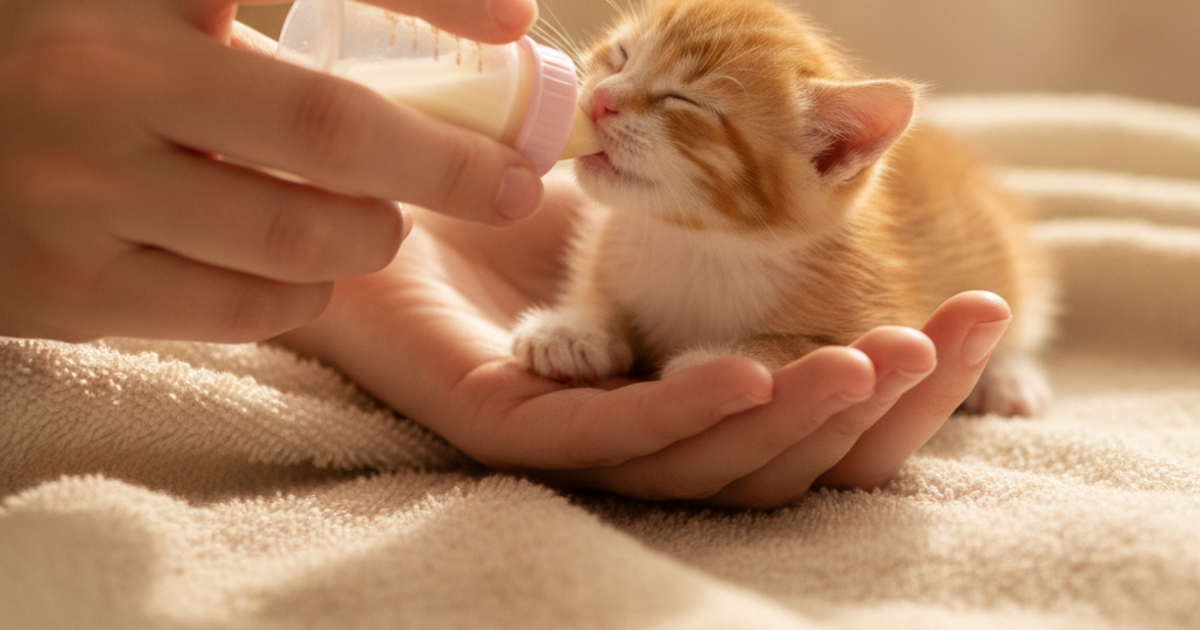
Orphaned or rejected kittens need a commercial kitten milk replacer (KMR), not cow's milk. Mix it according to the label, warm it to about body temperature, feed it from a kitten bottle with the kitten on its belly, and follow the label's amounts by weight and age. Newborns need feeding every 2-3 hours, day and night.
If you've found very young kittens, contact a vet or an experienced rescue right away: newborns are fragile, and feeding problems can turn serious fast. This guide covers why cow's milk is a bad idea, how to choose and mix formula, how to bottle-feed safely, how much and how often to feed, toileting, weaning and the warning signs that mean a vet visit. Also see fading kitten syndrome.
First: is the mother really gone?
Before stepping in, confirm the kittens are truly orphaned. A mother cat often leaves kittens for hours while she hunts or eats. If the kittens are warm, quiet and clean, watch from a distance for several hours. Take them in if they're cold, crying constantly, injured, dirty or clearly abandoned, or if the mother is known to be dead.
Why not cow's milk?
Cow's milk has too much lactose and too little protein and fat for kittens. It commonly causes diarrhea, which dehydrates a tiny kitten quickly. Goat's milk, plant-based milks, evaporated milk and homemade recipes are not reliable substitutes, and some can be dangerous. A commercial KMR is formulated to mimic queen's milk.
Choosing a milk replacer
- Pick a product made for kittens, in powder or liquid form. Puppy formulas aren't the same.
- Check the expiry date and storage directions.
- Buy a kitten nursing bottle with a small nipple. Syringes can work in some cases, but only if a vet shows you how, since kittens can easily inhale milk.
- Ask your vet to recommend a brand if the kitten is unwell.
How to mix and warm formula
- Wash your hands, bottles and nipples, and sterilize between uses.
- Mix powder and water exactly as the label says.
- Refrigerate mixed formula and discard it by the label's time limit.
- Warm the portion to roughly body temperature. A drop on your wrist should feel barely warm, not hot.
- Never microwave formula in the bottle; uneven heat can scald.
How to bottle-feed safely
- Keep the kitten on its belly, head level, like nursing. Never feed on its back.
- Let the kitten suck at its own pace. Don't squeeze the bottle.
- Stop if milk comes from the nose, the kitten coughs, gags or gasps, and call your vet (aspiration can cause pneumonia).
- Burp gently after feeding, as you would a baby.
- Stimulate to pee and poop after each meal with a warm, damp cotton ball or cloth, because kittens under about 3-4 weeks can't go on their own.
- Keep the kitten warm. Never feed a cold kitten.
How much and how often
Follow the tin's chart. As a typical veterinary reference, kittens need roughly 8 mL of formula per ounce of body weight per day in the first weeks, divided across feedings.
| Age | Typical feedings |
|---|---|
| Newborn to 1 week | Every 2-3 hours, day and night |
| 2-3 weeks | Every 3-4 hours |
| 3-4 weeks | Every 4-6 hours, introducing gruel |
| 4-6 weeks | Weaning to wet kitten food |
Weigh daily on a kitchen scale and record it. Steady gain is the best sign the feeding plan is working.
Worked example
Bean weighs 4 oz (113 g).
- Daily formula at about 8 mL per oz = 4 × 8 = about 32 mL.
- Fed every 3 hours (8 feedings) = about 4 mL per feeding.
- As Bean grows to 8 oz, her daily total roughly doubles to about 64 mL, so recalculate every few days.
Always check against your formula's label and confirm with your vet, because products differ in calories. See the cat feeding chart for how needs grow over time.
Keeping the kitten warm
Newborn kittens can't regulate body temperature. A common target is about 85-90°F (29-32°C) in the first week, reducing gradually. Use a heating pad on low under half the box or a fabric-wrapped warm water bottle, so the kitten can move away. A kitten that's cold won't digest milk.
Weaning
From about 3-4 weeks, offer a gruel of kitten wet food mixed with formula in a shallow dish. See 4 week old kitten care for the process. Most kittens are fully weaned by 8 weeks.
Hygiene and health
- Wash hands before and after handling.
- Clean bottles after every feeding.
- Keep bedding clean and dry.
- Ask your vet about deworming and flea control that's safe for kittens.
- Keep orphans away from unvaccinated adult cats until cleared by a vet.
When to call your vet
Call promptly for a kitten that refuses the bottle, is cold or limp, has diarrhea, a swollen belly, gasping or milk from the nose, or fails to gain weight every day.
Frequently asked questions
PawCalculator Editorial
We combine veterinary references, published guidelines, and calculator-grade modeling. This article is for education, not a substitute for an exam.
+ Follow on PawTalk