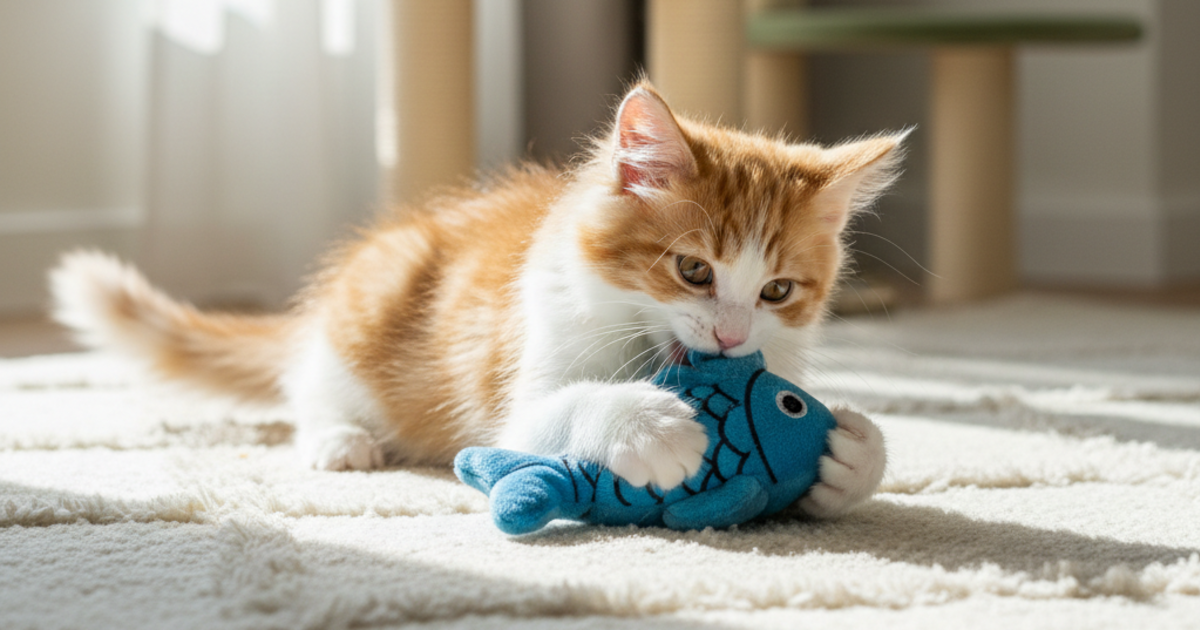
A 4 month old kitten is teething, growing fast and full of energy. Feed kitten food in about three meals a day at roughly 2-2.5 times its resting energy needs (about 235-295 kcal for a 2 kg kitten), redirect biting to toys, finish the vaccine series and talk to your vet about spay or neuter timing.
Four months is a busy stage: adult teeth are coming in, play gets rougher, climbing becomes a hobby and growth is rapid. It's also when good habits around biting, scratching and litter use either settle in or start to slip. This guide covers growth and size, teething, food and portions, play and biting, vet care, behavior and safety. Check portions with the cat feeding chart.
Growth and size
Many kittens weigh around 4-6 lb (1.8-2.7 kg) at 4 months, though breed and sex matter. Male kittens and large breeds such as Maine Coons tend to be heavier. A common rule of thumb is about a pound a month in the early months, slowing later. Kittens keep growing until about 12 months, and large breeds for up to 3-5 years.
Teething
Permanent teeth begin to replace baby teeth from about 3-4 months. The usual order is incisors first, then canines, then premolars and molars, finishing around 6-7 months. Signs include:
- Chewing and mouthing more than usual
- Mild drooling
- Reluctance to eat hard kibble
- Small baby teeth turning up on the floor, or none seen because kittens swallow them
- Slightly bad breath or red gums
Offer safe chew toys and a cold (not frozen solid) damp washcloth. Check gums if your kitten stops eating; retained baby teeth or dental pain need a vet.
Food and portions
Kitten calorie needs are about 2-2.5 × RER, where RER = 70 × (weight in kg)^0.75. Offer 3 meals a day of a food labeled for growth or all life stages. Include wet food for moisture, and keep fresh water available.
Worked example
Milo weighs 2 kg (4.4 lb).
- RER: 70 × 2^0.75 = 70 × 1.68 = about 118 kcal.
- Daily need at 2-2.5 × RER: about 235-295 kcal.
- On an 85 kcal can: about 2.8-3.5 cans a day if wet-only, or a mix of wet and dry. A mix might be 1.5 cans (about 128 kcal) plus 0.33 cup of dry at 390 kcal per cup (about 130 kcal).
- Weigh every week or two, and adjust portions if growth is too fast or slow.
Confirm by weight and body condition with your vet.
Play, biting and scratching
- Redirect biting to toys, not hands. Avoid play with fingers.
- Use wand toys for daily sessions, and let your kitten "win" so the hunt ends satisfyingly.
- Provide scratching posts in different textures and heights so claws go there instead of furniture.
- Schedule play before meals and bedtime to tire your kitten out.
- If biting is hard or frequent, rule out overstimulation, teething pain or lack of exercise.
Vet care
- Vaccines: boosters typically continue until about 16 weeks; rabies timing depends on local law. See the vaccination schedule.
- Spay/neuter: many vets recommend around 4-6 months, sometimes earlier. Ask what suits your kitten.
- Parasite prevention: flea and worm control per your vet.
- Microchip if not already done.
- Dental check: ask your vet to look at the mouth during teething.
Behavior and safety
Keep windows secure, hide cords and keep toxic plants (especially lilies) away. Offer multiple litter boxes if possible, and keep them clean. Introduce other pets slowly, and make sure your kitten has vertical space, hiding spots and quiet time.
When to call your vet
Call if your kitten has diarrhea, vomiting, loss of appetite, weight loss, limping, persistent sneezing or eye discharge, or blood in the mouth. Straining in the litter box without producing urine is an emergency, especially in males.
Frequently asked questions
PawCalculator Editorial
We combine veterinary references, published guidelines, and calculator-grade modeling. This article is for education, not a substitute for an exam.
+ Follow on PawTalk