Orphaned or underfed puppies need a commercial puppy milk replacer, not cow's milk. Mix it per the label, warm it to about body temperature, feed on the belly every 2-4 hours in the early weeks and start weaning at about 3-4 weeks.
If you've got newborn puppies without a mother, or a litter that isn't gaining weight, call your vet right away. Newborns are fragile: they can't regulate their own temperature, have tiny energy reserves and can decline in hours. This guide covers why cow's milk is a poor choice, how to choose and mix formula, how to bottle-feed safely, how much and how often, toileting, warmth, weaning and the warning signs that need a vet. Weigh them daily, and use the dog food calculator by weight and age once they're eating solid food.
When do puppies need milk replacer?
- The mother has died, is sick or has no milk
- The mother rejects some or all of the litter
- The litter is large and some puppies can't get enough milk
- A puppy is weak, small or not gaining weight
- Puppies are separated from the mother for medical reasons
Even when the mother is present, a runt or weak puppy may need supplemental feeding. Ask your vet to assess.
Why not cow's milk?
Cow's milk has less protein and fat and more lactose than dog milk. It can cause diarrhea and dehydration in puppies. Goat's milk, plant milks, evaporated milk and home recipes aren't reliable substitutes, and some can cause harm. A commercial puppy formula is designed to mimic a bitch's milk.
Choosing a puppy milk replacer
- Use a commercial formula made for puppies. Kitten formula is not the same.
- Check the expiry date and storage directions.
- Choose powder or ready-to-feed liquid, per your vet's advice.
- Buy a puppy nursing bottle with a nipple of the right size, or ask your vet to show you other methods such as tube feeding if needed.
- Keep several bottles and nipples so you can rotate them while sterilizing.
Mixing and warming
- Wash your hands, bottles and nipples; sterilize between uses.
- Mix exactly as the label says.
- Store mixed formula in the fridge and discard per the label.
- Warm to about body temperature. A drop on your wrist should feel barely warm.
- Never microwave formula in the bottle; uneven heat can scald.
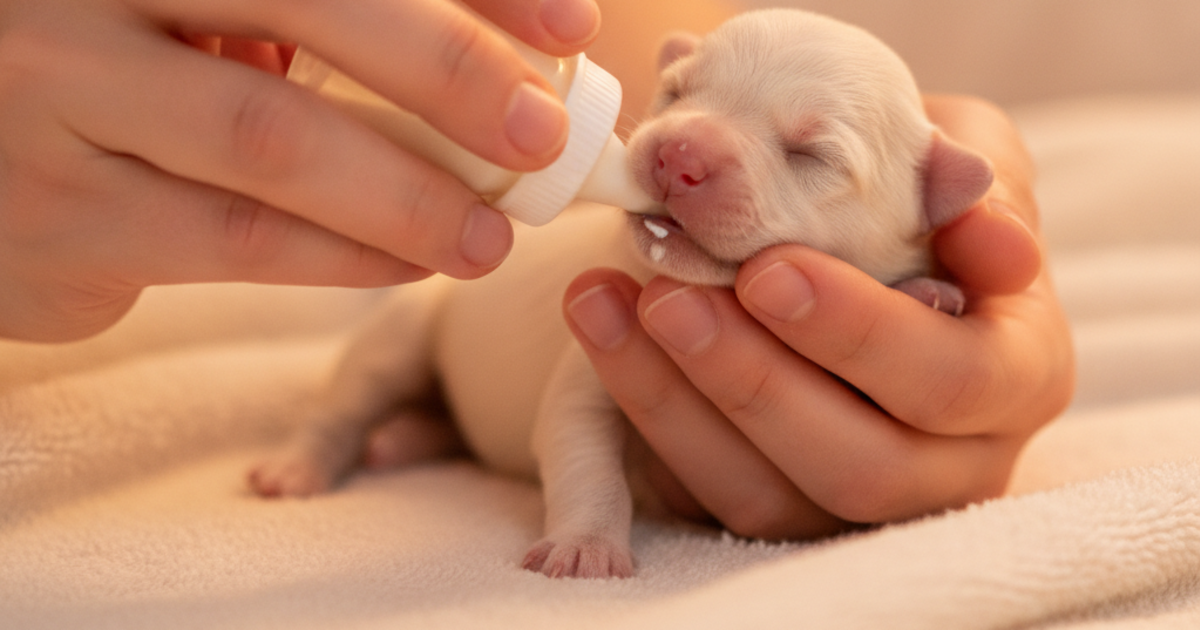
How to bottle-feed safely
- Place the puppy on its belly, head level, like nursing.
- Never feed a puppy on its back, which risks inhaling milk.
- Let the puppy suck at its own pace.
- If milk comes from the nose or the puppy coughs, stop and call your vet; aspiration can cause pneumonia.
- Burp gently after feeding.
- After each meal, stimulate urination and defecation with a warm, damp cloth until the puppy goes on its own, usually for the first 3 weeks.
- Keep puppies warm. A chilled puppy can't digest food, so never feed a cold puppy.
How much and how often
Follow the tin's chart. As a typical veterinary reference, newborns need roughly 13 mL of formula per 100 g of body weight per day in week 1, rising to roughly 22 mL per 100 g by week 4.
| Age | Typical feeding frequency |
|---|---|
| Week 1 | Every 2-3 hours, including nights |
| Weeks 2-3 | Every 3-4 hours |
| Week 4 | Every 4-6 hours, with gruel introduced |
Worked example
A 300 g newborn puppy in week 1.
- Daily formula: 13 mL × 3 (per 100 g) = about 39 mL.
- Eight feedings a day (every 3 hours): about 5 mL per feeding.
- Weigh daily, and aim for a gain of about 5-10% of birth weight a day.
- Recalculate every few days as the puppy grows.
- Check against the label, because formulas differ in calories.
Expect steady daily gain. A puppy that doesn't gain or loses weight needs a vet.
Warmth
Newborn puppies can't regulate their body temperature. A common target is about 85-90°F (29-32°C) in the first week, reducing gradually over the following weeks. Use a heating pad on low under half the box, or a fabric-wrapped warm water bottle, so puppies can move away.
Weaning
Around 3-4 weeks, offer a gruel of puppy food and formula in a shallow dish. Reduce the formula over 2-3 weeks. Most puppies are weaned by 6-8 weeks. See the dog food calculator by weight and age for portions as the puppy grows.
Health and hygiene
- Wash hands before and after handling.
- Keep bedding clean and dry.
- Ask your vet about deworming and vaccines.
- Keep orphans away from unvaccinated dogs.
When to call your vet
Call promptly if a puppy is cold, limp, isn't nursing, has diarrhea, a swollen belly, gasping, milk from the nose or isn't gaining weight.
Frequently asked questions
PawCalculator Editorial
We combine veterinary references, published guidelines, and calculator-grade modeling. This article is for education, not a substitute for an exam.
+ Follow on PawTalk