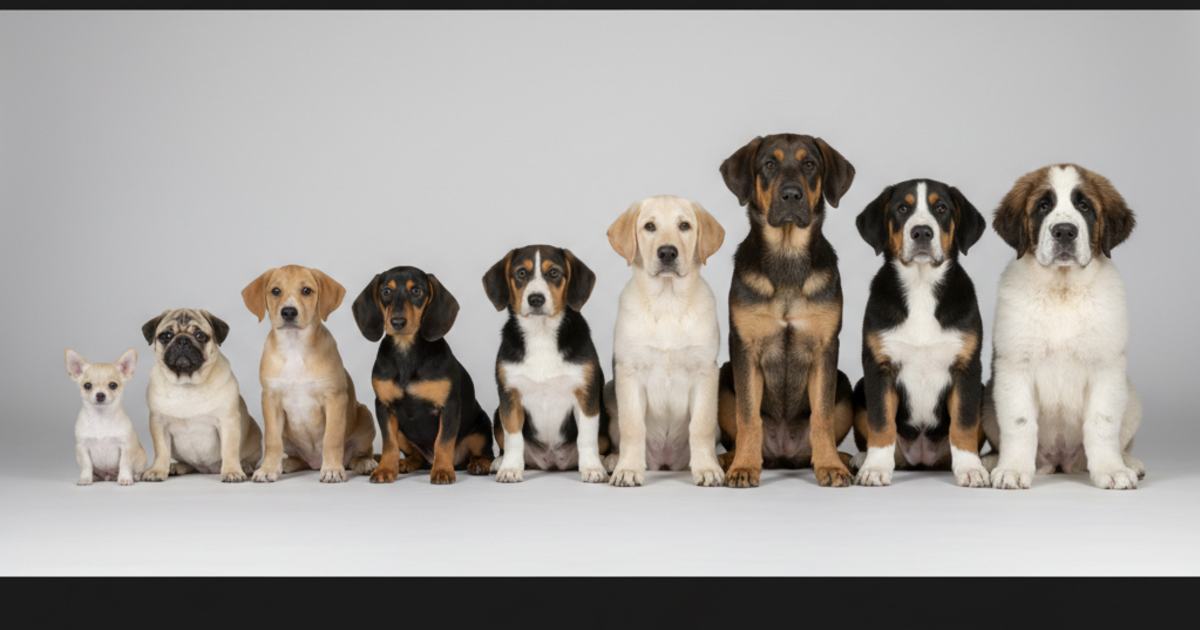
Puppies are usually about 50–75% of their adult weight by 6 months, depending on size. Toy and small breeds finish growing around 6–12 months, and large and giant breeds keep growing until 12–24 months, so compare your puppy against its own size band.
A good puppy weight chart is really a "typical range" chart. It won't tell you exactly what your puppy will weigh, but it will tell you whether you're in the ballpark. For a personal estimate, try our puppy weight predictor.
Puppy weight chart at a glance (toy, small, medium, large, giant)
This chart uses the American Kennel Club's growth percentages for each size group and applies them to example adult weights. Your puppy's breed will differ, so swap in your own expected adult weight.
| Size group | Example adult weight | At 6 months | At 12 months |
|---|---|---|---|
| Toy / small (AKC: up to 20 lb) | 5 lb (2.3 kg) | 3.8 lb (1.7 kg) | 5 lb (2.3 kg) |
| Small | 15 lb (6.8 kg) | 11 lb (5.1 kg) | 15 lb (6.8 kg) |
| Medium (21–50 lb) | 40 lb (18 kg) | 26 lb (12 kg) | 38 lb (17 kg) |
| Large (51–100 lb) | 70 lb (32 kg) | 42 lb (19 kg) | 60 lb (27 kg) |
| Giant (100+ lb) | 120 lb (54 kg) | 60 lb (27 kg) | Still growing |
The percentages behind it, from AKC's chart:
| Size group | % of adult weight at 6 months | % at 12 months |
|---|---|---|
| Small | about 75% | about 100% |
| Medium | about 66% | about 95% |
| Large | about 60% | about 85% |
| Giant | about 50% | still growing (up to 18–24 months) |
How to read the chart: percent of adult weight by age
The idea is simple. Your puppy's weight is a percentage of what it will eventually weigh. Small puppies get there fast, and big puppies take their time.
To use it:
- Pick your puppy's size group (from breed, or from the parents' adult weights).
- Find your puppy's age in the table.
- Compare its weight with the range for that size group.
A 6-month-old Great Dane and a 6-month-old Chihuahua are both "6 months old," but one is about halfway done and the other is nearly finished. That's why one chart for all puppies doesn't work.
Not sure how to pick a size group? Try our dog growth calculator.
Breed examples: German Shepherd and Golden Retriever
Both are large breeds, so they follow the "large" row. Adult weights vary by line, so check the AKC breed page and ask your breeder.
- Golden Retriever. The AKC standard puts females at about 55–65 lb (25–29 kg) and males at about 65–75 lb (29–34 kg). For a 60 lb (27 kg) female, expect roughly 36 lb (16 kg) at 6 months and 51 lb (23 kg) at 12 months.
- German Shepherd. Adults are typically in the range of about 50–90 lb (23–41 kg), with males larger than females. For a 70 lb (32 kg) dog, expect roughly 42 lb (19 kg) at 6 months and about 60 lb (27 kg) at 12 months.
Those are estimates built from AKC's large-breed percentages. If you'd like a Lab-specific breakdown, see our Labrador puppy weight chart.
When puppies stop growing, by size
Per AKC's growth guide:
- Small breeds: finish growing by about 6–8 months (some take up to 12).
- Medium breeds: reach adult size around 12 months.
- Large breeds: take longer, often 12–18 months.
- Giant breeds: may grow until 18–24 months.
Height and weight don't finish together. A large-breed puppy can reach adult height at 12 months and keep filling out for another six.
Is my puppy underweight or overweight?
Use the chart for a rough check, then use your hands.
- Healthy: Ribs are easy to feel but not sharply visible. There's a waist from above and a slight tuck behind the ribs from the side.
- Underweight: Ribs, spine and hip bones are easy to see. Muscle looks thin.
- Overweight: You can't feel ribs without pressing. No waist. Belly looks round.
A slightly lean puppy is healthier than a heavy one, especially in large breeds, where extra weight puts stress on growing joints. Our dog BMI calculator can add a second opinion, and our weight tracker lets you log weigh-ins so you can see the trend.
Track your puppy's growth (worked example)
Let's check two puppies against the "large" row. Both are Golden Retriever females, expected adult weight 60 lb (27 kg). At 6 months, the large-breed target is about 60%, so about 36 lb.
Scout weighs 38 lb (17 kg) at 6 months.
- 38 ÷ 60 = about 63%.
- The chart says about 60%. Scout is right on track.
Poppy weighs 50 lb (23 kg) at 6 months.
- 50 ÷ 60 = about 83%.
- That's well ahead of 60%. Either Poppy will end up bigger than 60 lb (50 ÷ 0.60 is about 83 lb), or she's carrying extra weight.
- Time for a body-condition check and a chat with the vet about portions.
Now try your own puppy. Enter age and weight in our puppy weight predictor and compare with the chart above. For how much to gain each week, see how much weight a puppy should gain per week. If your puppy is a mix, use our mixed-breed puppy weight chart instead, and for how the estimates work under the hood, see our AKC puppy weight calculator explainer.
When to call your vet
Contact your vet if you notice:
- No weight gain across two weekly weigh-ins, or any weight loss.
- Sudden, rapid gain, or a puppy that's well above its size band and looks round.
- A pot belly with a thin body, which can mean worms.
- Vomiting or diarrhea for more than a day, or blood in either.
- Lethargy or weakness, especially in a toy breed.
- Limping, swollen joints or a bunny-hop gait, especially in large and giant breeds.
- Refusing food for more than 24 hours (12 hours for toy breeds).
Frequently asked questions
PawCalculator Editorial
We combine veterinary references, published guidelines, and calculator-grade modeling. This article is for education, not a substitute for an exam.
+ Follow on PawTalk