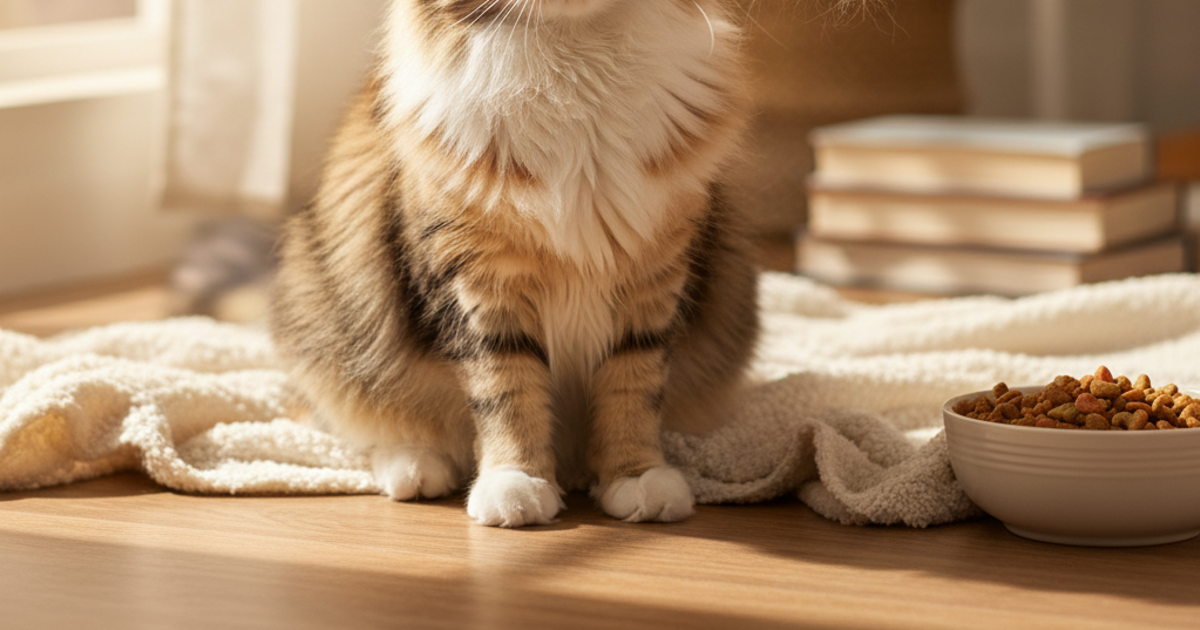
Hairball control cat food can help some cats pass swallowed hair through the gut instead of coughing it up, mainly by adding fiber that carries hair along in the stool. It works best alongside regular brushing and good hydration, and it is not a cure for frequent vomiting, which needs a vet.
Most cat owners have stepped on a damp surprise in the middle of the night. Cats groom constantly, swallow loose hair and normally pass most of it in their stool. A smaller amount can clump in the stomach and come back up as a hairball. Pet food companies sell special formulas to reduce that, and many owners swear by them, but the evidence is modest and results vary by cat. This guide explains how hairball control cat food works, who benefits, what to look for on the label, how to feed it, what else helps and when vomiting is a sign of something more serious. To portion any cat food correctly, use the cat food calculator.
What is a hairball?
A hairball (trichobezoar) is a cylindrical wad of hair mixed with saliva and stomach contents. Despite the name, it is usually tube-shaped because it passes through the narrow esophagus on the way out. Cats swallow hair from grooming, since the tiny barbs on their tongue pull loose fur into the mouth. Most of it moves through the intestines and leaves in the litter box.
How hairball control cat food works
Manufacturers use a few strategies, often in combination.
| Approach | How it is thought to help |
|---|---|
| Added insoluble fiber (cellulose, beet pulp, psyllium, pea fiber) | Adds bulk and speeds intestinal transit so hair leaves in the stool |
| Higher overall fiber content | Increases stool volume and motility |
| Omega-3 and omega-6 fatty acids | Support skin and coat health, which may reduce shedding |
| Highly digestible protein | Helps healthy skin and coat |
| Lubricating oils or gels (in supplements and treats) | Coat hair to help it slide through |
| Kibble shape or texture | Some brands claim mild brushing action, though evidence is limited |
In studies, diets with added fiber have been shown to increase the amount of hair passed in feces and reduce hairball formation in some cats. The effect is real but modest, and cats differ a lot.
Who might benefit most
- Long-haired cats, such as Persians, Maine Coons and Ragdolls
- Heavy groomers and shedders
- Cats with frequent hairballs (more than once or twice a month) but otherwise healthy
- Indoor cats that groom more and shed year-round
- Seniors or cats with overgrooming habits, after a vet rules out medical causes
What to look for on the label
- A complete-and-balanced statement for your cat's life stage, such as adult maintenance.
- A fiber source, often listed as cellulose, beet pulp, pea fiber or psyllium. Crude fiber is typically higher than in standard formulas, often around 5-8% in dry food.
- Quality animal protein in the first ingredients.
- Omega fatty acids for skin and coat.
- Appropriate calories. Fiber-rich foods can be lower in calories, but that depends on the brand, so check the kcal per cup or can.
- Wet or dry options. Wet food adds moisture, which helps digestion.
Wet vs dry hairball formulas
Dry hairball formulas are the most common because they are easy to make and feed. Wet versions exist and offer extra hydration, which helps hair move through the gut. Many vets like a mix, such as wet food for meals plus a measured amount of dry.
Worked example: portioning hairball formula
A 4.5 kg (10 lb) neutered indoor adult cat.
- Resting energy: RER = 70 × 4.5^0.75 = 70 × 3.09 = about 216 kcal.
- Neutered adult factor of 1.2: 216 × 1.2 = about 260 kcal per day.
- If the hairball formula is 330 kcal per cup: 260 ÷ 330 = about 0.79 cup per day, or roughly 3/4 cup.
- Split into two meals of about 0.4 cup each.
- If switching from a different food, transition over 7-10 days.
- Weigh monthly because some hairball formulas have fewer calories, and a cat that eats the same volume could lose or gain weight.
Use the cat calorie calculator to double-check your cat's daily needs.
Other ways to reduce hairballs
Food is only one part of the picture.
- Brush regularly. Daily for long coats, a few times a week for short coats. This removes hair before your cat swallows it, and it is often the most effective step.
- Increase hydration. Use a water fountain, add wet food or add a splash of water to meals.
- Add play and exercise to keep digestion moving.
- Use a vet-approved hairball gel or paste occasionally. Ask your vet first, and do not overuse mineral-oil products.
- Check for fleas and skin problems. Itchy cats overgroom and swallow more hair.
- Reduce stress, which can lead to excessive grooming.
- Consider a grooming appointment for severe mats in long-haired breeds.
Are hairballs normal?
Occasional hairballs, perhaps once every week or two, are usually normal for cats. A cat that coughs one up and then eats, plays and acts normally is likely fine. More frequent hairballs can signal overgrooming, a heavy shed or a digestive issue.
When vomiting is NOT just a hairball
Many cats vomit for reasons that have nothing to do with hair, and "hairballs" are sometimes blamed for other illnesses. Contact your vet if you see:
- Frequent vomiting, such as more than once or twice a month with no hair
- Repeated retching with nothing coming up
- Loss of appetite or refusal to eat
- Lethargy or hiding
- Constipation or no stool for more than a day or two
- Weight loss
- Painful or swollen belly
- Blood in vomit or stool
- Long-term coughing or wheezing, which can be asthma, not hairballs
- Overgrooming or bald patches
A cat repeatedly trying to bring up a hairball without success, or that stops eating, may have an intestinal blockage, which is an emergency. Conditions like inflammatory bowel disease, food sensitivities, hyperthyroidism, kidney disease and intestinal lymphoma can all cause chronic vomiting, so persistent vomiting should never be dismissed as a hairball problem.
Do hairball formulas have downsides?
- Not every cat does better. Some see no change.
- Higher fiber can mean larger stools or more gas.
- Lower calories can cause weight loss in some cats if portions are not adjusted.
- They do not replace brushing.
- Some cats dislike the texture or taste and need a gradual switch.
- They are not designed for medical diets. Cats with kidney disease, diabetes or other conditions need diets chosen with a vet.
Kittens and seniors
Kittens need growth formulas, not hairball formulas, unless a vet recommends otherwise. Senior cats may benefit from added fiber, but sudden changes in vomiting or weight in older cats deserve a vet check rather than a food swap.
How long until you see results?
Give a new formula at least 3-4 weeks while keeping up brushing. If hairballs are not reduced, or if vomiting continues, talk to your vet before trying more products.
When to call your vet
Call your vet for frequent vomiting, repeated unproductive retching, appetite loss, lethargy, constipation, sudden weight changes or any sign of pain. Go to an emergency clinic if your cat is retching without producing anything, has a hard swollen belly, is crying out or is unable to pass stool.
The bottom line
Hairball control cat food can reduce hairballs for some cats by adding fiber that moves hair through the gut, but brushing, hydration and a vet check for frequent vomiting matter just as much. Portion it carefully with the cat food calculator.
Frequently asked questions
PawCalculator Editorial
We combine veterinary references, published guidelines, and calculator-grade modeling. This article is for education, not a substitute for an exam.
+ Follow on PawTalk