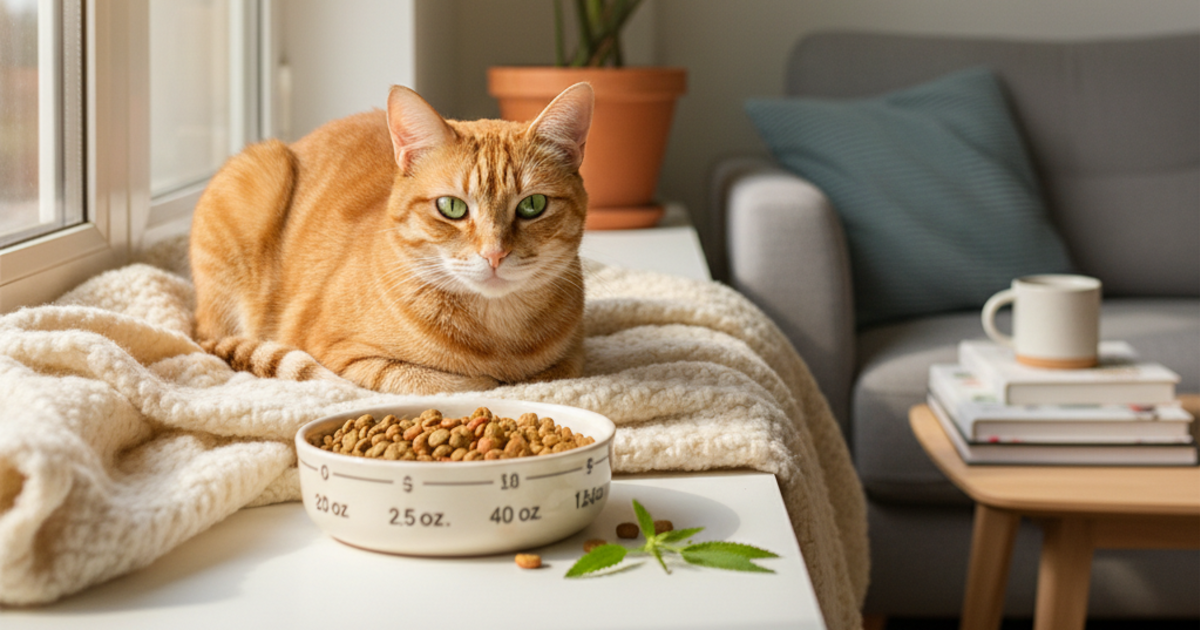
The best cat food for an indoor cat is a complete and balanced diet for its life stage that you can portion precisely. Indoor cats burn fewer calories than active outdoor cats, so weight control is the main issue. Indoor formulas add fiber for hairballs and often fewer calories, but measuring the amount matters more than the label.
Indoor cats live longer on average, but they're also more prone to weight gain, urinary problems and boredom-related eating. The right food helps, but the biggest lever is how much you feed. This guide covers why indoor cats need fewer calories, what to look for in an indoor formula, whether hairball foods work, how much to feed and the habits that keep an indoor cat lean. Use the cat calorie calculator to set a daily target, then pick a food that fits.
Why indoor cats need fewer calories
Indoor cats typically move less than cats that roam, and neutered cats have lower energy needs than intact ones. A neutered adult cat needs about 1.2 × RER per day, where RER = 70 × (weight in kg)^0.75. An indoor cat that is overweight and needs to lose weight will need even less. Because cats can gain weight on a surplus of only 10-20 kcal a day, an extra spoonful of kibble matters.
What to look for in an indoor cat food
- A complete and balanced statement from AAFCO for the right life stage.
- Moderate calories per cup or can, so you can feed a satisfying volume.
- High protein to preserve lean muscle. AAFCO's minimum is 26% dry matter for adults; most foods go higher.
- Moisture: wet food adds water and fewer calories per gram, which can help fullness and urinary health.
- Moderate fiber: can help move hair through the gut and add bulk.
- Clear contact details and quality control from the manufacturer.
Skip the pictures of sleek cats and look at the numbers: calories per serving and the nutritional adequacy statement.
Do hairball formulas work?
Hairball-control foods use added fiber to help hair pass through the gut instead of forming clumps. They can help some cats, but regular brushing is often more effective, particularly for long-haired breeds. Occasional hairballs are normal. Frequent vomiting, gagging without producing anything, loss of appetite or constipation deserves a vet check, because those signs can point to a blockage or another health problem.
Wet, dry or mixed for indoor cats?
| Option | Why it may suit indoor cats |
|---|---|
| Mostly wet | More water, fewer calories per gram, helps fullness, may support urinary health |
| Mostly dry | Convenient, lower cost, but easy to overfeed |
| Mixed | A balance of cost and hydration |
Whichever you pick, feed by calories, not by "a scoop."
Worked example: how much to feed
Meet Luna, a neutered indoor cat weighing 4.5 kg (10 lb).
- RER: 70 × 4.5^0.75 = 70 × 3.09 = about 216 kcal.
- Daily need at 1.2 × RER: about 260 kcal.
- Feeding half wet and half dry:
- Wet: 130 kcal = about 1.6 cans at 80 kcal each.
- Dry: 130 kcal = about 0.33 cup at 390 kcal per cup.
- Weigh monthly. If Luna gains, cut about 10%; if she loses weight unintentionally, see the vet.
Use the cat food calculator for your cat and food, and check body condition with the cat BMI calculator.
Feeding habits that help
- Measure meals with a scale or measuring cup rather than eyeballing.
- Avoid free-feeding if your cat gains weight. Measure the day's ration each morning instead.
- Use puzzle feeders and scatter feeding to slow eating and add activity.
- Split the day's food into 2-4 meals.
- Weigh monthly, and adjust by about 10% if weight moves the wrong way.
- Offer daily play sessions with wand toys to burn calories.
- Count treats: keep them to about 10% of daily calories.
Enrichment matters too
Indoor cats that are bored often beg and overeat. Provide vertical space (cat trees and shelves), window perches, scratching posts, rotating toys and regular play. Food puzzles turn meals into hunting.
Urinary health
Indoor cats, especially males, are prone to urinary problems. Encourage water intake with fountains and wet food, keep litter boxes clean and watch for straining. Some cats need veterinary urinary diets.
When to call your vet
Call your vet if your cat gains or loses weight quickly, vomits hairballs often, strains in the litter box (an emergency in male cats), drinks much more than usual, or refuses food for more than 24 hours.
Frequently asked questions
PawCalculator Editorial
We combine veterinary references, published guidelines, and calculator-grade modeling. This article is for education, not a substitute for an exam.
+ Follow on PawTalk