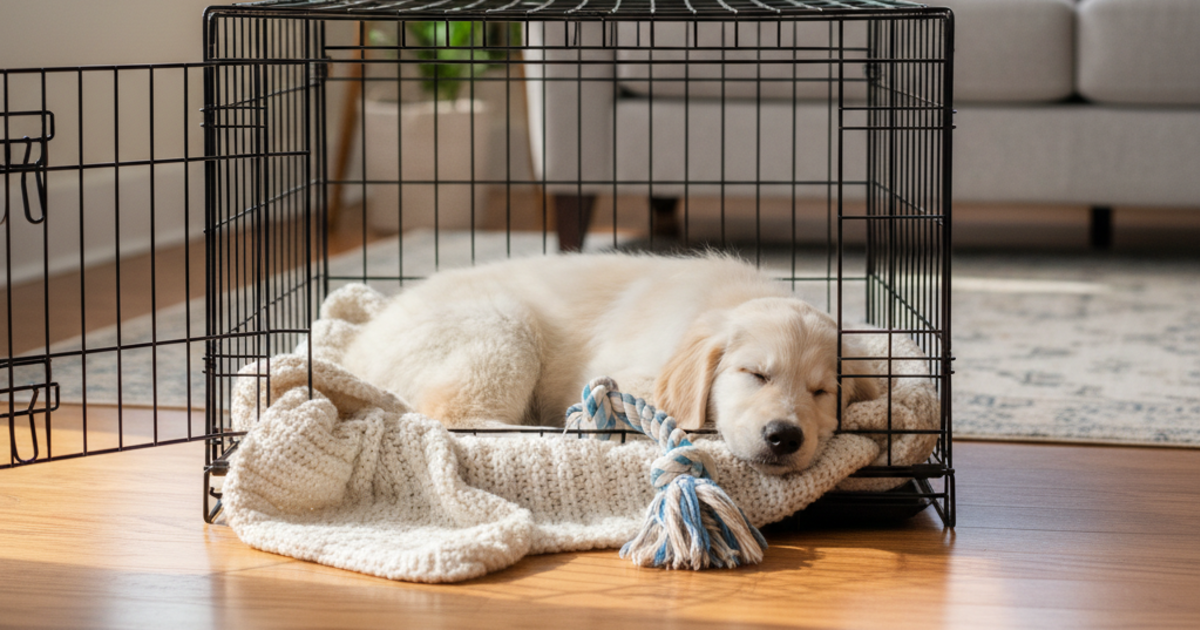
Crate train a puppy by choosing a snug, well-sized crate, building positive associations with treats and meals, and lengthening crate time gradually. As a rough guide, most puppies can wait about one hour per month of age during the day (plus a little), and young puppies need a potty break overnight. The crate should be a safe den, never a punishment.
A crate can make house training, travel, vet visits and recovery from surgery easier, and most dogs come to see it as their own space. Done badly, it can cause stress and set back training. This guide covers crate size, a step-by-step introduction, a sample schedule, nights, whining and common mistakes. Track your puppy's stage with the dog age calculator.
Why crate training works
Dogs are den animals by instinct and tend not to soil the space where they sleep. A crate uses both instincts: it gives a puppy a cozy retreat and helps teach bladder and bowel control. It also keeps a puppy safe when you can't supervise, since puppies chew cords, swallow socks and explore in dangerous ways.
Step 1: Choose the right crate
- Size: big enough for your puppy to stand, turn around and lie down comfortably, but not so big that one end becomes a toilet. Buy a crate sized for the adult dog with a divider, or size up as your puppy grows.
- Type: wire crates offer ventilation and visibility and often come with dividers. Plastic travel crates feel more den-like and suit car and air travel. Soft crates suit calm, trained dogs, not chewers.
- Placement: in a busy room such as the living room or near your bed, so your puppy doesn't feel isolated.
- Bedding: a washable mat or blanket, and a safe chew toy. Skip anything your puppy can shred and swallow.
Step 2: Make it a happy place
- Leave the door open and let your puppy explore at their own pace.
- Toss treats and toys inside.
- Feed meals inside the crate, with the door open at first.
- Praise calm behavior and never push or force your puppy in.
- Keep sessions short and upbeat.
Step 3: Close the door briefly
When your puppy walks in happily:
- Close the door for a few seconds while feeding treats through the bars.
- Open the door before your puppy gets upset.
- Build from seconds to a minute, then several minutes, while you sit nearby.
- Then step away briefly and return.
Always open the door when your puppy is calm, not while whining, so your puppy learns that quiet gets results.
Step 4: Build up time
Bladder control varies by puppy, breed and age. A general guideline:
| Puppy age | Typical maximum daytime crate stretch |
|---|---|
| 8-10 weeks | 30-60 minutes |
| 11-14 weeks | 1-3 hours |
| 15-16 weeks | 3-4 hours |
| 17+ weeks | 4-6 hours |
Always take your puppy out before crating and right after releasing. Never leave a puppy crated for long stretches during the day. Daytime crate time should be mixed with exercise, play and company.
Sample daily schedule (10-week-old puppy)
- 6:30 Potty, breakfast in the crate
- 7:00 Potty, play
- 8:00 Nap in the crate
- 10:00 Potty, play and short training
- 11:30 Potty, lunch, nap in the crate
- 14:00 Potty, play
- 16:00 Potty, short outing
- 17:30 Potty, dinner
- 19:00 Play and training
- 21:00 Last potty, bedtime in the crate
- Overnight: one or two potty breaks
Young puppies need 18-20 hours of sleep a day, so a large share of the day should be naps.
Step 5: Nights
- Put the crate near your bed at first so your puppy can hear and smell you.
- Take your puppy out right before bed, and set an alarm for a potty break after about 3-4 hours for very young puppies.
- Keep night potty breaks boring: quiet, no play.
- Gradually lengthen the stretch between breaks over several weeks.
- Move the crate further away once your puppy sleeps through the night.
Worked example
Milo is 12 weeks old (about 3 months). Using the rule "months of age plus one hour," he can be crated for about 3-4 hours if he has had a potty break and exercise. A sensible plan is to start with 1-2 hours and increase by 15-30 minutes every few days as long as there are no accidents. If accidents start, shorten the stretch and go back a step.
Fixing whining
- Check needs first: potty, hunger, thirst, pain or overheating.
- Wait for a pause before opening the door, and keep departures and returns calm.
- Add exercise and mental work before crating.
- Cover part of a wire crate with a blanket for a den-like feel, keeping ventilation.
- Never use the crate as punishment, and don't shout at your puppy in it.
Common mistakes
- Leaving a puppy in for too long
- Using the crate as punishment
- Letting the puppy out whenever they cry
- A crate that's too big
- Skipping exercise
- Putting pads or food and water in a crate for long stretches and expecting toilet training to work
When to call your vet or trainer
Call your vet if your puppy is distressed for hours, hurts themselves on the crate, has repeated vomiting or diarrhea, strains to pee, or has frequent accidents that may point to a health problem. A certified trainer or behaviorist can help with severe separation anxiety.
Frequently asked questions
PawCalculator Editorial
We combine veterinary references, published guidelines, and calculator-grade modeling. This article is for education, not a substitute for an exam.
+ Follow on PawTalk