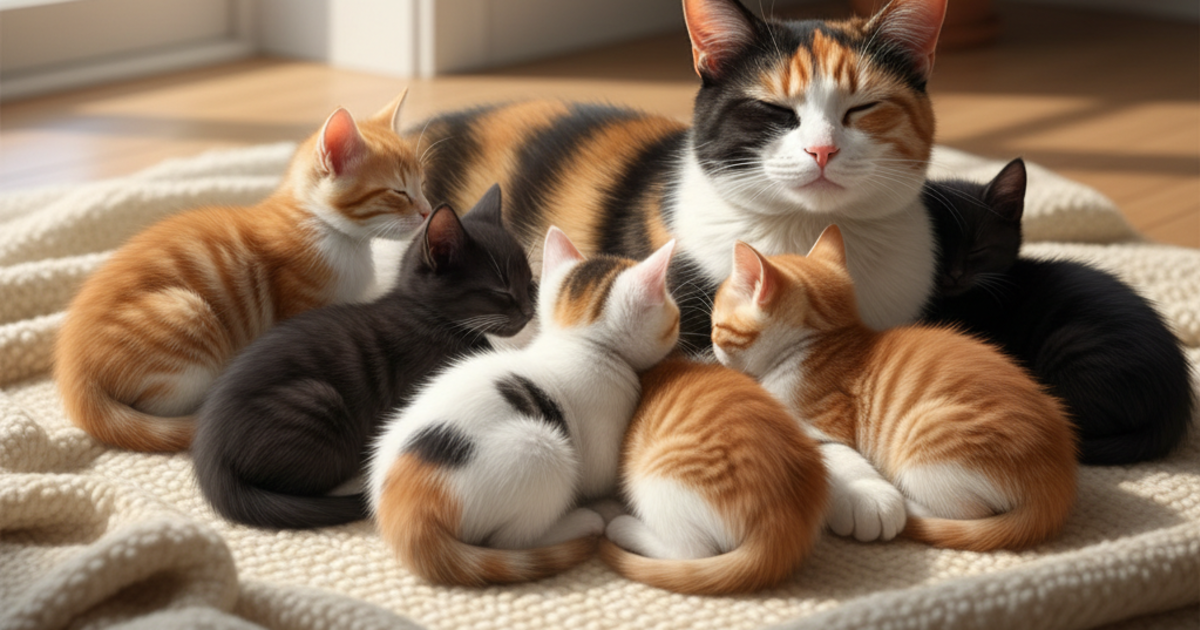
The myth: coat color is basically random
Cat coat colors can look like a grab bag — orange, black, calico, tabby, tortoiseshell — but underneath it, feline coat genetics follows the same predictable Mendelian rules as any other inherited trait. A handful of genes, acting together, account for nearly every color and pattern combination you'll see. Once you know what those genes do, a litter's coat colors stop looking random and start looking like straightforward math.
The genes that actually control cat coat color
The Orange gene (O). This is the one responsible for one of the most-asked questions in cat genetics: why are most orange cats male? The orange gene sits on the X chromosome. Males have one X, so one copy of the gene determines their color outright — orange or not. Females have two X chromosomes, so they need two copies of the orange gene to be fully orange; with one copy of each, X-inactivation produces patches of both colors, which is what creates tortoiseshell and calico patterning. This is also why genetically male tortoiseshell or calico cats are rare — it typically requires an extra X chromosome (an XXY chromosome pattern), and these cats are usually infertile.
The B locus (black/chocolate/cinnamon). This gene determines the base pigment. The most common (dominant) version produces black, while recessive versions produce chocolate or cinnamon — meaning two black cats can produce a chocolate kitten if both parents happen to carry a hidden recessive copy.
The Agouti gene (A). This controls whether the tabby pattern shows at all. The dominant version allows the banded "agouti" hairs that create tabby striping; the recessive version suppresses the pattern, producing a solid-looking coat (though faint "ghost striping" can sometimes still show, especially in kittens).
The Dilution gene (D). This gene can mute a color down — turning black into blue-gray, or orange into cream. It's recessive, so both parents need to carry a copy for a kitten to show a diluted color.
White spotting (S) and dominant white (W). These genes control how much white appears. White spotting creates the bicolor patches you see in tuxedo cats. Dominant white is a separate, stronger gene that can mask all other color genes entirely, producing an all-white cat regardless of what color genes it's actually carrying underneath.
| Gene | Common name | What it controls | Inheritance pattern |
|---|---|---|---|
| O | Orange gene | Orange vs. non-orange base color | X-linked |
| B | Black/chocolate/cinnamon | Base pigment shade | Dominant (black) over recessive variants |
| A | Agouti | Whether tabby striping shows | Dominant (tabby) over recessive (solid) |
| D | Dilute | Muting color intensity | Recessive |
| S / W | Spotting / dominant white | Amount and masking of white | Variable |
Common mistakes people make with cat coat genetics
Assuming coat color predicts personality. "Orange cats are goofy" and "tortoiseshell cats have attitude" are popular claims with no reliable scientific backing — coat color genes and temperament genes aren't linked.
Expecting two orange cats to only produce orange kittens. Other genes (agouti, dilution, white spotting) still act independently, so an orange-to-orange pairing can still produce kittens with different patterns and shades.
Assuming male calicos are common. They show up in roughly 1 in 3,000 calico/tortoiseshell cats, tied to a chromosomal exception rather than standard inheritance, and most are infertile.
Confusing "no visible pattern" with "no agouti gene present." A solid-colored cat can still carry a hidden copy of the tabby-enabling gene and pass striping on to kittens if paired with another carrier.
Ignoring that white can mask everything else. A cat that looks solid white may be carrying color genes for tabby, tortoiseshell, or any other combination underneath a masking dominant-white gene — genetics, not photos, are what actually predict offspring color.
Recommended tools
- Cat Genetics / Coat Color Calculator — see the likely coat outcomes from a breeding pair
- Pet Name Generator — find a name that fits your kitten's new coat
- Cat Age Calculator — track your cat's age in human-equivalent years
- Cat BMI Calculator — check whether your cat is at a healthy weight
- Cat Food Calculator (portions) — get daily portion targets for a growing kitten
FAQs
Why are most orange cats male? The orange gene is carried on the X chromosome. Males only need one copy to be orange, while females need two — making solid orange far more common in males and tortoiseshell/calico patterns (partial orange) far more common in females.
Can two black cats have an orange kitten? Not from the black gene alone — orange is controlled by a separate gene (O), not a variant of black. Two black cats could, however, produce a kitten of a different black-family shade like chocolate if both carry a hidden recessive copy.
What causes tabby patterns? The Agouti gene (A) allows the banded hair structure that creates tabby striping to show. Its recessive version suppresses the pattern, producing what looks like a solid coat.
Are calico cats always female? The vast majority are, because the pattern requires two X chromosomes carrying different orange-gene copies. Male calicos exist but are rare and usually linked to an extra X chromosome.
Does coat color affect a cat's temperament? There's no solid scientific evidence linking coat color genes to personality traits — popular claims about orange or tortoiseshell cat temperaments are anecdotal, not genetic.
Can I predict kitten colors from parent colors? You can estimate likely outcomes using the parents' visible colors and known genetics, though hidden recessive genes carried by either parent can produce colors that don't visibly appear in either one.
The bottom line
Cat coat color isn't random — it's a small set of genes interacting in predictable ways, most of which trace back to a handful of loci first mapped out in feline genetics research. Once you know what each gene does, most "how did we get this color kitten" surprises stop being surprising.
Frequently asked questions
PawCalculator Editorial
We combine veterinary references, published guidelines, and calculator-grade modeling. This article is for education, not a substitute for an exam.
+ Follow on PawTalk