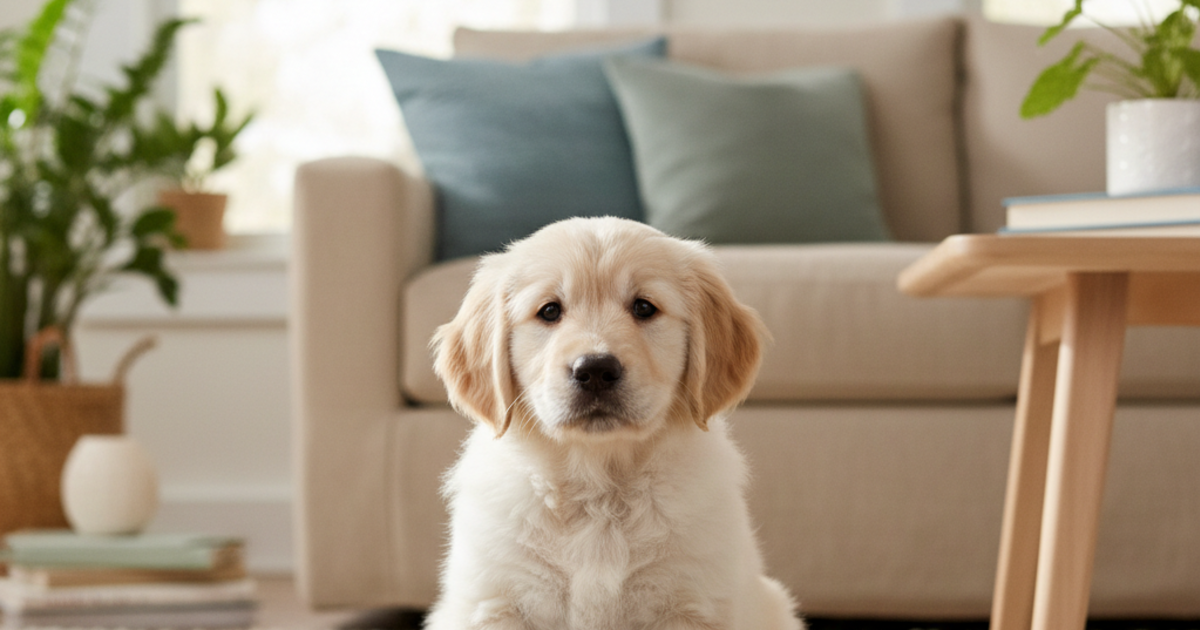
An 8 week old puppy needs four small meals a day of a complete-and-balanced puppy food, 18-20 hours of sleep, frequent potty trips (every 1-2 hours while awake), a first vet visit within a few days and gentle, positive training. Keep it safe from unvaccinated dogs until your vet says it is protected, and socialize carefully in controlled settings.
Eight weeks is when most puppies leave their litter and arrive in new homes. It is exciting, exhausting and full of firsts: first night alone, first vet visit, first accidents on the rug. The habits you set in these early weeks shape your puppy's behavior and health for years. This guide explains what an 8 week old puppy is like, how much and how often to feed, how much sleep to expect, a sample daily schedule, first vet visits and vaccines, potty training, crate training, socialization, biting, safety and what to expect in the weeks ahead. To work out portions, use the dog food calculator by weight and age.
What an 8 week old puppy is like
| Feature | Typical at 8 weeks |
|---|---|
| Weight | Varies by breed: toy breeds 1-3 lb, small 3-8 lb, medium 8-20 lb, large 15-25 lb, giant 20-30 lb |
| Teeth | All baby (deciduous) teeth are in, and they are sharp |
| Sleep | 18-20 hours a day, in short stretches |
| Bladder control | Very limited, about 1-2 hours while awake |
| Attention span | Very short, so keep training to 2-5 minute sessions |
| Learning | Highly receptive to new experiences, in a key socialization window |
| Immune system | Maternal antibodies are fading, so vaccines are essential |
Feeding an 8 week old puppy
Puppies grow fast and need frequent meals of a food made for growth.
- Choose a complete-and-balanced puppy food (or an AAFCO "growth" or "all life stages" statement). For large breeds, choose a large-breed puppy formula.
- Feed four meals a day, spaced evenly, for example 7am, 11am, 3pm and 7pm.
- Measure portions by calories, not by eye.
- Keep the food the same as the breeder or shelter used for the first few days, then change gradually over 7-10 days if you want to switch.
- Provide fresh water at all times, but pick it up an hour or two before bedtime to reduce overnight accidents.
- Pick up uneaten food after 15-20 minutes.
Worked example: how much to feed
A 5 kg (11 lb) puppy at 8 weeks.
- Resting energy: RER = 70 × 5^0.75 = 70 × 3.34 = about 234 kcal.
- Puppy factor of about 3 (up to 4 months): 234 × 3 = about 700 kcal per day.
- If the puppy food is 400 kcal per cup: 700 ÷ 400 = about 1.75 cups per day.
- Split into four meals of about 0.45 cup each.
- Check the label's feeding guide and compare, since foods vary.
- Weigh your puppy weekly and adjust the portion as it grows. Keep your puppy lean, with ribs easily felt but not seen.
Use the dog food calculator by weight and age for a quick estimate.
Sleep: how much is normal?
Young puppies sleep about 18-20 hours a day. They play hard for short bursts, then crash.
- Provide a quiet, safe sleeping spot, such as a crate or pen with a soft bed.
- Do not wake a sleeping puppy for play.
- Use naps. An overtired puppy becomes cranky, mouthy and hyperactive.
- Expect nighttime wake-ups to pee, usually every 2-4 hours at first.
Sample daily schedule
| Time | Activity |
|---|---|
| 6:30 am | Wake, potty immediately, then praise |
| 7:00 am | Breakfast, then potty |
| 7:30 am | Short play or training |
| 8:00 am | Nap in crate or pen |
| 10:30 am | Potty, play |
| 11:00 am | Lunch, then potty |
| 12:00 pm | Nap |
| 2:30 pm | Potty, short training |
| 3:00 pm | Meal, then potty |
| 4:00 pm | Nap |
| 6:00 pm | Potty, play, gentle socialization |
| 7:00 pm | Dinner, then potty |
| 8:00 pm | Calm play, last water |
| 10:00 pm | Final potty, bed |
| 2:00 am | Potty if the puppy wakes, quiet, no play |
Adjust to your own household, but keep the structure consistent.
First vet visit and vaccines
Schedule a vet visit within the first few days, even if the breeder or shelter has given first vaccines. Bring any records.
| Age | Typical care |
|---|---|
| 6-8 weeks | First DHPP (distemper, adenovirus, parvovirus, parainfluenza), deworming |
| 10-12 weeks | DHPP booster, possibly leptospirosis, Bordetella, Lyme depending on location |
| 14-16 weeks | Final DHPP booster, rabies (by law at 12-16 weeks in many places) |
| 6-12 months | Spay or neuter timing, based on breed and vet advice |
Ask your vet about flea, tick and heartworm prevention suitable for puppies, and microchipping. Until your puppy has completed its vaccine series, avoid dog parks, pet stores and other places with unknown dogs. Many vets still encourage safe socialization in controlled settings, such as at home with healthy, vaccinated dogs and in clean, private spaces.
Potty training basics
Puppies cannot hold their bladder long. A rough guide is one hour per month of age plus one, so an 8 week old puppy needs a break every 2-3 hours at most, and more often when awake.
- Take your puppy out first thing in the morning, after every meal, after waking from naps, after play and before bed.
- Use the same spot and a cue word, such as "go potty."
- Praise and reward immediately after the puppy finishes, within a few seconds.
- Supervise closely indoors. Use a leash, a pen or a crate when you cannot watch.
- Do not punish accidents. Interrupt calmly if you catch it, take the puppy outside and clean the spot with an enzymatic cleaner.
- Expect setbacks. Most puppies take weeks to months to be reliable.
Crate training
A crate gives your puppy a safe den and helps with house-training.
- Choose a crate just big enough to stand, turn and lie down in.
- Make it positive with treats, toys and meals inside.
- Start with short periods and build up gradually.
- Never use the crate as punishment.
- Place it near you at night at first to reduce stress, and move it gradually.
- Do not leave a young puppy in a crate longer than it can hold its bladder, usually 2-3 hours during the day.
First nights
Crying is normal. Your puppy has left its littermates for the first time.
- Keep the crate in your bedroom for the first few nights.
- Offer a warm, safe comfort item, such as a blanket that smells like the litter, with no loose parts to swallow.
- Do a final potty trip right before bed.
- Take the puppy out when it wakes to pee, without turning on bright lights or playing.
- Avoid giving in to crying with long play sessions, but check that the puppy is not in need of a potty break.
Socialization
The window between about 3 and 14 weeks is crucial for building confidence.
- Introduce new sights, sounds, surfaces and people gradually, with treats and calm encouragement.
- Arrange meetings with healthy, vaccinated adult dogs in safe spaces.
- Get the puppy used to handling: paws, ears, mouth and gentle brushing.
- Take car rides and short outings in a carrier or your arms to see the world while avoiding the ground in high-risk places.
- Consider a puppy class that requires vaccines and has good hygiene.
- Keep experiences positive and stop if your puppy seems scared.
Biting and mouthing
Puppies explore with their mouths, and those baby teeth are sharp.
- Redirect to an appropriate chew toy.
- Stop play briefly if teeth touch skin, then resume when calm.
- Provide plenty of chew toys, including frozen ones for teething.
- Avoid rough play that encourages biting.
- Do not hit or yell, which can frighten the puppy and worsen behavior.
- Ensure enough sleep, because overtired puppies bite more.
Basic training to start this week
- Name recognition. Say the name, reward eye contact.
- Sit. Lure with a treat above the nose, reward when the bottom touches the ground.
- Come. Reward every time the puppy comes to you, never call it for something unpleasant.
- Settle on a mat.
- Handling and grooming.
Keep sessions to 2-5 minutes, a few times a day, using tiny, soft treats from the daily food allowance.
Puppy-proofing your home
- Hide electrical cords and use cord covers.
- Remove or secure toxic plants, chemicals, medications and small objects.
- Keep shoes, socks and kids' toys out of reach.
- Use baby gates or a pen to restrict areas.
- Secure trash cans.
- Keep human foods that are toxic to dogs out of reach: chocolate, grapes, raisins, onions, garlic, xylitol and macadamia nuts.
Common health concerns at 8 weeks
- Parasites: roundworms, hookworms and giardia are common.
- Parvovirus: deadly, so avoid exposure until vaccinated.
- Kennel cough and other respiratory infections.
- Hypoglycemia in toy breeds.
- Diarrhea from stress or diet changes.
- Congenital problems such as heart murmurs or hernias, which your vet can check.
Warning signs: call your vet
- Lethargy or weakness
- Vomiting or diarrhea, especially bloody or repeated
- Refusing to eat for more than a few hours (toy breeds sooner)
- Coughing, sneezing or discharge
- Pale gums or swollen belly
- Trembling, stumbling or seizures
- Straining to urinate or defecate
For suspected poisoning, call the ASPCA Animal Poison Control Center at 888-426-4435 or the Pet Poison Helpline at 855-764-7661 (fees may apply).
What comes next
- 10-12 weeks: more vaccines, longer play sessions, house-training improving.
- 3-4 months: teething begins, with adult teeth coming in.
- 4-6 months: adolescent behavior may start, with testing of boundaries.
- 6-12 months: spay or neuter decisions, continued training.
When to call your vet
Call your vet within the first few days for a health exam, and any time your puppy shows warning signs. Puppies can go downhill quickly, so do not wait if something seems wrong.
The bottom line
At 8 weeks, your puppy needs four measured meals, lots of sleep, frequent potty trips, careful socialization and a first vet visit. Keep training short and positive, protect your puppy until vaccinated and be patient. Calculate portions with the dog food calculator by weight and age.
Frequently asked questions
PawCalculator Editorial
We combine veterinary references, published guidelines, and calculator-grade modeling. This article is for education, not a substitute for an exam.
+ Follow on PawTalk