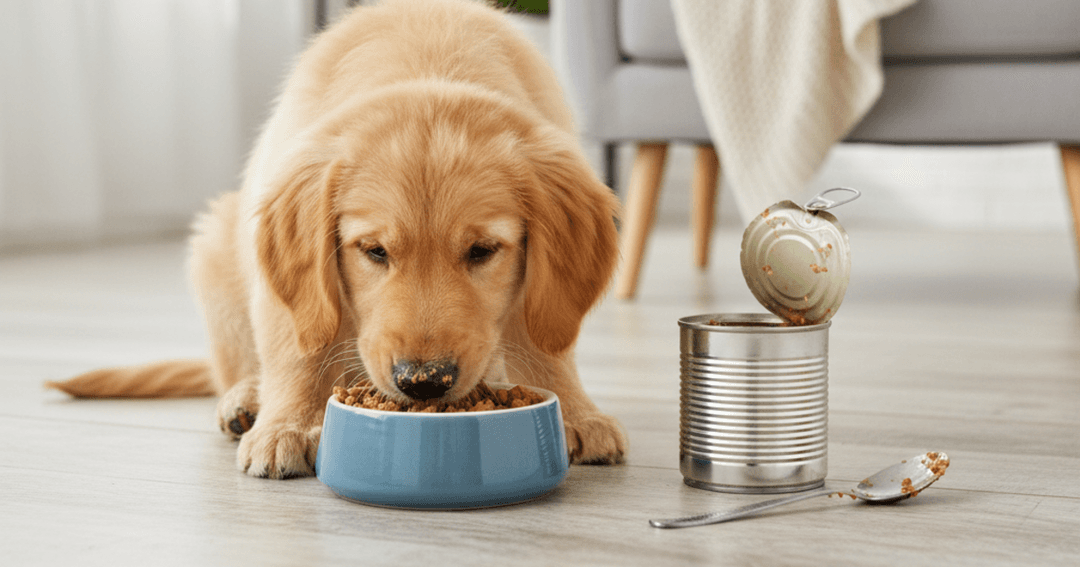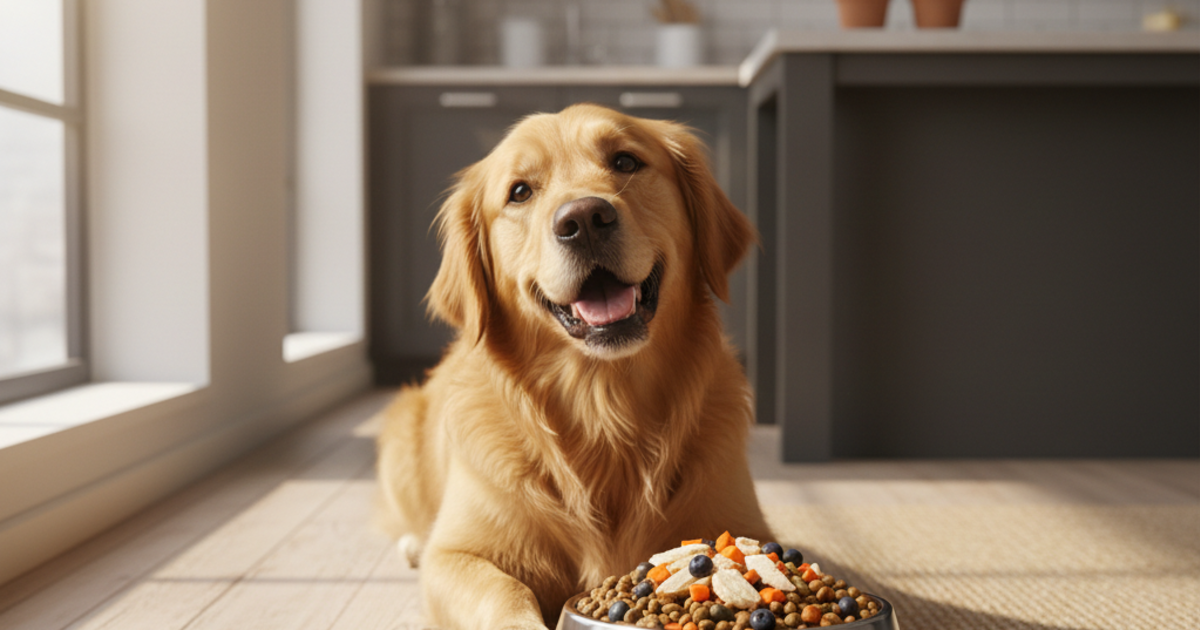
A good topper can make kibble more appealing, but it adds calories. Keep toppers to about 10% of your dog's daily calories, choose safe options such as plain cooked meat, vegetables or a spoonful of wet food, and reduce the kibble slightly so your dog stays lean.
Toppers are one of the easiest ways to help a fussy dog eat, add moisture to dry food or simply make mealtime more fun. The risk is that a "little extra" quickly becomes a lot, especially for small dogs. This guide covers why toppers work, safe topper ideas, foods to avoid, how to count the calories, how to adjust the bowl and how to fade toppers once your dog is eating well. Work out your dog's daily target with the dog calorie calculator first.
Why use a topper?
- Picky eating: a strong smell or new texture can restart a dog's interest.
- Hydration: warm water or broth softens kibble and adds moisture.
- Medication or supplements: a spoonful of topper can hide a pill.
- Variety: some dogs lose interest in the same bowl every day.
- Older dogs: reduced smell and dental problems can make dry kibble less appealing.
- Slowing down fast eaters: a moist topper mixed through kibble makes gulping harder.
If your dog suddenly refuses food, rule out illness first. A sudden loss of appetite is a health signal, not a flavor problem.
Safe topper ideas
| Topper | Why it works | Calorie note |
|---|---|---|
| Warm water or low-sodium broth | Releases aroma and adds moisture | Very low, check no onion or garlic |
| Plain cooked chicken, turkey or lean beef | Strong smell and flavor | About 40-50 kcal per ounce |
| A spoonful of the same brand's wet food | Keeps the diet balanced | Counts toward daily calories |
| Plain pumpkin puree (not pie filling) | Adds fiber and moisture | Low, about 10 kcal per tablespoon |
| Green beans, carrots or blueberries | Low-calorie crunch and fiber | Very low |
| Plain scrambled or boiled egg | Protein and flavor | About 70 kcal per large egg |
| Plain unsweetened yogurt or cottage cheese | Palatable for many dogs | Small amounts only, skip if dairy-sensitive |
| Freeze-dried meat crumbled over the bowl | Intense smell | High per piece, measure carefully |
| Commercial dog food toppers or meal enhancers | Convenient and flavorful | Check calories per serving |
| Sardines packed in water, no added salt | Omega-3s and strong smell | About 25 kcal each for small ones, use sparingly |
What to avoid
Never top a bowl with onions, garlic, chives, grapes, raisins, chocolate, macadamia nuts, xylitol-sweetened foods, alcohol or cooked bones. Skip fatty trimmings, heavily seasoned leftovers and fried foods, which can trigger pancreatitis. Check any sauce or broth label for onion, garlic and high sodium. Be careful with peanut butter and check that it contains no xylitol.
The 10% rule
Treats and toppers together should stay at or below about 10% of daily calories, with the remaining 90% coming from a complete-and-balanced diet. A topper that adds more than that can unbalance the diet and add weight.
Worked example
A 10 kg (22 lb) neutered adult dog.
- Resting energy: RER = 70 × 10^0.75 = 70 × 5.62 = about 394 kcal.
- Daily need: 394 × 1.6 (neutered adult) = about 630 kcal.
- Topper budget (10%): about 63 kcal.
- Choose toppers within budget: for instance 1 oz plain cooked chicken (about 45 kcal) plus a tablespoon of pumpkin (about 10 kcal) is 55 kcal.
- Reduce the kibble: if the kibble is 350 kcal per cup, 55 kcal is about 0.16 cup, so trim roughly 2.5 tablespoons.
- Reweigh monthly and adjust if your dog gains or loses.
For a 4 kg toy dog the same logic applies, but the 10% budget is only about 35 kcal, so even one egg is too much.
Topper budget by dog size
| Dog size | Approx. daily calories | 10% topper and treat budget |
|---|---|---|
| 4 kg (9 lb) | 350 kcal | About 35 kcal |
| 10 kg (22 lb) | 630 kcal | About 63 kcal |
| 20 kg (44 lb) | 1,060 kcal | About 105 kcal |
| 30 kg (66 lb) | 1,435 kcal | About 145 kcal |
Remember that training treats count too, so if you use many treats during the day, your topper budget shrinks.
How to use toppers well
- Start small: introduce one topper at a time so you can spot a reaction.
- Use a measuring spoon, not eyeballed handfuls.
- Mix it in so your dog does not pick out the topper and leave the kibble.
- Keep the base food complete and balanced. Toppers are extras, not the diet.
- Refrigerate fresh toppers and discard anything left out for more than a couple of hours.
- Do not rely on toppers permanently if your dog dislikes the food. Consider changing to a food your dog genuinely enjoys.
- Fade gradually. Once your dog eats reliably, reduce the topper over a week or two so it is not required for every meal.
Toppers for specific dogs
Picky eaters: warm broth or a spoonful of wet food is often enough. Avoid constantly changing toppers, which teaches a dog to hold out.
Overweight dogs: use very low-calorie toppers such as green beans, cucumber or a splash of warm water.
Dogs with allergies or sensitive stomachs: stick to one protein that matches the base diet and introduce changes slowly.
Dogs with medical conditions: ask your vet before adding anything to a prescription or therapeutic diet.
Puppies: stick with a small amount of the same brand's wet food, and avoid anything that unbalances a growth diet.
Common mistakes
- Adding a topper on top of a full portion of kibble
- Using rich, fatty leftovers
- Switching toppers daily
- Forgetting toppers when counting calories
- Using seasoned or onion-containing broth
- Giving too much dairy to a lactose-sensitive dog
When to call your vet
Contact your vet if your dog has vomiting, diarrhea, itching or ear problems after a new topper, refuses food for more than a day, or loses weight. For suspected poisoning, call the ASPCA Animal Poison Control Center at 888-426-4435 or the Pet Poison Helpline at 855-764-7661 (fees may apply).
The bottom line
Toppers are a useful tool when you measure them and trim the bowl to match. Calculate your dog's daily calories with the dog calorie calculator, set a topper budget and keep the main meal complete and balanced.
Frequently asked questions
PawCalculator Editorial
We combine veterinary references, published guidelines, and calculator-grade modeling. This article is for education, not a substitute for an exam.
+ Follow on PawTalk