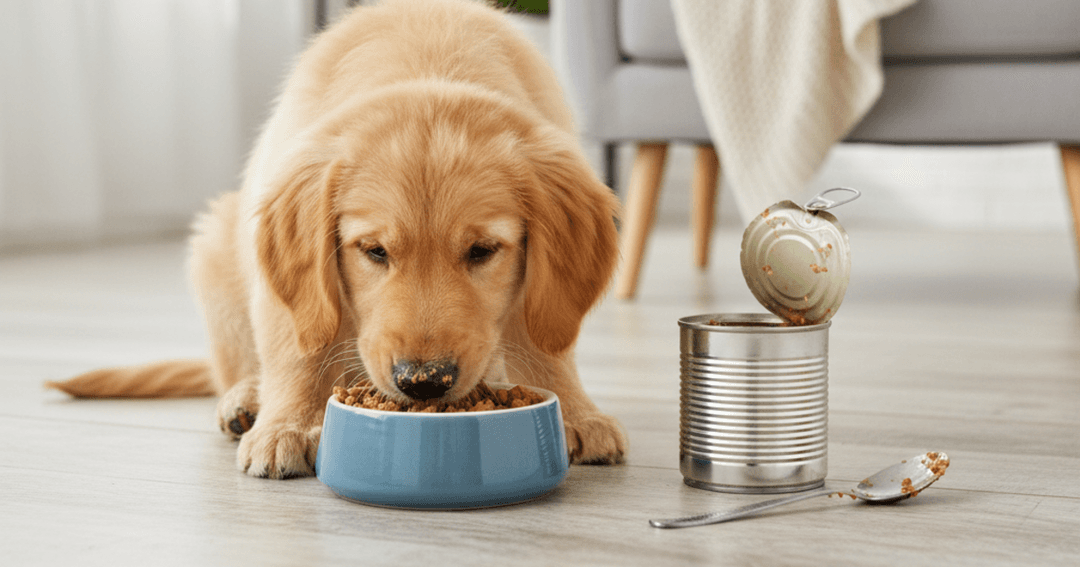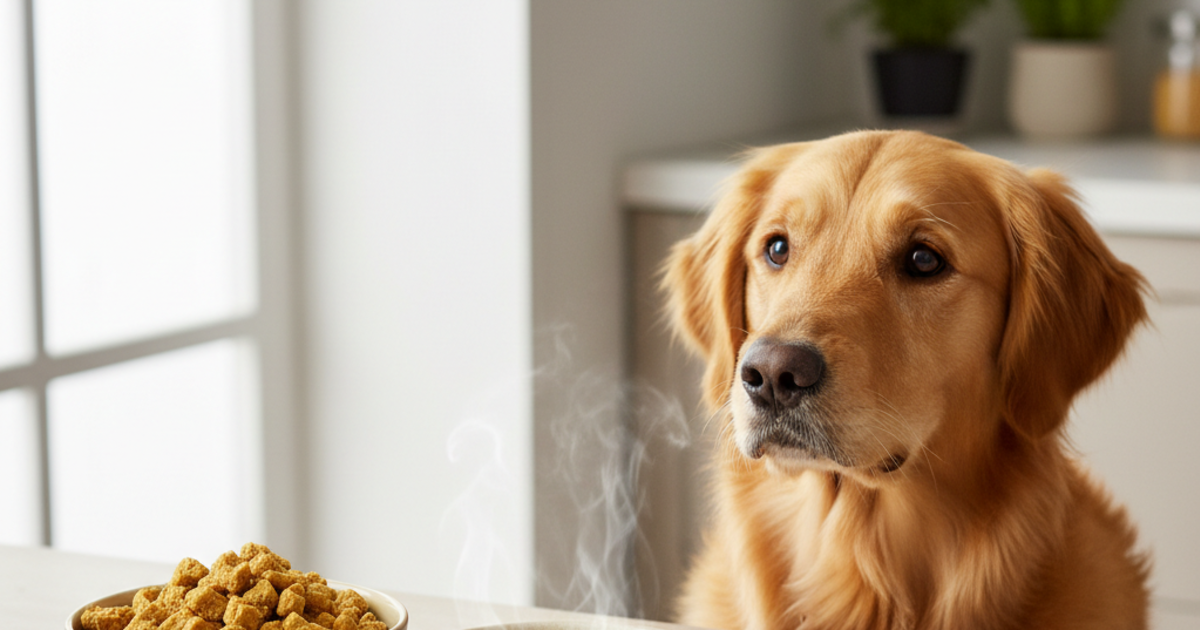
Dehydrated dog food is made by gently removing water from fresh ingredients, leaving a lightweight, shelf-stable product that you usually rehydrate with warm water before serving. It can be palatable and convenient, but it is not automatically healthier than other diets, so check for a complete-and-balanced statement, safe processing and calories per cup or gram.
Dehydrated food sits between kibble and fresh food. It is popular with owners who want less processed ingredients without freezer space or the hassle of cooking. But "dehydrated" covers a wide range of products, from complete diets to toppers, and the details matter. This guide explains what dehydrated dog food is, how it differs from air-dried and freeze-dried foods, the pros and cons, how to rehydrate and portion it, how to switch your dog safely and what to check on the label. Use the dog food calculator to find your dog's daily calories first.
What is dehydrated dog food?
Dehydrated dog food is made by warming ingredients at low temperatures to evaporate most of the water. The result is a light, dry product with a long shelf life. Some formulas are mixed with fruits, vegetables, grains and supplements to make a complete diet, while others are single-ingredient toppers or treats.
Dehydrated vs air-dried vs freeze-dried
| Type | How it is made | Texture | Rehydration |
|---|---|---|---|
| Dehydrated | Warm air removes moisture | Dense, grainy or flaky | Usually needed, using warm water |
| Air-dried | Slow, gentle air drying, often at low heat | Jerky-like pieces | Optional, many dogs eat it dry |
| Freeze-dried | Frozen, then moisture removed under vacuum | Light, crunchy | Often rehydrated, quick to absorb |
| Kibble | Cooked and extruded at high heat | Hard pellets | None |
Different brands use these terms differently, so read the feeding instructions.
Pros of dehydrated dog food
- Palatable. Many dogs find it more appealing than kibble.
- Less processed. Gentle drying can keep more of the original ingredients' character.
- Lightweight and compact. Easy to store and travel with.
- Shelf stable. Long shelf life before opening, with no freezer needed.
- Controllable moisture. You can serve it drier or wetter, which helps dogs that need more water.
- Customizable. It can be mixed with fresh or wet food.
Cons of dehydrated dog food
- Higher cost. It is often more expensive per day than kibble.
- Preparation time. Rehydration takes several minutes.
- Variable quality. Not every product is complete and balanced.
- Bacteria concerns. If it is made from raw ingredients and not treated to reduce pathogens, it can carry Salmonella or Listeria. Choose a product with a documented kill step and handle it carefully.
- Easy to overfeed. A small dry scoop expands with water, so people can misjudge portions.
- Short life after rehydration. Wet food spoils quickly and should not sit out.
What to check on the label
- A complete-and-balanced statement from AAFCO for your dog's life stage, not "for intermittent or supplemental feeding only" unless you plan to use it as a topper.
- Calories per cup or per gram in the dry form, so you can portion.
- Named proteins and a clear ingredient list.
- Processing information, including whether the product is heat-treated or pathogen-tested.
- A qualified nutritionist and quality-control practices you can verify by contacting the company.
- Feeding guidelines with rehydration instructions.
How to rehydrate dehydrated dog food
Follow the package, since ratios differ. A common starting point is about one part food to one to two parts warm water by volume.
- Measure the dry food by weight if possible.
- Add warm (not boiling) water according to the label.
- Stir and wait about 5-10 minutes until the food absorbs the water.
- Check texture: it should be moist and soft, not soupy.
- Serve right away and discard leftovers within the time on the label.
- Wash the bowl after each meal.
Worked example
A 15 kg (33 lb) neutered adult dog.
- Resting energy: RER = 70 × 15^0.75 = 70 × 7.62 = about 533 kcal.
- Daily need: 533 × 1.6 = about 853 kcal.
- If the dry food has 4,000 kcal per kg: 853 ÷ 4.0 = about 213 g of dry food per day.
- Two meals: about 107 g each.
- Rehydrate each meal with about 1.5 times its weight in warm water, so roughly 160 mL per meal, or 320 mL per day.
- Total fed weight per day is about 213 g of food plus 320 mL of water, near 530 g.
- Cost check: if the product costs $9 per pound (illustrative), 213 g is about 0.47 lb, or around $4.20 per day.
Weigh your dog every few weeks and adjust by about 10% if weight drifts. Always use the calories on your actual bag, because densities differ.
How to switch to dehydrated food
- Transition over 7-10 days. Start with about 25% new food and 75% old, increasing every couple of days.
- Watch stool quality and appetite. Soft stool can mean you are going too fast.
- Keep water available. Some dogs drink more on a drier diet.
- Do not mix many changes at once. Avoid introducing new treats during the switch.
Is dehydrated food good for every dog?
- Healthy adult dogs can do well on a complete and balanced dehydrated diet.
- Puppies need a food complete and balanced for growth. Large-breed puppies need a large-breed growth formula.
- Dogs with kidney, liver, pancreatic or heart disease may need prescription diets. Ask your vet.
- Immunocompromised dogs or homes with young children, elderly or ill people should avoid unprocessed raw-derived products because of bacterial risk.
Storage and safety
- Store dry food in a cool, dry place in an airtight container.
- Keep the original bag for the lot number and best-by date.
- Wash hands, bowls and scoops after handling.
- Do not leave rehydrated food out for more than the time on the label, usually under an hour or two.
- Refrigerate any unused rehydrated food promptly and discard it within the time given.
When to call your vet
Contact your vet if your dog has vomiting, diarrhea, weight loss, itching or low energy after a diet change, or if you are considering a diet for a medical condition. For suspected poisoning, call the ASPCA Animal Poison Control Center at 888-426-4435 or the Pet Poison Helpline at 855-764-7661 (fees may apply).
The bottom line
Dehydrated dog food can be a convenient, palatable option when it is complete and balanced and safely processed. Rehydrate as directed, portion by calories rather than by scoop and monitor your dog's weight. Calculate your dog's needs with the dog food calculator before you buy.
Frequently asked questions
PawCalculator Editorial
We combine veterinary references, published guidelines, and calculator-grade modeling. This article is for education, not a substitute for an exam.
+ Follow on PawTalk