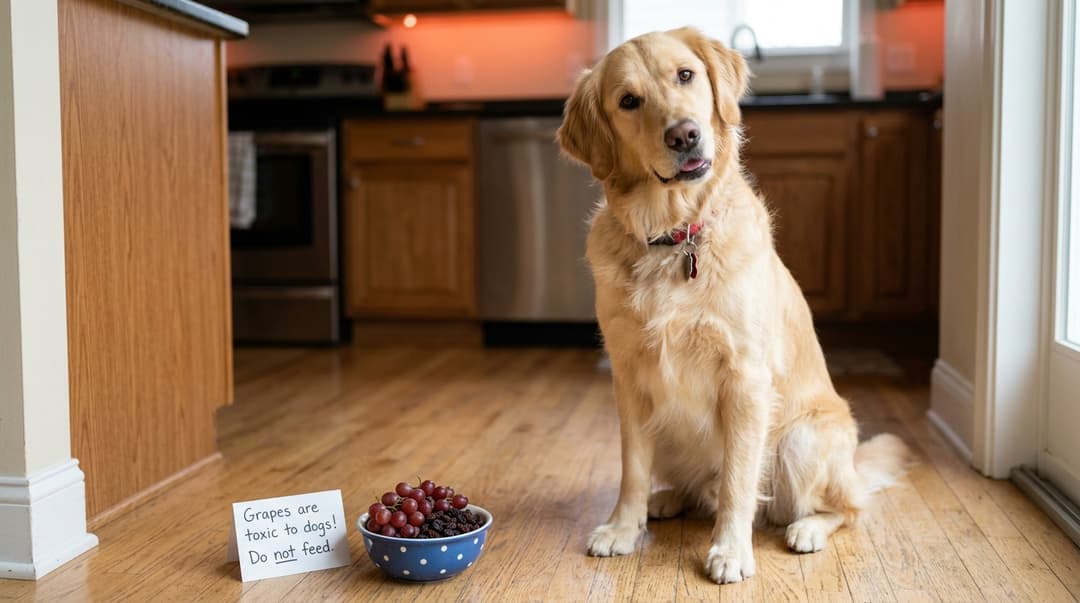
Grape & Raisin Toxicity Calculator for Dogs
Your inputs
Results update live as you type.
Your results
Live — updates as you change inputs.
Grape / raisin exposure
Call your vet now
Risk band
Educational estimate only — not a diagnosis or prescription.
If toxic ingestion is possible, call your vet, an emergency clinic, ASPCA (888) 426-4435, or Pet Poison Helpline (855) 764-7661 (fees may apply).
Do not induce vomiting unless a veterinarian tells you to.
Veterinary reference only
Educational estimate only — not a diagnosis or prescription. If your pet ate something toxic, call your veterinarian, an emergency clinic, or a pet poison line now: ASPCA Animal Poison Control (888) 426-4435 or Pet Poison Helpline (855) 764-7661 (fees may apply).
Keep going with a related calculator.
The short answer: call your vet, and do it now
If your dog has eaten grapes or raisins, call your veterinarian or a poison line now, even if your dog seems fine. Grapes and raisins can cause sudden kidney injury in some dogs, the damage can start before any obvious sign appears, and nobody has found an amount that is reliably safe. The calculator above helps you see how the amount eaten compares with the level Merck describes, and it gives you the 72-hour timeline to watch. It is a decision aid, not a substitute for a vet.
ASPCA Animal Poison Control: (888) 426-4435. Pet Poison Helpline: (855) 764-7661. Both may charge a consultation fee, and that is usually far less than the cost of treating kidney injury later.
What Merck says, and what it means
Merck's veterinary guidance says that more than about one grape or raisin per 4.5 kg (10 lb) of body weight may contain enough tartaric acid to pose a kidney risk in dogs. The calculator uses that ratio as its reference point. It is important to read it correctly:
- It is a warning threshold, not a safe limit. Being under it does not mean the dog is safe.
- Individual dogs react differently. Some show kidney changes after amounts that others tolerate without signs.
- The reason for the weight-based ratio is simple arithmetic: a small dog has less body mass to spread the same amount of the compound across. The effect on the kidney is not something that can be predicted to a precise number.
Because the tool compares a total amount against body weight, the same handful of raisins can be a very different situation for a Chihuahua than for a Labrador.
Worked examples
Example 1: a 5 lb (2.3 kg) Chihuahua. The Merck ratio gives a threshold of about half a grape for a dog this size. One grape is already above it. This dog should be seen by a vet urgently, even if it seems fine.
Example 2: a 50 lb (22.7 kg) Labrador. The ratio gives a threshold of about five grapes. Five raisins sits right at the threshold, which is still a call-the-vet situation because the sensitivity varies, and because a raisin is a concentrated form of the fruit. The owner should call anyway.
Example 3: an unknown amount. You find an empty bag of trail mix, and you cannot tell how many raisins were in it. Treat this as unknown exposure. Use the calculator with your best estimate on the high side, and call a vet or poison line. Tell them the brand and ingredients if you can see the packaging.
These examples are to show how the threshold works, not to suggest that a small amount is fine. Any confirmed ingestion warrants a call.
What to do in the first hour
- Remove any remaining grapes or raisins from your dog's reach, and check the floor and the dog's mouth.
- Note the amount and the time. An estimate is fine. Write down what the food was, the number of grapes or raisins, and the time they were eaten.
- Weigh your dog if you can, or use the most recent weight from the vet.
- Call a vet or a poison line. Tell them the weight, the amount, and the time. Do not induce vomiting at home unless a vet or poison line tells you to. Home methods can cause harm, and the timing matters.
- Follow the advice. A vet may ask you to bring your dog in, may tell you to watch at home, or may induce vomiting if the ingestion was recent.
What the vet will likely do
Treatment depends on how much was eaten, how long ago, and the dog's condition. Common steps include:
- Decontamination, such as inducing vomiting, if the dog was seen soon after eating.
- Bloodwork and urinalysis to check kidney function. Markers such as creatinine and BUN are followed over the first few days.
- IV fluids to support the kidneys, often for 48 to 72 hours.
- Monitoring of urine output, which can drop when kidney injury develops.
Activated charcoal is sometimes used, but it does not guarantee protection, so ask the vet whether it fits your dog's situation. Early treatment generally gives better outcomes, which is why the calculator emphasises prompt action over waiting for symptoms.
Timeline: what to expect and when
- First few hours: vomiting, diarrhoea, drooling, lethargy, or reduced appetite are the common early signs. Some dogs show nothing at this stage.
- 12 to 24 hours: abdominal pain, weakness, and changes in drinking can appear. Urine output may start to fall.
- 24 to 72 hours: the window in which kidney injury is most often confirmed. Reduced or absent urination, dehydration, and rising kidney markers are the main signs. This is why the 72-hour timeline matters.
- After 72 hours: the vet will decide whether the dog needs longer monitoring, and whether the kidneys are recovering.
A dog that looked normal in the first hour is not automatically in the clear. Keep the vet informed through the full window.
Where grapes and raisins hide
- Trail mix and granola: often contains raisins, sometimes alongside chocolate, which is a second problem.
- Baked goods: fruit cake, hot cross buns, scones, and some breads.
- Breakfast cereals: raisin bran and similar products.
- Fruit salads, grape juice, and some sauces.
- Baby food pouches, which occasionally include raisin or grape purée.
- Cats and other pets can be exposed in the same way, but the advice in this guide is for dogs.
Keep bags on counters and in cupboards the dog cannot reach, and check labels when sharing food.
What about currants and other fruits?
Merck notes that true currants (Ribes species) have not been linked to the same kidney injury. Cream of tartar has been discussed as a tartaric acid source, so treat it with the same caution as grapes if a dog has eaten a meaningful amount. If you are unsure whether a fruit is a grape-type product, call a vet, because a mislabelled product can cause confusion.
Why this is not a safe-amount tool
Owners often look for a "how many grapes are toxic" number, and that is understandable. The honest answer is that the Merck figure is a warning level. Sensitivity is not predictable from weight alone, and kidney injury can develop even when the amount looks small. The calculator is designed to show you how close you are to the threshold and how urgent the situation is, not to tell you what is safe.
Related tools and guides
- Onion & Garlic Toxicity Calculator, for the other common kitchen toxins
- Xylitol Toxicity Calculator, for sugar-free products
- Dog Chocolate Toxicity Calculator, since trail mix often contains chocolate too
- Food Safety Checker, for "can dogs eat" questions
- Toxicity Calculators hub, for the full set
Questions about this calculator
There is no reliable lethal number. Merck's guidance is that more than about one grape or raisin per 4.5 kg (10 lb) of body weight may pose a kidney risk, and some dogs have been affected by much smaller amounts. Because sensitivity varies between individuals, a death threshold is not a safe guide. Any confirmed ingestion should be discussed with a vet or poison line.
The math, openly documented.
Weight & exposure
Pet weight and amount/product determine dose.
weight_kg · amount
Dose estimate
Compare with published veterinary thresholds.
dose = amount ÷ kg
Risk band
Map to call-vet / urgent / emergency actions.
band = tier(dose)
Action
Call vet or poison control — do not wait for symptoms.
ASPCA · Pet Poison Helpline
More from Health

Xylitol Toxicity Calculator for Dogs
Xylitol poisoning in dogs? Enter weight and the gum, mint or peanut butter amount eaten to see the risk band. Call a vet
Open tool
Onion & Garlic Toxicity Calculator
how much onion powder is toxic to dogs: How much onion powder, onion or garlic is toxic to your dog or cat? Enter weight
Open tool
Toxicity calculators — check exposure by weight
dog toxicity calculator: Free toxicity calculators for dogs and cats — chocolate, grapes/raisins, xylitol, onion/garlic,
Open toolArticles from Insights



Got an edge case the calculator can't handle?
247 active threads about dog nutrition right now. Verified vets and experienced owners answer within hours.