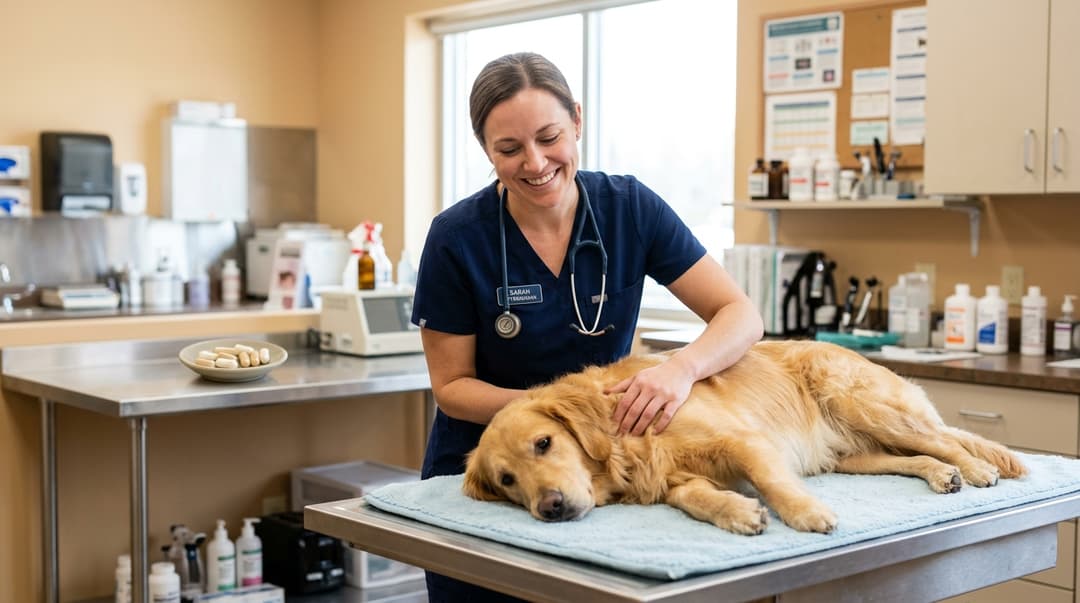
Apoquel Dosing Chart for Dogs by Weight
Your inputs
Results update live as you type.
Your results
Live — updates as you change inputs.
Apoquel (oclacitinib) label reference
7.3–10.9 mg (0.4–0.6 mg/kg)
Label dose per administration
Schedule
Twice daily for up to 14 days, then once daily maintenance
Tablet strength selected
16 mg — match your prescribed tablet
Prescription only. Tell your vet about infections, tumours, or other medicines.
Not evaluated for breeding, pregnant or lactating dogs per product labeling/VCA cautions.
Veterinary reference only
Prescription only. Not for dogs under 12 months per label.
Keep going with a related calculator.
What the Apoquel label says for dogs
Apoquel (oclacitinib) is a prescription medicine for controlling itch and allergic dermatitis in dogs at least 12 months old. The FDA labeling uses 0.4 to 0.6 mg per kg per dose, twice daily for up to 14 days, then once daily for maintenance at the same dose range. The calculator above converts your dog's weight into the label range and shows the tablet options that make up that dose.
This page is a label-range reference for understanding a prescription. It is not a reason to start the drug without a vet's diagnosis. Itch can come from fleas, infections, food reactions or other skin conditions, and Apoquel is only one part of a plan. Your vet should rule those out before choosing a long-term approach.
Worked example: a 50 lb dog
A 50 lb dog weighs about 22.7 kg. The label range is 0.4 × 22.7 = about 9 mg per dose at the low end, and 0.6 × 22.7 = about 14 mg per dose at the high end. Your vet will round to the nearest tablet strength and choose the number of tablets, which is why the calculator lists the options rather than a single figure.
The label describes two phases. The first is twice daily for up to two weeks. The second is once daily for maintenance. A prescription that matches that structure is the standard pattern. If your vet has chosen a different plan, ask them to explain the difference.
A 20 lb (9.1 kg) dog at the same mg/kg range would be about 3.6 to 5.4 mg per dose, which again shows why weight drives the arithmetic.
What the calculator does not tell you
- Whether Apoquel is the right drug for your dog's itch, which requires a diagnosis.
- How long before improvement to expect. Many dogs respond within days, but the full effect varies from dog to dog.
- Whether your dog can have vaccines or other medicines at the same time. Ask your vet about timing before any vaccine or lab test.
- Whether the dog needs other treatment for flea control, infection or diet, which often matter as much as the tablet.
Before you start
Your vet will usually check for fleas, mites, and bacterial or yeast infections before starting Apoquel. They may ask about diet, flea control, previous treatments and how long the itch has been going on. If your dog has an infection, treating it first often gives better results.
Tell your vet about every medicine and supplement, and about any history of cancer, infection or vaccination reactions. The label gives specific cautions, and your vet is the right person to weigh them against your dog's history.
Side effects to watch for
The label and published studies report vomiting, diarrhoea, lethargy, changes in appetite, and increased thirst and urination. These are worth a call to the vet, especially if they persist beyond the first days.
Apoquel reduces part of the immune response, so the label warns about infections and about lymph node enlargement or unusual lumps. Contact your vet if your dog develops fever, a new skin infection, swollen lymph nodes, or any lump that does not go away.
Ask your vet whether they want bloodwork before starting and at follow-up visits, since the monitoring plan depends on your dog's history.
Stopping and restarting
Do not stop or change the dose without talking to your vet, because itch can return quickly. If you miss a dose, give it when you remember unless it is close to the next one. Do not double the next dose. If the itch returns after stopping, the vet may want to look again at the underlying cause rather than simply restarting the same plan.
Itch from other causes
Itch is a symptom with many possible causes. Fleas are the most common cause and must be controlled for any itch treatment to work. Bacterial or yeast infections often need their own treatment. Food reactions and environmental allergies can be managed with diet trials or allergy testing. A vet can help sort these out, and the answer changes the medicine you need.
Storage and handling
Store tablets in their original labelled container, out of reach of children and other pets. Wash your hands after handling the tablets, and keep them away from food preparation areas. If a tablet is accidentally swallowed by a person, contact a doctor or poison centre.
Related tools and guides
- Benadryl Dosage Calculator for antihistamine information
- Cephalexin Dosage Calculator for skin infection antibiotics
- Prednisone Dosage Calculator
- Toxicity Calculators hub
Emergency or unsure?
Call your vet or ASPCA Animal Poison Control — available 24/7.
Questions about this calculator
For a 50 lb (22.7 kg) dog, the label range is 0.4 to 0.6 mg per kg per dose, which works out to roughly 9 to 14 mg per dose. Tablets come in several strengths, so your vet will choose the strength and the number of tablets. Use the calculator for the range, then follow your vet's written directions.
The math, openly documented.
Inputs
Weight, use case, and product strength where relevant.
weight · tablet_mg · use
Formula
Published veterinary reference dosing math.
dose = f(weight_kg)
Output
Reference range with safety notes.
mg · tablets · frequency
Disclaimer
Not a prescription — vet confirmation required.
reference only
More from Health
Dog Medication Dosage Reference Hub
Hub for all dog medication reference tools.
Open tool
Benadryl Dosage for Dogs, By Weight
Weight-based diphenhydramine reference with tablet conversion.
Open tool
Understanding Meloxicam Dosing for Dogs
NSAID loading and maintenance dose reference.
Open toolArticles from Insights



Got an edge case the calculator can't handle?
247 active threads about dog nutrition right now. Verified vets and experienced owners answer within hours.