Understanding Meloxicam Dosing for Dogs
Your inputs
Results update live as you type.
Your results
Fill in the form to see your estimate.
Ready when you are
Fill in the form to see your reference estimate
Veterinary reference only
Product/legal decision point: consider showing the formula only (no bolded final number) to avoid the page reading as a standalone dosing source. Loop in your vet board before shipping.
Keep going with a related calculator.
Understanding Meloxicam Dosing for Dogs
Meloxicam (brand name Metacam) is a commonly prescribed NSAID for canine pain and inflammation, and its dosing is weight-based like most veterinary medications — the standard labeled protocol for dogs is a higher loading dose on day one (commonly cited around 0.2 mg/kg) followed by a lower daily maintenance dose (commonly around 0.1 mg/kg), given with food to reduce GI irritation. This tool exists to help you understand why your vet's prescribed dose is what it is and to catch obvious math errors — it is not a substitute for your vet's specific instructions, which may differ based on your dog's condition, kidney/liver function, or concurrent medications. Never use this to dose a dog without an active veterinary prescription, and never use dog-formulated meloxicam on cats — feline dosing is dramatically different and errors are frequently fatal.
How to use this calculator
Enter your dog's weight to see the standard day-one loading dose alongside the lower daily maintenance dose that follows it.
Reference dosing by weight
| Dog weight | Day 1 loading dose (~0.2 mg/kg) | Maintenance dose (~0.1 mg/kg/day) |
|---|---|---|
| 10 lb (4.5 kg) | ~0.9 mg | ~0.45 mg |
| 20 lb (9 kg) | ~1.8 mg | ~0.9 mg |
| 40 lb (18 kg) | ~3.6 mg | ~1.8 mg |
| 60 lb (27 kg) | ~5.4 mg | ~2.7 mg |
| 80 lb (36 kg) | ~7.2 mg | ~3.6 mg |
| 100 lb (45 kg) | ~9 mg | ~4.5 mg |
Meloxicam oral suspension (commonly 1.5 mg/mL for dogs) makes these small figures easy to measure precisely with the dosing syringe provided — always use the syringe that came with the prescription rather than a kitchen measuring spoon.
Understanding your results
The loading dose is higher only on day one; giving the loading-dose amount every day instead of stepping down to maintenance is a common at-home dosing error and raises GI risk without added benefit. Always give meloxicam with food — NSAIDs like meloxicam work by inhibiting prostaglandins, which among other things protect the stomach lining, so dosing on an empty stomach meaningfully increases ulcer risk. Watch for vomiting, dark or tarry stool, or reduced appetite, which can signal GI irritation and warrant a call to your vet.
Why the maintenance dose is exactly half the loading dose. This isn't arbitrary — the loading dose front-loads the medication to reach a steady, therapeutic blood concentration faster than daily maintenance dosing alone would achieve, then maintenance dosing sustains that level without continuing to build up further. Doubling up on day two undermines the reason for having a maintenance dose at all.
Long-term use needs periodic monitoring. Dogs on meloxicam for chronic conditions (arthritis is the most common) are typically monitored with periodic bloodwork checking kidney and liver values, since NSAIDs are processed through both — this is routine vet-directed monitoring, not a sign the medication itself is inherently risky at the prescribed dose.
Managing chronic arthritis pain with meloxicam long-term
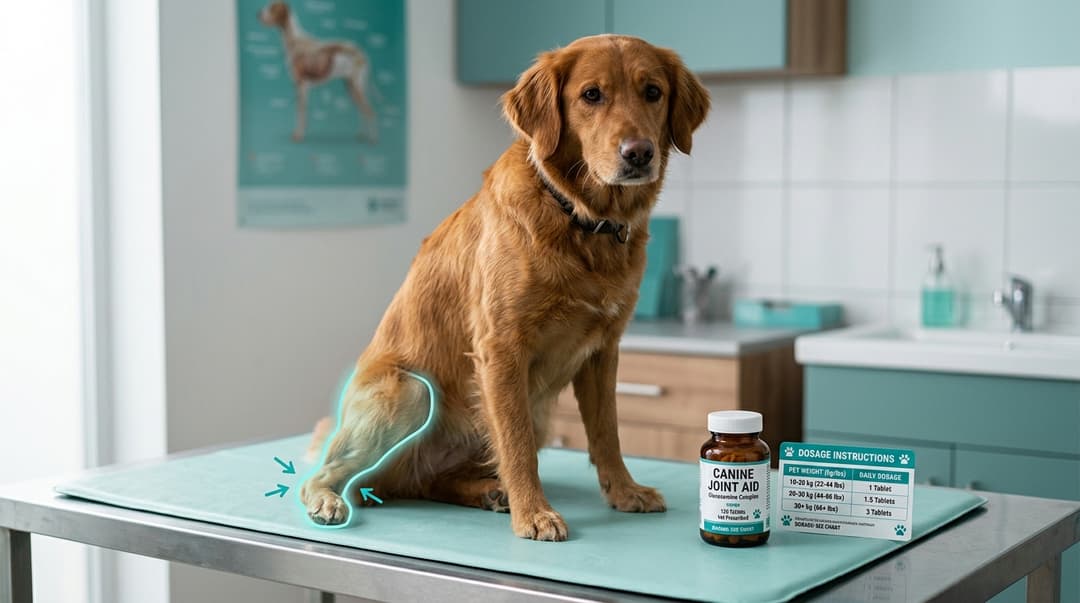
For the large share of dogs prescribed meloxicam for ongoing arthritis management rather than a short acute course, thinking about the medication as one part of a broader joint-care approach rather than a standalone fix tends to produce better long-term outcomes. Weight management is the single highest-leverage complementary factor — every extra pound of body weight adds measurable mechanical stress to already-compromised joints, and dogs that reach a healthier body condition alongside their medication often need lower doses or experience better pain control than medication alone would provide on an overweight frame. Joint supplements (glucosamine/chondroitin combinations are the most commonly used) work through a different mechanism than an NSAID and are frequently used alongside meloxicam rather than as a replacement for it — think of them as supporting cartilage health over the longer term while meloxicam manages active inflammation and pain in the present. Moderate, consistent low-impact exercise (controlled leash walks, swimming) also plays a role, since joints that move regularly within a comfortable range tend to maintain function better than joints that are either overworked or left completely immobile.
Recognizing when the current dose needs reassessment
A dose that worked well initially doesn't necessarily stay optimal indefinitely, and knowing what prompts a reassessment conversation with your vet helps catch a mismatch before it becomes a bigger problem. If your dog's pain or stiffness seems to be returning at a dose that previously controlled it well, that's worth mentioning rather than assuming the medication has simply "stopped working" — sometimes it reflects disease progression rather than a dosing issue, and your vet may explore a dose adjustment, a combination approach, or further diagnostic workup. Conversely, any new GI symptoms, increased thirst or urination beyond what's typical, or unusual lethargy at a previously well-tolerated dose should also prompt a check-in, since individual tolerance can shift over time, particularly as a dog ages and kidney or liver function naturally changes. Regular bloodwork monitoring, already standard practice for long-term NSAID use, is what actually catches these shifts early, which is part of why skipping recommended monitoring appointments removes an important safety check even if your dog seems to be doing fine day-to-day.
When to consult a professional
For health, dosage, or nutrition decisions, always confirm calculator output with your veterinarian. This tool provides reference estimates, not medical advice.
Read the full guide
- Meloxicam for Dogs: Dosage Chart, Uses, and Side Effects — the complete write-up, including long-term monitoring guidance and interactions with other medications.
Emergency or unsure?
Call your vet or ASPCA Animal Poison Control — available 24/7.
Questions about this calculator
A higher first dose gets the medication to a therapeutic level in the bloodstream faster; NSAIDs like meloxicam accumulate more slowly at maintenance doses alone.
The math, openly documented.
Inputs
Weight, use case, and product strength where relevant.
weight · tablet_mg · use
Formula
Published veterinary reference dosing math.
dose = f(weight_kg)
Output
Reference range with safety notes.
mg · tablets · frequency
Disclaimer
Not a prescription — vet confirmation required.
reference only
More from Health
Dog Medication Dosage Reference Hub
Hub for all dog medication reference tools.
Open tool
Benadryl Dosage for Dogs, By Weight
Weight-based diphenhydramine reference with tablet conversion.
Open tool
Trazodone Dosage for Dogs, By Weight
Situational anxiety dose range by weight.
Open toolArticles from Insights



Got an edge case the calculator can't handle?
247 active threads about dog nutrition right now. Verified vets and experienced owners answer within hours.