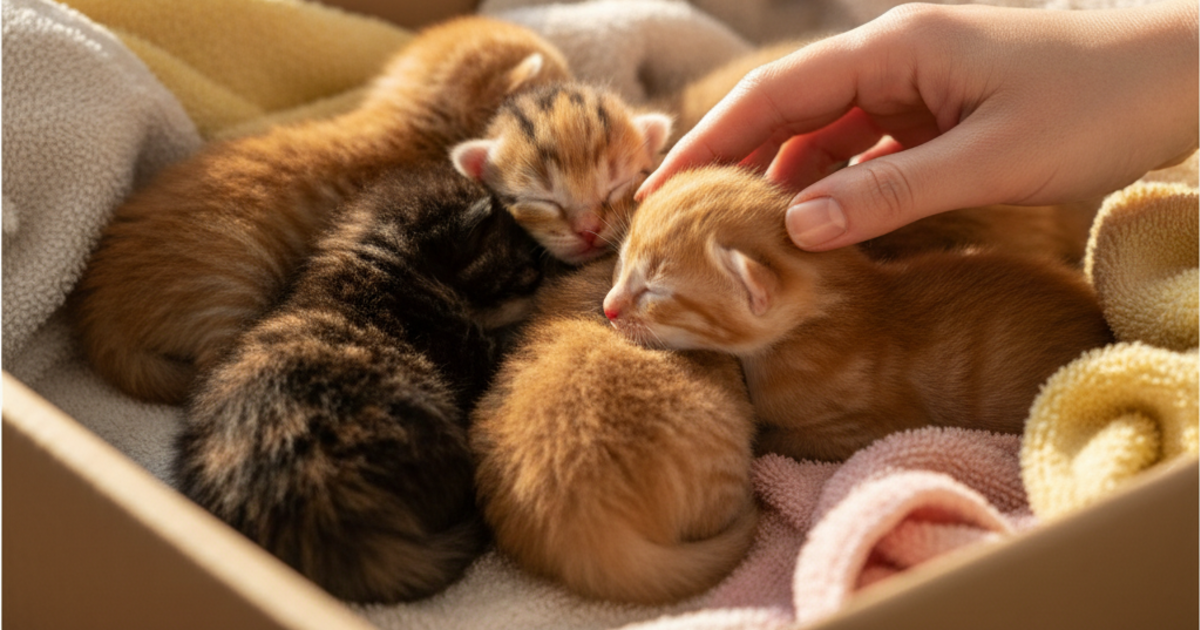
Kitten season is the period from spring through fall, usually peaking in late spring and summer, when most unspayed cats give birth and shelters take in large numbers of kittens. If you find kittens, observe first: the mother is often nearby. Help most by spaying and neutering, fostering, donating and supporting trap-neuter-return.
Every year animal shelters and rescues brace for a flood of kittens. Warm weather and longer days bring cats into heat, and a single litter can mean four to six kittens. This guide explains when kitten season happens, why, what to do if you find kittens, how to estimate their age, what to feed and how to keep them safe, how you can help and how spay and neuter helps. Use the cat pregnancy calculator to estimate due dates.
When is kitten season?
The exact timing depends on your climate, but in most of the United States kitten season runs from about early spring (March or April) through fall (October or November), with the peak in late spring and summer. In warmer regions it can last nearly year-round. The cause is biological: cats are seasonally polyestrous, which means they cycle repeatedly when days are long and temperatures are mild.
Why kitten season matters
- A cat can get pregnant as young as about 4 months old.
- Gestation lasts about 63-65 days, and a mother can become pregnant again soon after giving birth.
- A single litter is typically about 4-6 kittens, and a female cat can have several litters a year.
- Shelters and rescues fill quickly, with limited space, foster homes and funds.
- Many kittens born outdoors face danger from weather, predators, parasites and disease.
Quick math: how fast it adds up
A single unspayed cat who gives birth twice in a year to four kittens each produces eight kittens in a year. If some of those kittens are female and are not spayed, they can start having litters of their own within months. Even with conservative numbers, populations rise quickly when cats are not spayed or neutered.
Worked example: estimating a due date
If you know your cat mated on April 1:
- Gestation is about 63-65 days.
- April 1 + 63 days = about June 3.
- April 1 + 65 days = about June 5.
- Expect kittens between June 3 and June 5, though a few days earlier or later can happen.
- Prepare a quiet nesting box a couple of weeks ahead and arrange a vet check.
Use the cat pregnancy calculator to enter your own dates.
What to do if you find kittens outdoors
The most important rule is not to rush. Mother cats often leave kittens while they look for food, and removing healthy kittens can do more harm than good.
- Observe from a distance for several hours (a common guideline is up to 4 hours), keeping people and pets away. A mother who is nervous will not return while you are there.
- Look at the kittens. If they are clean, warm, quiet and sleeping, they are probably being cared for.
- Step in right away if the kittens are cold, crying constantly, injured, dirty, covered in fleas, in danger (traffic, weather, predators) or the mother is clearly gone or hurt.
- Warm them first. Cold kittens cannot digest food. Use a warm (not hot) water bottle wrapped in cloth.
- Call a local rescue, shelter or vet for advice and a plan.
- Do not feed cow's milk. Use kitten milk replacer, and only after warming the kitten.
- Wash your hands and keep them away from your own pets until a vet has checked them.
Estimating a kitten's age
| Age | What you may see |
|---|---|
| Under 1 week | Eyes closed, ears folded, umbilical stump present, 3-4 oz or less |
| 1-2 weeks | Eyes open, blue, ears starting to unfold |
| 3-4 weeks | Standing, walking, ears upright, tiny teeth, may begin lapping |
| 5-6 weeks | Playing, eating soft food, using litter |
| 8 weeks | Active, eating well, around 2 lb |
A vet or rescue can help you confirm age.
What if the mother is gone?
Newborn kittens need feeding every 2-3 hours, warmth, stimulation to urinate and defecate and close monitoring. This is a serious commitment, and many neonates do not survive without proper care. Contact a rescue that offers neonatal support or an experienced foster. A vet can show you how to bottle-feed safely.
What about adult community cats?
Not every cat outdoors needs rescuing. Many are community cats, who are unsocialized or semi-feral. For them, the best humane solution is trap-neuter-return (TNR): cats are humanely trapped, spayed or neutered, vaccinated, ear-tipped to show they have been fixed and returned to their outdoor home. TNR stops new litters and improves cats' lives. Local rescues often run low-cost clinics.
How you can help during kitten season
- Spay and neuter your cats and encourage others to do the same.
- Foster kittens for your local shelter, which frees up space and gives kittens a safe start.
- Donate supplies, such as kitten milk replacer, wet food, blankets and litter.
- Donate money or volunteer your time.
- Support TNR programs and low-cost spay and neuter clinics.
- Adopt, including adult cats, who are often overlooked.
- Keep your own cat indoors or supervised to prevent unplanned litters.
- Share accurate advice with neighbors who find kittens.
Why spay and neuter is the real solution
Spaying and neutering prevents unwanted litters and has health benefits, including lowering the risk of certain cancers and infections and reducing roaming and spraying. Many vets spay and neuter kittens at around 4-6 months, and shelters often do it earlier, at about 8 weeks and 2 lb. Low-cost programs exist in many areas.
Common mistakes
- Taking kittens too early from a mother who is just out searching for food
- Feeding cow's milk
- Not warming a cold kitten first
- Letting a mother cat have repeated litters
- Waiting too long to spay a young female
- Assuming all outdoor cats are lost or abandoned
When to call your vet
Contact a vet or rescue right away if kittens are cold, limp, not nursing, have discharge from the eyes or nose, diarrhea, fleas or are injured. Seek emergency care for kittens that are unresponsive or struggling to breathe. For suspected poisoning, call the ASPCA Animal Poison Control Center at 888-426-4435 or the Pet Poison Helpline at 855-764-7661 (fees may apply).
The bottom line
Kitten season is predictable and preventable. Observe before you intervene, keep newborns warm, call local rescues for help and support spay, neuter and TNR programs. If a pregnancy is already underway, the cat pregnancy calculator can help you plan.
Frequently asked questions
PawCalculator Editorial
We combine veterinary references, published guidelines, and calculator-grade modeling. This article is for education, not a substitute for an exam.
+ Follow on PawTalk