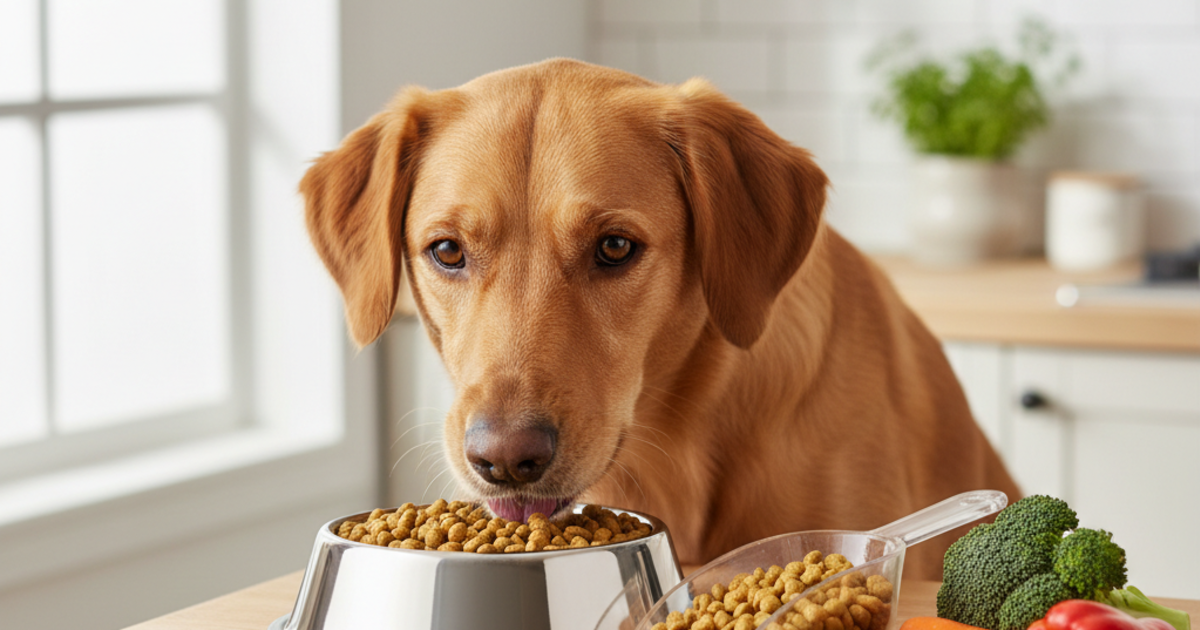
The healthiest dog food is complete and balanced for your dog's life stage, made by a company with real nutrition expertise and quality control, and fed in the right amount to keep your dog lean. Marketing words like "natural," "ancestral" and "human-grade" matter far less than these basics.
"Healthiest" isn't a single recipe. A food that's perfect for a growing Great Dane puppy would be wrong for a senior Chihuahua with kidney disease, and a formula that's ideal for a working Border Collie can make a couch-loving Pug gain weight. This guide explains what actually separates a healthy food from hype: the nutritional adequacy statement, who makes it, calories and portions, protein and fat, digestibility, and how to tell whether the food is working for your dog. After you choose, set portions with the dog food calculator.
1. Complete and balanced for the right life stage
Find the AAFCO nutritional adequacy statement on the bag. It should say the food is "complete and balanced" for a life stage: growth, adult maintenance, or all life stages. Two things to check:
- Large-breed puppies need a growth food labeled for large-size dogs (or an all-life-stages food that specifically covers large breeds), because too much calcium and too many calories can harm growing joints.
- "For intermittent or supplemental feeding only" means the food isn't a complete diet.
The statement should also say whether the food was formulated to meet AAFCO profiles or proven in feeding trials. Feeding trials are the stronger evidence.
2. Who makes it and how
Healthy food depends heavily on the company. Good signs include:
- A board-certified veterinary nutritionist (DACVN) or PhD animal nutritionist on staff
- Diets formulated to AAFCO profiles or fed in AAFCO feeding trials
- Quality control on ingredients and finished product, with batch testing
- Transparent answers about where the food is made, and who owns the plant
- Willingness to share full nutrient analysis and calories
- A clear record of handling recalls and complaints
See our guide to WSAVA dog food guidelines for the questions to ask.
3. Calories and portions
The healthiest food fed in the wrong amount makes an unhealthy dog. Obesity shortens lifespan and worsens arthritis, breathing problems and heart disease. Check the kcal per cup or per kg, and feed to a calorie target rather than "a scoop." Use the dog calorie calculator and check body condition with the dog BMI calculator.
4. Protein, fat and digestibility
AAFCO profiles set minimums on a dry-matter basis:
| Life stage | Minimum crude protein | Minimum crude fat |
|---|---|---|
| Adult maintenance | 18% | 5.5% |
| Growth and reproduction | 22.5% | 8.5% |
Higher isn't automatically better. Protein quality, amino acid balance and digestibility matter and aren't visible on the label. Very high-fat foods can cause digestive upset or pancreatitis in susceptible dogs, and very high-protein diets aren't appropriate for some dogs with kidney disease.
5. What your dog's body says
The best test of a food is your dog:
- Steady, healthy weight with ribs easy to feel under a thin layer of padding
- A visible waist from above
- Firm, well-formed stools
- Good energy and a shiny coat
- Healthy skin without persistent itching or recurring ear infections
If something is off, talk to your vet before switching foods.
Kibble, canned, fresh and raw: which is healthiest?
No format is automatically the healthiest. Complete and balanced kibble, canned and fresh diets can all support health. Homemade and raw diets are difficult to balance and carry food-safety risks unless formulated by a veterinary nutritionist. If you're considering either, talk to your vet first.
What's marketing, not medicine
- Grain-free: most dogs don't need it. The FDA investigated a possible link between some grain-free, legume-heavy diets and dilated cardiomyopathy (DCM).
- "Natural" and "holistic": no legal guarantee of better nutrition.
- Long lists of exotic ingredients: not a quality marker.
- "Human-grade": has a legal definition only when the whole product and facility meet human-food standards.
- "Ancestral" and "wolf diet": marketing, not science. Dogs have adapted to digest starch.
- "No by-products" or "no fillers": not automatic signs of quality or poor quality.
Worked example: cost and calories
A 20 kg dog needs about 1,050 kcal a day.
- Food X: 3,800 kcal/kg at $2.20 per kg. 1,050 ÷ 3.8 = 276 g a day. Cost = 0.276 × $2.20 = about $0.61 a day.
- Food Y: 3,400 kcal/kg at $3.50 per kg. 1,050 ÷ 3.4 = 309 g a day. Cost = 0.309 × $3.50 = about $1.08 a day.
Food Y costs about 77% more per day, about $170 more a year. That doesn't make Food X worse; check both against the quality criteria above before deciding.
When to call your vet
Talk to your vet before changing food if your dog has a health condition, is pregnant, is a growing large-breed puppy, or has vomiting, diarrhea, itching or weight changes. Some health conditions call for prescription diets. Switch foods gradually over 7-10 days.
Frequently asked questions
PawCalculator Editorial
We combine veterinary references, published guidelines, and calculator-grade modeling. This article is for education, not a substitute for an exam.
+ Follow on PawTalk