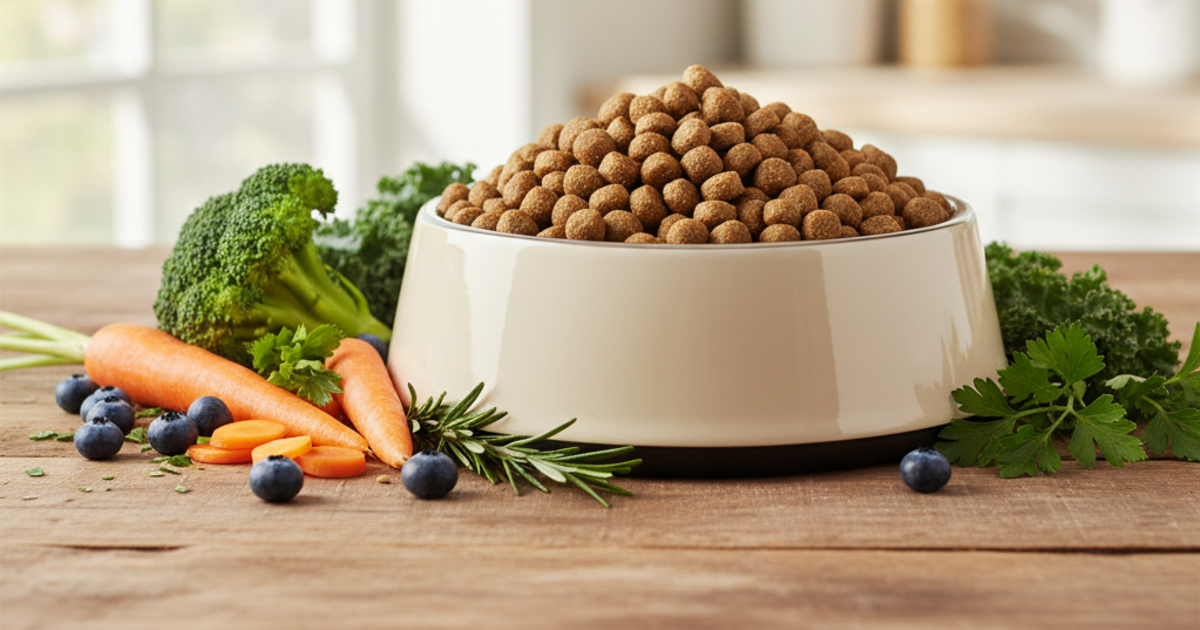
"All natural" on a dog food label means the ingredients come from plant, animal or mined sources and have not been produced by a chemically synthetic process, with exceptions such as added vitamins and minerals. It does not mean the food is organic, higher quality, healthier, safer or better suited to your dog.
Walk down any pet food aisle and "natural" is everywhere, often with pictures of vegetables, meadows and wolves. It feels reassuring, but the word is easier to claim than most people realize. This guide explains the official AAFCO definition of natural, what it does and does not guarantee, how natural differs from organic and "human-grade," what actually matters on a label, how to compare costs and how to feed your dog well whatever the bag says. Use the dog food calculator to set the right daily portion.
The official definition of "natural"
AAFCO's model pet food regulations define "natural" for feed ingredients as derived solely from plant, animal or mined sources, either in an unprocessed form or having been subject to physical processing, heat processing, rendering, purification, extraction, hydrolysis, enzymolysis or fermentation, but not produced by or subject to a chemically synthetic process, and not containing any additives or processing aids that are chemically synthetic, except in amounts that might occur unavoidably in good manufacturing practices.
In plain language, "natural" restricts chemically synthetic ingredients and additives. But there is a major exception: synthetic vitamins, minerals and trace nutrients are allowed in a product called natural, as long as the label says so, with wording such as "natural with added vitamins, minerals and trace nutrients." That matters because most complete-and-balanced foods need those additions to meet nutrient profiles.
What "natural" does not mean
- It does not mean organic. Organic claims follow USDA rules for how ingredients are grown and handled. Natural does not.
- It does not mean human-grade. That claim has its own requirements.
- It does not mean higher quality. A natural food can be well or poorly formulated.
- It does not mean grain-free, raw or free of by-products.
- It does not guarantee safety. Natural foods are recalled for contamination too.
- It does not mean the food is the right match for your dog's age, size, allergies or medical needs.
- It does not mean the ingredients are fresh or locally sourced.
Natural vs organic vs human-grade
| Claim | What it generally means | What it does not mean |
|---|---|---|
| Natural | No chemically synthetic ingredients or additives, apart from permitted added vitamins and minerals | Healthier, higher quality, organic |
| Organic | Ingredients meet USDA organic rules | Complete and balanced by itself, or safer |
| Human-grade | All ingredients and the product are suitable for human consumption and made in compliant facilities | Better suited to your dog |
| Complete and balanced | Meets AAFCO nutrient profiles for a life stage | Premium ingredients |
What actually matters on the label
- A complete-and-balanced AAFCO statement for your dog's life stage.
- Named protein sources and a clear ingredient list.
- Calories listed per cup or kilogram.
- A qualified nutritionist and quality-control practices you can confirm with the company.
- Recall history and how the company responded.
- Your dog's response. Healthy weight, energy, coat and stool.
Reading a natural label step by step
- Find the natural claim and look for the added-vitamins wording.
- Check the nutritional adequacy statement. Is it complete and balanced for your dog's life stage?
- Scan the ingredients. Look for named animal proteins and recognizable ingredients.
- Check for artificial colors and preservatives, which natural foods avoid. Natural preservatives such as mixed tocopherols (vitamin E) and rosemary extract are common.
- Compare the guaranteed analysis on a dry-matter basis if you are comparing wet and dry.
- Ask the company about quality control and nutrient analysis.
Worked example: natural vs conventional cost
An 8 kg (18 lb) neutered adult dog.
- Resting energy: RER = 70 × 8^0.75 = 70 × 4.76 = about 333 kcal.
- Daily need: 333 × 1.6 = about 533 kcal.
- If the food is 3,900 kcal per kg: 533 ÷ 3.9 = about 137 g per day.
- Cost comparison (illustrative): a natural food at $1.60 per 1,000 kcal costs 0.533 × $1.60 = about $0.85 per day. A conventional food at $1.00 per 1,000 kcal costs about $0.53 per day.
- Difference: about $0.32 per day, or roughly $117 a year.
- Decide if the extra cost is worth it for your dog based on its response, not the word on the bag.
Use the dog calorie calculator to estimate your dog's needs and compare real prices.
Are natural dog foods healthier?
Some owners report better coats and stools on natural diets, and some natural foods are very well made. But evidence that "natural" itself improves health is limited. Dogs thrive on diets that are complete, balanced, digestible and suited to them. A conventional food from a company with qualified nutritionists and rigorous quality control can outperform a natural food from a company without them.
Common marketing tricks to watch for
- Pictures of fresh meat and vegetables that are not what is in the bag
- "Made with real chicken" when chicken is a small part of the recipe
- Ingredient splitting, where one ingredient is listed as several to push others down the list
- "Inspired by the wolf diet" and similar claims that ignore dogs' evolved ability to digest starch
- Vague claims such as "premium" and "holistic" with no regulatory meaning
Who may benefit from natural foods
- Owners who prefer to avoid artificial colors, flavors and synthetic preservatives.
- Dogs with sensitivities to specific additives, as identified by a vet.
- People who value ingredient transparency.
If you choose natural, choose a brand with the same quality markers you would expect from any good food.
Who should be cautious
- Dogs on prescription diets, which are medically formulated.
- Puppies of large breeds, who need large-breed growth formulas, natural or not.
- Owners tempted by unbalanced homemade "natural" diets without veterinary nutritionist input.
When to call your vet
Contact your vet if your dog has persistent diarrhea, vomiting, itching, weight loss or low energy on any diet, or before changing foods for a medical condition. For suspected poisoning, call the ASPCA Animal Poison Control Center at 888-426-4435 or the Pet Poison Helpline at 855-764-7661 (fees may apply).
The bottom line
"Natural" is a narrow ingredient-sourcing claim, not a promise of quality. Judge a natural food like any other: look for a complete-and-balanced statement, named ingredients, listed calories and a trustworthy company, then watch how your dog does. Calculate portions with the dog food calculator.
Frequently asked questions
PawCalculator Editorial
We combine veterinary references, published guidelines, and calculator-grade modeling. This article is for education, not a substitute for an exam.
+ Follow on PawTalk