Why "How Big Will My Dog Get" Is Hard to Guess
Puppy paws are famously misleading. A dog with oversized paws at 10 weeks might level out at 40 pounds, or might be telling you something real about a 90-pound future. Breed, current age, current weight, and growth rate all matter more than any single visual cue — which is why guessing from photos alone gets it wrong so often.
The good news: adult size is predictable with reasonable accuracy once you know a puppy's breed (or breed mix) and where they are on the growth curve. That's the math behind the Dog Size Calculator — enter current weight and age, and it projects an adult size range instead of a guess.
The Dog Size Categories, Explained
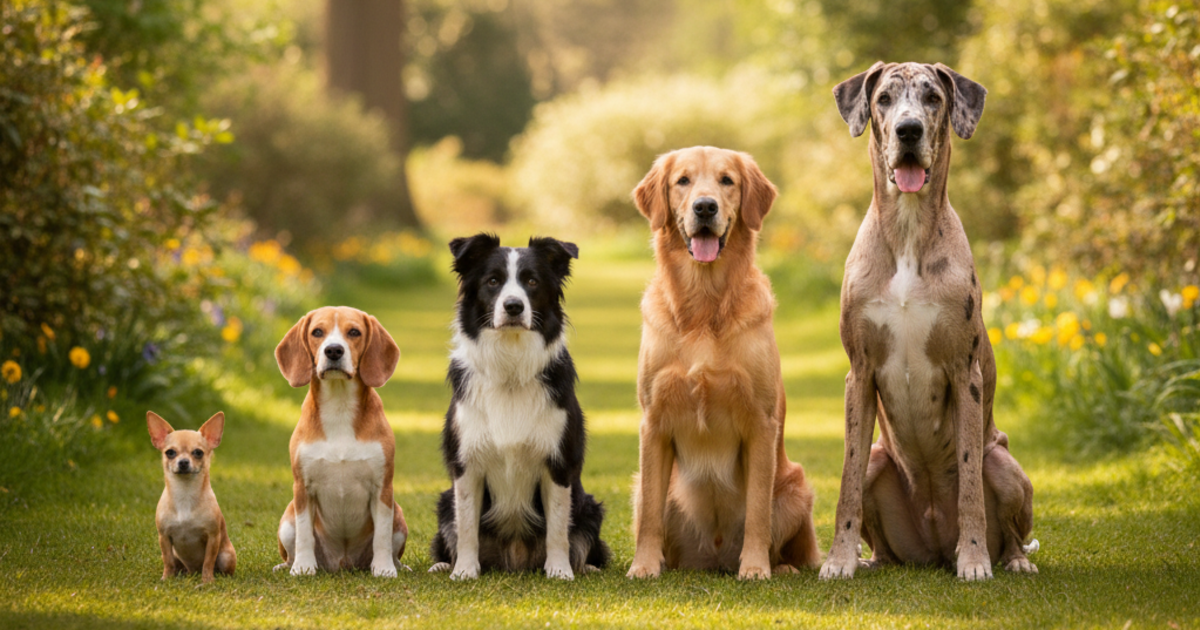
Size categories aren't official breed standard terms, but they're the shorthand every vet, groomer, and boarding facility uses:
| Category | Adult Weight | Example Breeds |
|---|---|---|
| Toy | Under 10 lbs | Chihuahua, Yorkshire Terrier, Pomeranian |
| Small | 10–25 lbs | French Bulldog, Beagle, Cocker Spaniel |
| Medium | 25–50 lbs | Border Collie, Bulldog, Standard Poodle |
| Large | 50–90 lbs | Labrador, German Shepherd, Golden Retriever |
| Giant | 90+ lbs | Great Dane, Mastiff, Saint Bernard |
The category matters for more than curiosity — it drives crate size, food volume, medication dosing, and even furniture decisions people don't think about until the dog outgrows the couch they bought for a "medium-sized" puppy.
How Growth Rate Actually Works
Small and toy breeds reach adult size fast — often by 9–12 months. Large and giant breeds take much longer, sometimes not filling out completely until 18–24 months. This is the single biggest reason two puppies that look identical at 12 weeks end up wildly different sizes as adults: a large-breed puppy still has a year or more of growth left when a small-breed puppy has already stopped.
A rough rule of thumb for purebred puppies: most reach about 50% of adult weight around 4-5 months old, though this varies by breed growth pattern. Giant breeds tend to grow more slowly and steadily rather than front-loading growth the way small breeds do — which is part of why a giant-breed puppy that seems "behind" a small-breed littermate isn't actually behind at all.
Mixed-Breed and Rescue Puppies: What to Look For
No known breed doesn't mean no signal. A few things correlate reasonably well with eventual size:
Paw size relative to legs. Oversized paws on a still-lean body often (not always) mean more growing ahead — but this is a soft signal, not a formula.
Bone structure at the wrist and ankle. Thicker joints tend to predict a heavier adult frame better than paw size alone.
Littermate size spread. If a litter has a wide size range at birth, that range often persists into adulthood.
A DNA test. For a firmer answer than physical traits can give, a breed test (typically $70-150) identifies the breeds in the mix, which then maps to expected size ranges. The Dog Breed Percentage Estimator covers what a test adds versus guessing from traits.
For mixed breeds specifically, the Mixed-Breed Puppy Weight Calculator uses current weight, age, and paw size together rather than relying on a single data point.
Growth Curve by Size Category
| Age | Toy/Small Breeds | Medium Breeds | Large/Giant Breeds |
|---|---|---|---|
| 3 months | ~50-60% of adult weight | ~35-45% of adult weight | ~25-35% of adult weight |
| 6 months | ~85-95% of adult weight | ~65-75% of adult weight | ~50-60% of adult weight |
| 12 months | Adult size reached | ~90-95% of adult weight | ~75-85% of adult weight |
| 18-24 months | — | Adult size reached | Adult size reached |
Use the Dog Size Calculator to plug in your specific puppy's current weight and age against these curves for a projected adult range, rather than eyeballing it against this general table.
Why Getting the Size Estimate Right Actually Matters
Food and calorie planning. A puppy tracking toward "large" needs a different feeding trajectory than one tracking toward "medium" — overfeeding a large-breed puppy to grow "faster" is linked to joint problems later, not a benefit. The Dog Calorie Calculator adjusts for projected adult size, not just current weight.
Crate and equipment sizing. Buying a crate, harness, or bed for the size a dog will actually be avoids replacing gear every few months.
Medication dosing. Weight-based medications only make sense in the context of expected adult weight when a dog is still growing — a topic worth understanding early, not scrambling to figure out during a vet visit.
Housing and lifestyle fit. Apartment living, other pets, and household routine all interact with adult size in ways that are easier to plan for before the dog is fully grown than after.
Common Mistakes People Make
Assuming paw size alone is decisive. It's a data point, not a formula — plenty of large-pawed puppies stay small, and vice versa.
Ignoring growth curve differences by category. Comparing a 6-month-old Great Dane puppy's size to a 6-month-old Beagle's size as if they're on the same timeline leads to false alarm or false reassurance.
Skipping the vet check on unusual growth. A puppy that's dramatically off the expected curve for their breed — either too fast or too slow — is worth a vet conversation, not just a bigger or smaller food bowl.
Treating a DNA test as the only "real" answer. Tests are more precise than trait-guessing, but current weight and growth trajectory tools are legitimate estimates in their own right, especially in the meantime.
Recommended Tools
- Dog Size Calculator — Enter current weight and age for a projected adult size category and weight range.
- Puppy Weight Calculator — A closer numeric estimate of adult weight for known breeds.
- Mixed-Breed Puppy Weight Calculator — Built specifically for puppies without a known breed standard.
- Dog Breed Percentage Estimator — See what a DNA test adds in precision over trait-based guessing.
- Dog Calorie Calculator — Feed for the dog your puppy is becoming, not just the one in front of you today.
Find Your Puppy's Projected Adult Size
Paw size and gut feeling only go so far. Current weight, age, and breed trajectory get you a real projection instead of a guess.
→ Use the Dog Size Calculator to see where your puppy is likely headed.
Frequently asked questions
PawCalculator Editorial
We combine veterinary references, published guidelines, and calculator-grade modeling. This article is for education, not a substitute for an exam.
+ Follow on PawTalk