An estimated 70-80% of cats over three years old have some degree of dental disease. Most of their owners have no idea.
That gap exists because cats don't show dental pain the way dogs or humans do. They keep eating. They keep grooming. They keep functioning. Meanwhile, bacteria work their way under the gumline, destroy the structures supporting the teeth, and - in chronic cases - enter the bloodstream and affect the kidneys, liver, and heart.
By the time a cat owner notices something is wrong - bad breath that's gotten noticeably worse, a cat that's suddenly less interested in dry food, drooling that wasn't there before - the disease is usually well advanced. Stage 3 or 4 periodontal disease, tooth resorption, or an abscess that's been quietly developing for months.
This guide covers what dental disease actually looks like, what home care can and can't do, and what professional cleaning involves - including the anaesthesia question that stops most owners from going through with it.
What's Actually Happening in an Unhealthy Cat Mouth
Dental disease in cats follows a predictable progression that's worth understanding, because where a cat is on that progression determines what treatment they need.
Plaque forms within hours of eating - a soft, sticky bacterial film on the tooth surface. At this stage it's invisible and removable by brushing.
Tartar (calculus) forms when plaque mineralises - typically within days to weeks. It's the yellow-brown hard deposit visible at the gumline. Tartar cannot be brushed off at home. It requires professional scaling.
Gingivitis is inflammation of the gums caused by bacterial toxins in plaque and tartar. The gums look red, swollen, and may bleed when touched. At this stage the disease is still fully reversible with a professional cleaning and consistent home care.
Periodontitis is what happens when gingivitis isn't treated. Bacteria work under the gumline, destroying the periodontal ligament and bone that hold teeth in place. This stage causes genuine pain. It is not reversible - you can stop progression but you cannot regrow destroyed tissue. Teeth affected by advanced periodontitis need extraction.
Tooth resorption is a separate but common condition in cats where the tooth structure is broken down from the inside, often starting at the gumline. The cause isn't fully understood. It's painful, progressive, and the treatment is extraction of affected teeth. Studies suggest up to 50% of adult cats have at least one tooth resorption lesion.
The Signs Most Owners Miss
Because cats don't stop eating when their mouths hurt (hunger overrides pain in most cats), the symptoms of dental disease tend to be subtle until they're not.
What to actually look for:
- Bad breath beyond normal "cat breath" - a decay or chemical smell indicates bacterial load or systemic involvement
- Red gum margin - the line where gum meets tooth should be pink, not red or swollen
- Yellow-brown deposits at the gumline - visible tartar, especially on the upper back teeth (carnassials) where it accumulates fastest
- Dropping food while eating, chewing on one side, or preferring soft food that was previously refused
- Pawing at the mouth or rubbing the face on surfaces - pain behaviour
- Drooling that's new or increased
- Reduced grooming - a cat with a sore mouth grooms less efficiently
- Blood-tinged saliva on toys or food bowls
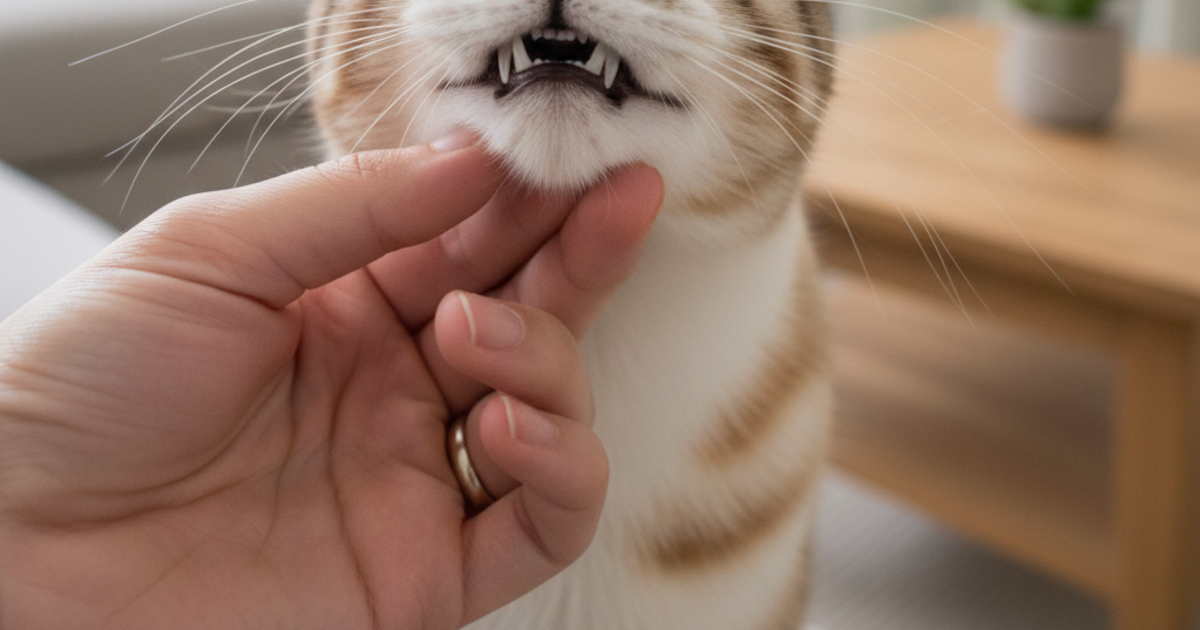
Lift your cat's lips at the back teeth once a month and look. Most dental disease is visible if you look. Most owners never look.
Home Care: What It Actually Achieves
Home dental care has one primary purpose: removing plaque before it mineralises into tartar. That's it. It cannot remove existing tartar, treat gingivitis, reverse periodontitis, or address tooth resorption. These require professional treatment.
What this means in practice: if your cat already has visible tartar or red gums, start with a professional cleaning first. Home care after a clean mouth maintains that clean mouth. Home care on top of existing disease manages the rate of progression slightly but doesn't solve the underlying problem.
Brushing
Tooth brushing is the most effective home dental care available - more effective than any dental treat, water additive, or gel. Daily is ideal. Three times a week produces meaningful benefit. Once a week is better than nothing but not enough to significantly slow plaque accumulation.
What you need:
- Cat-specific toothpaste - enzymatic formulas work by breaking down bacterial biofilm between brushing sessions. Never use human toothpaste; fluoride is toxic to cats, and the foaming agents cause distress.
- A soft-bristle finger brush or a small-headed cat toothbrush. Finger brushes are easier to start with.
- Patience and weeks, not days.
How to actually get a cat to tolerate it:
The introduction process is the part most guides rush. Go faster than this and most cats become resistant - you've created a negative association that's hard to undo.
Week 1: Let your cat lick a small amount of toothpaste from your finger. Do this daily. End with a treat. The goal is the cat associating the toothpaste flavour with something positive - not getting a clean tooth.
Week 2: With toothpaste on your finger, gently lift the lip and touch the outer surface of the upper back teeth (not the front teeth - start where the disease accumulates most). One or two teeth. Five seconds. End with a treat.
Week 3: Introduce the finger brush with toothpaste. Same approach - one or two teeth, gum line contact, brief session, end positively.
Week 4+: Gradually extend the session and coverage. A full brush of all outer tooth surfaces takes about 30-45 seconds once established. You don't need to do the inner surfaces - the cat's tongue provides some mechanical cleaning there, and most disease occurs on the outer surfaces.
The critical rule: stop before the cat gets agitated, not after. A session that ends on the cat's terms is a session that builds tolerance. A session that ends with the cat bolting is a session that makes next time harder.
Dental Products That Actually Have Evidence
The VOHC (Veterinary Oral Health Council) seal is the only meaningful quality marker for dental products. It means the product has been tested and shown to reduce plaque or tartar - not just claimed to. If a product doesn't carry it, the efficacy claims are marketing, not evidence.
VOHC-accepted products for cats include specific dental chews, certain water additives, and some dental diets. The list changes - check the current VOHC accepted products list rather than assuming a specific brand.
What the products can do: reduce plaque accumulation rate as a supplement to brushing. What they cannot do: substitute for brushing, remove existing tartar, or treat disease that's already present.
Water additives are worth mentioning separately because owners often use them as a primary care strategy. They help - measurably - but they're the lowest-effect option on the list. Better than nothing, not sufficient alone.
Dental diets - prescription dental dry foods with a specific kibble texture designed to scrape teeth - have reasonable evidence for tartar reduction in cats that actually chew their food rather than swallowing whole. The prescription dental diets (Hill's t/d, Royal Canin Dental) have more evidence than "dental" labelled over-the-counter foods.
Professional Cleaning: What It Involves and Why Anaesthesia Is Non-Negotiable
Professional dental cleaning (dental prophylaxis) in cats is performed under general anaesthesia. This is not optional and it's not excessive caution - it's the only way to do it properly and safely.
Conscious "anaesthesia-free" dental cleanings - offered by some grooming salons and some vets - only clean the visible surface of teeth. The disease happens below the gumline and between teeth. Scaling below the gumline on a conscious cat is impossible without causing pain and injury. Dental X-rays - the only way to assess root health, bone loss, and tooth resorption - cannot be performed on a conscious cat. Anaesthesia-free cleaning addresses aesthetics (visible tartar) while leaving disease untreated. Multiple veterinary dental organisations have position statements against it.
What a proper professional cleaning involves:
Pre-anaesthetic bloodwork - standard before any anaesthetic procedure, especially important in cats over seven or those with known conditions. This checks kidney and liver function to ensure the cat metabolises anaesthetic safely.
Full-mouth dental radiographs - taken under anaesthesia, these show everything happening below the gumline: bone levels, root integrity, tooth resorption lesions, retained root fragments. Up to 30-40% of significant dental findings in cats are below the gumline and invisible without X-rays.
Scaling and polishing - ultrasonic scaling removes tartar above and below the gumline. Polishing smooths the tooth surface to slow plaque reattachment.
Extractions if needed - teeth with significant bone loss, resorption, or fractures are extracted during the same procedure. Extraction sites are sutured. Cats recover from multi-tooth extractions remarkably well - often eating more comfortably within days.
Frequency: Annual dental assessment as part of a routine vet visit, with professional cleaning recommended as often as disease indicates. Some cats need it annually; cats with naturally clean teeth and good home care may go 2-3 years between cleans. Your vet's assessment of gum inflammation and tartar accumulation rate guides the schedule - not a fixed calendar rule.
The anaesthesia concern: The risk of anaesthesia in a healthy cat is very low. The risk in an older cat with managed kidney disease or heart disease is higher but often still acceptable. Pre-anaesthetic bloodwork and a thorough physical assessment quantifies that risk. The risk of untreated dental disease - systemic bacterial load, chronic pain, secondary organ effects - is frequently higher than the anaesthetic risk, especially in cats with advanced disease. This is a conversation to have with your vet with numbers, not a reason to avoid cleaning indefinitely.
Starting Kittens Early
If you have a kitten: start dental handling now, before adult teeth erupt around 6 months. Handle the mouth daily. Introduce toothpaste early. Build the association before there's anything to resist.
Adult cats can learn to tolerate brushing, but it takes longer and patience runs thinner on both sides. Kittens are infinitely more adaptable. The owners who have the easiest time with cat dental care are the ones who started when the cat was 8-12 weeks old and never stopped.
My cat has terrible breath but seems fine. Is dental cleaning really necessary? Bad breath in a cat indicates significant bacterial load - usually advanced gingivitis or periodontitis. The cat "seeming fine" is the point made at the start of this article: cats mask dental pain effectively. An oral exam and dental X-rays will show what's actually happening. In most cases where owners describe severe bad breath, the cleaning reveals disease that needed treatment.
My vet quoted for multiple extractions. Is that really necessary? Almost always, yes. Teeth with significant bone loss, fractures, or resorption cause chronic pain and serve as bacterial reservoirs. Extracting them removes the source of the problem. Cats adapt to tooth loss quickly and often eat better after extractions than they did before, because the source of their pain is gone.
Can I use coconut oil instead of cat toothpaste? Coconut oil has no evidence for dental efficacy in cats. Enzymatic cat toothpaste has. Use the right tool.
My cat absolutely won't tolerate brushing. What else can I do? Work through the introduction protocol above over 4-6 weeks rather than giving up after a week. If the cat genuinely cannot be conditioned to brushing, a combination of VOHC-accepted dental chews, a water additive, and more frequent professional cleanings is the fallback. It's less effective than brushing but meaningfully better than nothing.
At what age should dental cleaning start? First oral exam at the one-year vet visit. First professional cleaning when there's clinical indication - visible tartar, gum redness, or odour. Some cats need it at 2-3 years; many cats with good genetics and home care can wait until 4-5. Annual assessment guides the timing.
Use the PawCalculator Vet Cost Estimator to budget for routine dental care, and the Vaccination Schedule to track your cat's full preventive care calendar.
Partner picks for this guide
As an Awin affiliate, Paw Calculator may earn a commission from qualifying purchases. Prices and availability can change.


Frequently asked questions
PawCalculator Editorial
We combine veterinary references, published guidelines, and calculator-grade modeling. This article is for education, not a substitute for an exam.
+ Follow on PawTalk