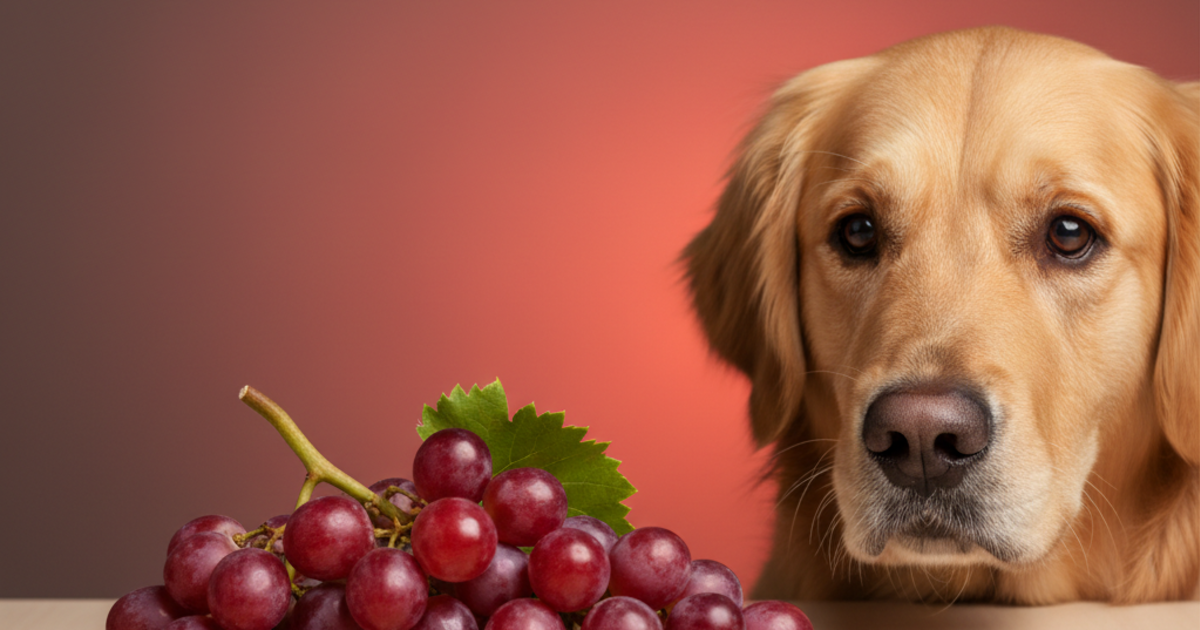
No. Grapes, raisins, sultanas and currants can cause acute kidney failure in dogs, and no safe amount has been established. If your dog ate any, call your vet, an emergency clinic or a poison hotline immediately, even if your dog seems fine. Early treatment greatly improves the outlook.
Emergency? Call your vet or the nearest emergency clinic now. You can also call the ASPCA Animal Poison Control Center at 888-426-4435 or the Pet Poison Helpline at 855-764-7661 (fees may apply). Don't wait for symptoms to appear.
Grapes are one of the most common causes of preventable food poisoning in dogs, and it catches people off guard because grapes are a healthy snack for humans and some dogs eat them with no obvious problem. This guide explains why they're dangerous, what to watch for, what to do and how to keep your dog safe.
Why grapes are dangerous to dogs
Grapes and raisins (red, green, seedless, organic, store-bought, homegrown or wild) have been linked to kidney injury in dogs for decades. Key facts:
- The toxin is still uncertain. Tartaric acid has been proposed as a cause, but researchers haven't settled it. That means nobody can say which grapes are "safe."
- Dose doesn't predict outcome. Some dogs eat a large number and seem fine, while others become seriously ill after eating a small number. You can't rely on weight or number of grapes to judge the risk.
- Raisins, currants and sultanas are concentrated. A small handful of dried fruit can be a bigger dose than fresh grapes.
- Processed foods count. Raisin bread, cookies, trail mix, granola, cereal, fruitcake, grape juice and some supplements or grape seed extract can all be risks.
Because no safe dose is known, the rule is simple: never feed grapes or raisins, and treat any ingestion as urgent.
Symptoms of grape or raisin toxicity
Signs often begin within 6-24 hours, but they can be subtle at first:
- Vomiting, sometimes with visible grape or raisin pieces
- Diarrhea
- Lethargy and weakness
- Loss of appetite
- Abdominal pain (a hunched posture, reluctance to be touched)
- Increased thirst and urination early on, followed by little or no urine as the kidneys fail
- Bad breath with a chemical smell
- Tremors, collapse or seizures in severe cases
Kidney damage typically develops over 1-3 days, so a dog that looks fine right after eating grapes can still be in danger. Don't wait for symptoms.
What to do right away
- Call your vet or poison control immediately. Have ready your dog's weight, what was eaten (grapes, raisins or a food containing them), how much and when.
- Don't induce vomiting at home unless a vet tells you to. Home methods such as hydrogen peroxide can be harmful, and timing matters.
- Take the packaging or a photo of what was eaten.
- Go to the clinic if advised. Don't delay while waiting for signs.
- Expect a treatment plan. Vets commonly induce vomiting safely if ingestion was recent, give activated charcoal, and start IV fluids for 24-72 hours. They monitor kidney values with blood tests and may repeat them over several days.
Early, aggressive treatment improves the odds of recovery considerably. Kidney failure that's already established carries a guarded outlook and may require intensive care or dialysis referral.
To plan for costs, see the vet cost estimator.
Worked example: why size doesn't make it safe
Meet Duke, a 30 kg (66 lb) dog who ate 10 raisins from a dropped cereal bowl.
- Natural assumption: "He's big, it's only 10 raisins, he'll be fine."
- What vets know: there's no reliable per-kilogram threshold. Reported cases include kidney injury after small amounts, and some dogs eating far more were unaffected.
- Right action: call the vet or poison control now, give the details, and follow their advice. That may be a short vet visit with induced vomiting, charcoal and fluids, rather than waiting.
- Cost of acting early: a fraction of the cost of treating established kidney failure.
The same logic applies to a 3 kg dog that ate one grape: call.
Safe fruit swaps
Good low-risk alternatives, in small amounts, include blueberries, strawberries, sliced apple (no seeds), banana slices and seedless watermelon. Check any other food with our food safety checker.
How to keep grapes out of reach
- Store grapes, raisins and baked goods containing them in closed cupboards or the fridge.
- Tell guests and children not to share them, and pick up dropped fruit immediately.
- Be careful with lunch boxes, gym bags and handbags.
- Check labels on trail mix, cereal, granola bars and baked goods.
- Fence off backyard grapevines, and supervise dogs near vineyards or fruit stalls.
- Keep the poison control numbers saved in your phone.
When to call your vet
Call immediately for any ingestion, even a single grape, and urgently for vomiting, lethargy, reduced urination, belly pain or collapse. If you can't reach your vet, go to an emergency clinic or call poison control: ASPCA Animal Poison Control Center, 888-426-4435; Pet Poison Helpline, 855-764-7661.
Frequently asked questions
PawCalculator Editorial
We combine veterinary references, published guidelines, and calculator-grade modeling. This article is for education, not a substitute for an exam.
+ Follow on PawTalk