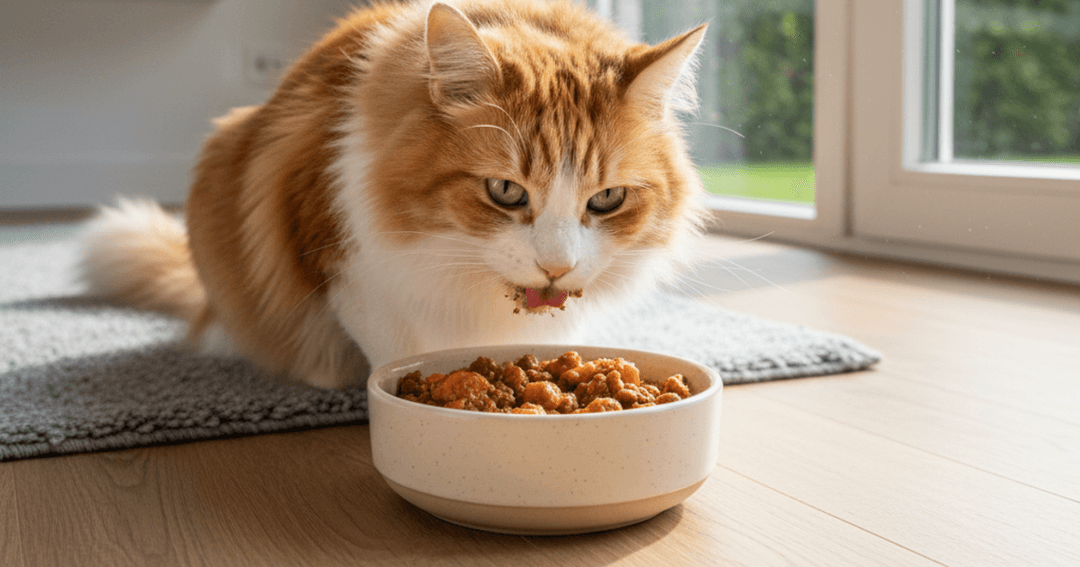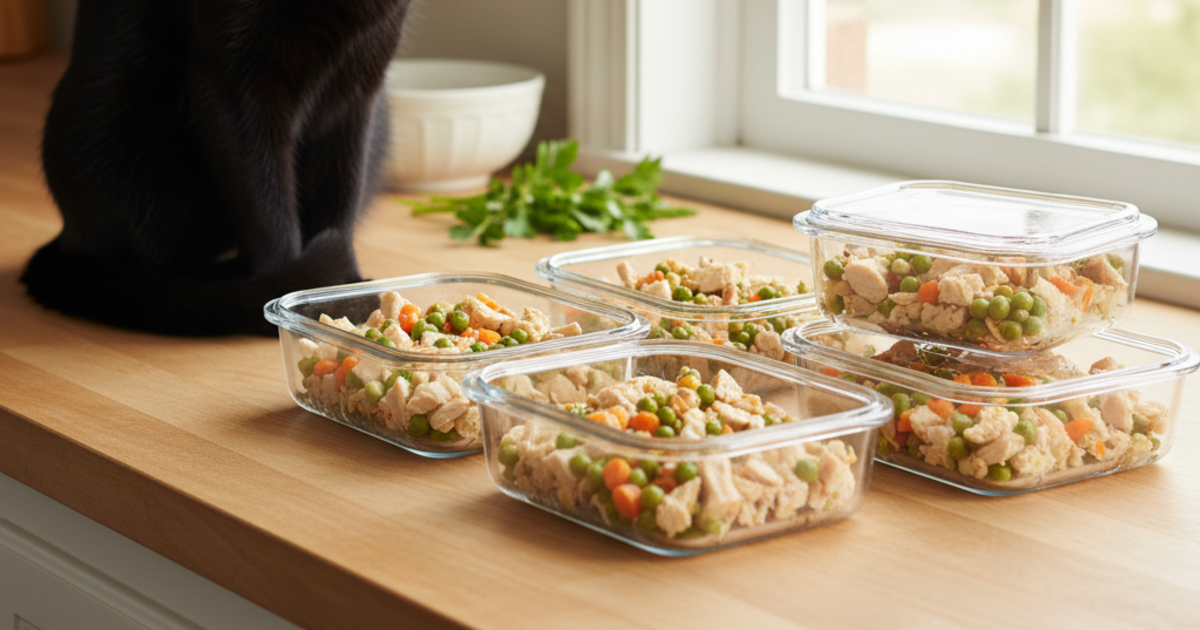
Homemade cat food can work, but it's harder to get right than homemade dog food. Cats are obligate carnivores, so a homemade diet has to be mostly meat, and it must be balanced with nutrients cats can't make well themselves: taurine, calcium, vitamin A, vitamin E, B vitamins and arachidonic acid. Plain chicken alone will cause deficiencies within months. The safest route is a cooked, meat-based recipe plus a balancing supplement made for homemade cat food, chosen with your vet or a veterinary nutritionist.
Portions come from calories. The cat calorie calculator gives your cat's daily target.
The Nutrients Homemade Cat Food Can't Skip
| Nutrient | Why cats need it | What happens if it's missing |
|---|---|---|
| Taurine | Heart, eyes, reproduction | Dilated cardiomyopathy, retinal degeneration and blindness |
| Calcium | Bones, nerves, muscles | Bone loss and fractures (meat is very low in calcium) |
| Preformed vitamin A | Vision, skin, immunity | Cats can't convert beta-carotene like dogs can |
| Arachidonic acid | Skin, coat, reproduction | Poor coat, skin problems |
| Vitamin E | Protects fats from oxidation | Painful fat inflammation (steatitis) |
| B vitamins (thiamine, niacin) | Energy and nerve function | Thiamine deficiency can cause neurological signs |
| Protein | Energy and muscle | Muscle loss; cats use protein for energy |
Cooking destroys some taurine, and so does grinding and freezing. That's one reason homemade diets need a supplement rather than relying on meat alone. A 2019 study of home-prepared cat food recipes found that most published recipes were deficient in at least one essential nutrient, so "found it online" isn't the same as balanced.
Two Homemade Cat Food Recipe Templates
These cooked templates follow the structure veterinary nutritionists use. They are not complete without a balancing supplement. Use a commercial premix designed for homemade cat diets, at the amount on its label, and have your vet or a board-certified veterinary nutritionist (ACVN) confirm the recipe for your cat.
Recipe 1: Chicken and Heart (about 184 kcal per 100 g)
- 800 g boneless, skinless chicken thigh, cooked
- 100 g chicken hearts, cooked (a natural taurine source)
- 50 g chicken liver, cooked (keep liver to about 5% of the recipe; too much causes vitamin A toxicity)
- 2 egg yolks, cooked
- Balancing supplement for homemade cat food, per label
Recipe 2: Turkey and Pumpkin (about 169 kcal per 100 g)
- 800 g boneless turkey thigh (dark meat), cooked
- 100 g chicken hearts, cooked
- 50 g chicken liver, cooked
- 30 g plain canned pumpkin (a little fiber for hairballs and stool quality)
- Balancing supplement for homemade cat food, per label
How to make homemade cat food: gently cook the meats through, chop or grind them, mix in the supplement once the food has cooled, add a little water for texture, and portion. Store in the fridge for up to 3 days or freeze for up to 2 months. Calorie figures are estimates from USDA data and will vary with your ingredients.
How Much Homemade Cat Food to Feed
Cats' daily calories are worked out from the Resting Energy Requirement (RER):
RER = 70 × (body weight in kg)^0.75
A neutered indoor adult cat usually needs 1.0–1.2 × RER.
Worked example: a 4 kg (8.8 lb) neutered indoor cat on Recipe 1.
- RER = 70 × 4^0.75 ≈ 198 kcal
- Daily need: 198 × 1.2 ≈ 238 kcal
- Recipe 1 has ~184 kcal per 100 g: 238 ÷ 1.84 ≈ 130 g per day
- Split into 2–3 meals: about 45–65 g per meal
Daily portions by weight
| Cat weight | Calories per day (1.0–1.2 × RER) | Recipe 1 per day | Recipe 2 per day |
|---|---|---|---|
| 3 kg (6.6 lb) | 160–190 kcal | 87–105 g | 95–113 g |
| 4 kg (8.8 lb) | 200–240 kcal | 108–130 g | 118–141 g |
| 5 kg (11 lb) | 235–280 kcal | 127–152 g | 139–166 g |
| 6 kg (13.2 lb) | 270–320 kcal | 146–174 g | 159–190 g |
Overweight cats should be fed for their ideal weight, not their current one. The cat food calculator handles that, and the cat feeding chart shows how homemade portions compare with wet and dry food.
Is Homemade Cat Food Better Than Commercial Food?
Not automatically. A good commercial food labeled "complete and balanced" by AAFCO standards has been formulated, and often feeding-tested, to cover all of the above. Homemade food makes sense when a cat has specific needs, like multiple food allergies, and a veterinary nutritionist designs the recipe. It's also a lot of work to do safely every week.
What About Raw Homemade Cat Food?
Raw diets carry a real risk of Salmonella, Listeria and E. coli, both for your cat and for the people in your home. The FDA and AVMA recommend against feeding raw meat to pets. If you're set on raw, talk to your vet first and follow strict hygiene. Cooking is the safer choice for homemade cat food.
Common Mistakes
- Feeding plain meat. It's missing calcium, vitamins and enough taurine.
- Too much liver. Vitamin A toxicity causes bone and joint problems.
- Adding onion, garlic or chives for flavor. They damage red blood cells in cats.
- Switching suddenly. Mix gradually over 7–10 days.
- Using dog supplements. They aren't formulated for cats.
Not sure about an ingredient? Check the food safety checker.
When to Call Your Vet
Talk to your vet before starting any homemade cat food, especially for kittens, pregnant cats, seniors, or cats with kidney, liver, bladder or heart disease. Call them if your cat:
- Stops eating for more than 24 hours (risk of fatty liver disease)
- Vomits or has diarrhea for more than a day
- Loses weight or muscle, or develops a dull, greasy coat
- Seems stiff, weak, or bumps into things (possible nutrient deficiency)
- Strains to pee or has blood in the urine
The Bottom Line
Homemade cat food is possible, but it must be meat-based, cooked, and balanced with a supplement made for cats. Portion by calories, weigh the food, and get the recipe checked by a vet. Start by finding your cat's daily calorie needs with the cat calorie calculator.
Frequently asked questions
PawCalculator Editorial
We combine veterinary references, published guidelines, and calculator-grade modeling. This article is for education, not a substitute for an exam.
+ Follow on PawTalk