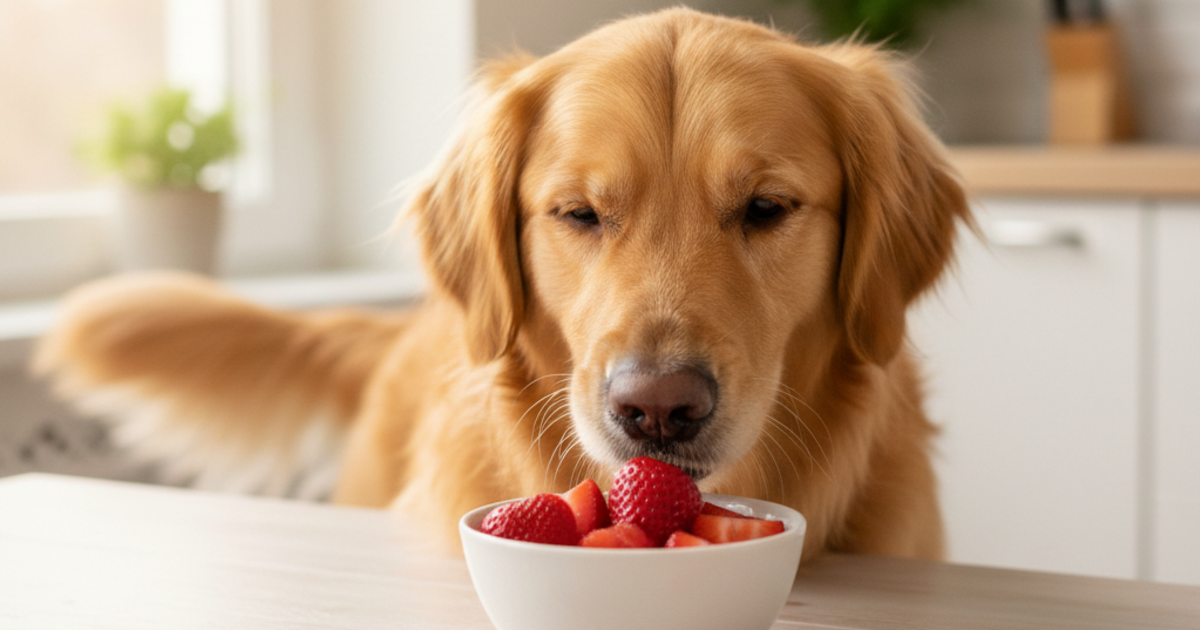
Yes, dogs can eat plain fresh strawberries in moderation. Wash them, remove the leafy top, cut them to a size your dog can't choke on, and keep all treats (including fruit) to about 10% of daily calories. Skip jam, syrup, canned strawberries in sugar, chocolate-covered berries and anything containing xylitol.
Strawberries are one of the easiest human foods to share with a dog. They're mostly water, low in calories and most dogs love the taste. But "safe" depends on the form, the portion and your dog's size and health, and a few strawberry products are genuinely dangerous. This guide covers the benefits, exactly how many to give, how to prepare them and when to skip them. You can check any other ingredient with our food safety checker.
Are strawberries good for dogs?
Fresh strawberries are about 91% water and roughly 32 kcal per 100 g, which makes them one of the lighter fruit treats. They also provide:
- Vitamin C. Dogs make their own vitamin C, so they don't need it from food, but it does no harm.
- Fiber. A little fiber supports digestion, though too much at once can loosen stools.
- Manganese, potassium and folate in small amounts.
- Antioxidant plant compounds such as anthocyanins, which give the berries their red color.
The honest summary: strawberries aren't a nutritional necessity. A dog eating a complete and balanced diet already gets everything it needs. Their real value is as a low-calorie, high-appeal treat that can replace a biscuit or training reward that would cost far more calories.
The sugar question
Strawberries contain natural sugar, about 5-7 g per 100 g. For a healthy dog, a few berries is nothing to worry about. For dogs with diabetes, pancreatitis, a history of weight problems or a sensitive digestive system, even "healthy" sugar needs to be counted. Ask your vet before adding fruit to a medical diet.
How many strawberries can a dog eat?
The safest rule is the 10% rule: treats should make up no more than about 10% of a dog's daily calories, with the rest coming from a complete and balanced food. A medium strawberry (about 12 g) has roughly 4 kcal, so berries rarely break a calorie budget on their own. The practical limits are stomach upset and choking, not calories.
| Dog size | Weight | Starting portion |
|---|---|---|
| Toy | Under 10 lb (4.5 kg) | 1 small berry, cut up |
| Small | 10-25 lb (4.5-11 kg) | 1-2 berries |
| Medium | 25-50 lb (11-23 kg) | 2-3 berries |
| Large | 50-90 lb (23-41 kg) | 3-4 berries |
| Giant | Over 90 lb (41 kg) | 4-6 berries |
Offer one piece first and wait a day. Dogs that aren't used to fruit can get gas or loose stool from even a small amount, and introducing one new food at a time makes it obvious what caused a reaction.
Worked example: fitting strawberries into the calorie budget
Meet Juno, a neutered 10 kg (22 lb) dog.
- Resting energy requirement (RER): 70 × 10^0.75 = 70 × 5.62 = about 394 kcal.
- Daily calories: a neutered adult at typical activity needs about 1.6 × RER = about 630 kcal a day.
- Treat allowance at 10%: about 63 kcal a day for every treat combined.
- Three medium strawberries: 3 × 4 kcal = about 12 kcal, roughly 19% of her treat allowance.
- What's left: about 51 kcal for training treats or chews that day.
If Juno eats strawberries, her main meal doesn't need to shrink. If she's also eating lots of other treats, reduce her meal by the extra calories. Work out your own dog's numbers with the dog calorie calculator.
How to prepare and serve strawberries
- Wash thoroughly. Strawberries are often on lists of produce with pesticide residue. Rinse them under running water, or choose organic if you can.
- Remove the green top. The leaves and stem aren't considered seriously toxic, but they're tough and can irritate the stomach.
- Cut to size. Quarter berries for medium dogs and dice them for small dogs. Whole berries can be swallowed by a gulper.
- Freeze for summer. Frozen plain strawberries make a cool treat, but give small pieces, because a hard frozen chunk is a choking and tooth hazard for some dogs.
- Mash into a lick mat or mix a spoonful into food for a dog that's going off its meals (after your vet has ruled out a medical cause).
Strawberry products to avoid
The fruit is fine; much of what's made from it isn't.
- Jam, jelly, syrup and pie filling: loaded with sugar, and sometimes xylitol.
- Canned strawberries in syrup: far more sugar than fresh.
- Chocolate-covered strawberries: chocolate is toxic to dogs. Check the amount eaten with our chocolate toxicity calculator and call your vet.
- Strawberry yogurt, ice cream and milkshakes: sugar, dairy and sometimes artificial sweeteners.
- Anything labeled "sugar-free": it may contain xylitol, which can cause a dangerous drop in blood sugar and liver failure in dogs.
- Dried or freeze-dried strawberries: concentrated sugar and calories, so a small handful can equal many fresh berries. Use tiny amounts only.
Strawberries for puppies, seniors and dogs with health conditions
- Puppies: small pieces are fine once they're eating solid food, but a complete puppy food should make up nearly all of the diet, and treats should stay well under 10%.
- Seniors: soft, mashed berries are easy to eat for dogs with dental problems.
- Dogs with diabetes: only with vet approval, and counted as part of the day's carbohydrates.
- Dogs with pancreatitis or kidney disease: ask your vet first; some dogs on therapeutic diets should eat nothing outside the prescribed food.
- Dogs with allergies: fruit allergies are uncommon but possible. Watch for itching, hives or ear problems after the first serving.
Signs you've given too much
Mild stomach upset is the usual problem: gas, soft stool, diarrhea or a rumbly belly. It usually resolves within a day once you stop. If your dog ate a whole punnet, expect loose stool and monitor closely, and call your vet if it doesn't settle.
When to call your vet
Call your vet if your dog has vomiting or diarrhea lasting more than a day, belly pain, swelling of the face, hives, trouble breathing, or constant scratching after eating strawberries. Call right away if your dog ate a product containing xylitol or chocolate, or swallowed a large amount of any fruit with a pit. ASPCA Animal Poison Control Center: 888-426-4435. Pet Poison Helpline: 855-764-7661. Fees may apply, and calling early is always worth it.
Frequently asked questions
PawCalculator Editorial
We combine veterinary references, published guidelines, and calculator-grade modeling. This article is for education, not a substitute for an exam.
+ Follow on PawTalk