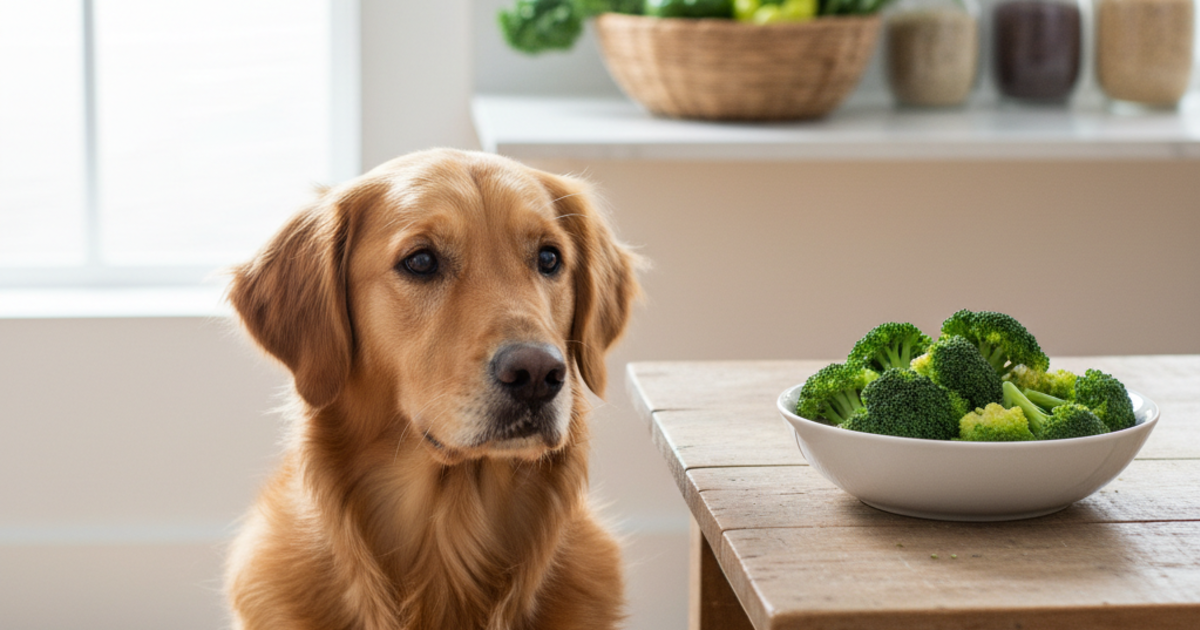
Yes, dogs can eat small amounts of plain broccoli, raw or lightly cooked. Keep it well under 10% of daily calories, chop it small, and skip butter, oil, garlic, onion and seasoning. Broccoli florets contain isothiocyanates that can irritate the stomach in larger amounts, and stalks can be a choking hazard.
Broccoli is low in calories, high in fiber and cheap, so it's a popular veggie treat for dogs on a weight-loss plan. It's also a vegetable where "a little is fine, a lot is a problem." This guide explains the real limits, the best way to prepare it and when to skip it. Check other foods in our food safety checker.
Is broccoli good for dogs?
Broccoli has about 34 kcal per 100 g and is roughly 89% water. It provides:
- Vitamin C and vitamin K in good amounts.
- Fiber, about 2.6 g per 100 g.
- Folate, potassium and small amounts of other minerals.
- Sulforaphane and other plant compounds, which are studied in people for their health effects. There's little evidence of a proven benefit in dogs.
Dogs don't need broccoli. On a complete and balanced diet, it's a low-calorie extra, valuable mainly as a crunchy swap for high-calorie biscuits.
The 10% rule and isothiocyanates
Broccoli florets contain isothiocyanates, compounds that can irritate a dog's gastrointestinal tract. In small amounts, most dogs tolerate them. In larger amounts, they can cause gas, cramping, vomiting or diarrhea. Sources commonly say broccoli should stay well under 10% of a dog's total daily intake, and many vets suggest much less, since even a modest quantity can cause gas.
Practical translation: a few small florets a couple of times a week is plenty. It shouldn't become a meal component.
Raw vs cooked broccoli
- Raw: crunchy and satisfying for big dogs, but harder to digest and more likely to cause gas. Thick stalks are a choking hazard.
- Steamed or boiled (plain): softer and easier to digest, a better choice for small dogs, seniors and dogs with sensitive stomachs. Light cooking reduces some of the compounds that cause gas.
- Avoid: butter, oil, salt, garlic, onion, cheese sauce, stir-fry sauces and seasoning. Onion and garlic are toxic to dogs.
How much broccoli can a dog eat?
| Dog size | Weight | Portion (per serving, a couple of times a week) |
|---|---|---|
| Toy | Under 10 lb (4.5 kg) | 1-2 tiny florets |
| Small | 10-25 lb (4.5-11 kg) | 2-3 small florets |
| Medium | 25-50 lb (11-23 kg) | 3-4 florets |
| Large | 50-90 lb (23-41 kg) | A small handful |
| Giant | Over 90 lb (41 kg) | A handful |
Start with a single floret and watch for gas or loose stool.
Worked example
Meet Bear, a neutered 30 kg (66 lb) dog.
- RER: 70 × 30^0.75 = 70 × 12.82 = about 897 kcal.
- Daily calories at 1.6 × RER: about 1,435 kcal.
- Treat allowance at 10%: about 143 kcal.
- A small handful of florets (50 g): 50 × 0.34 = about 17 kcal.
- Result: about 12% of his treat allowance. Calories aren't the concern; his gut is. One serving two or three times a week is a sensible ceiling.
Plan your dog's treat allowance with the dog calorie calculator, and see the dog food calculator for weight loss if your dog needs to slim down.
Stalks, stems and leaves
- Stalks: fibrous and can get stuck in the throat or cause a blockage, especially in small dogs. Chop them very small, cook them until soft, or skip them.
- Leaves: generally fine in small amounts, but can also cause gas.
- Whole heads: never give a whole head of broccoli to a dog. It's a choking and blockage hazard.
Serving ideas
- Steamed and chopped as a topper on regular food, in small amounts.
- Frozen florets as a crunchy summer treat for big dogs.
- Mashed into a lick mat for a dog that struggles with crunchy foods.
- Mixed with other dog-safe veg such as green beans or carrot for variety.
Gas and other side effects
Broccoli is a common cause of gas in dogs. If your dog has flatulence, loose stool or a bloated feel after eating it, cut the portion or skip it. Large amounts over several days can cause more serious stomach irritation.
Who should be careful?
- Dogs with sensitive stomachs, IBD or a history of pancreatitis: stick to the vet's plan.
- Dogs with thyroid problems: cruciferous vegetables contain goitrogens. Small amounts are generally fine, but ask your vet if your dog has thyroid disease.
- Dogs prone to bloat (gastric dilatation-volvulus): gas-forming foods are best kept small.
- Puppies: a single small piece is plenty.
When to call your vet
Call your vet if your dog has repeated vomiting, severe diarrhea, belly swelling, pain or trouble swallowing after eating broccoli. Call urgently if your dog is choking or seems bloated and is retching without producing anything, because that can signal bloat. If your dog ate broccoli prepared with garlic, onion or heavy seasoning, contact poison control: ASPCA Animal Poison Control Center, 888-426-4435; Pet Poison Helpline, 855-764-7661.
Frequently asked questions
PawCalculator Editorial
We combine veterinary references, published guidelines, and calculator-grade modeling. This article is for education, not a substitute for an exam.
+ Follow on PawTalk