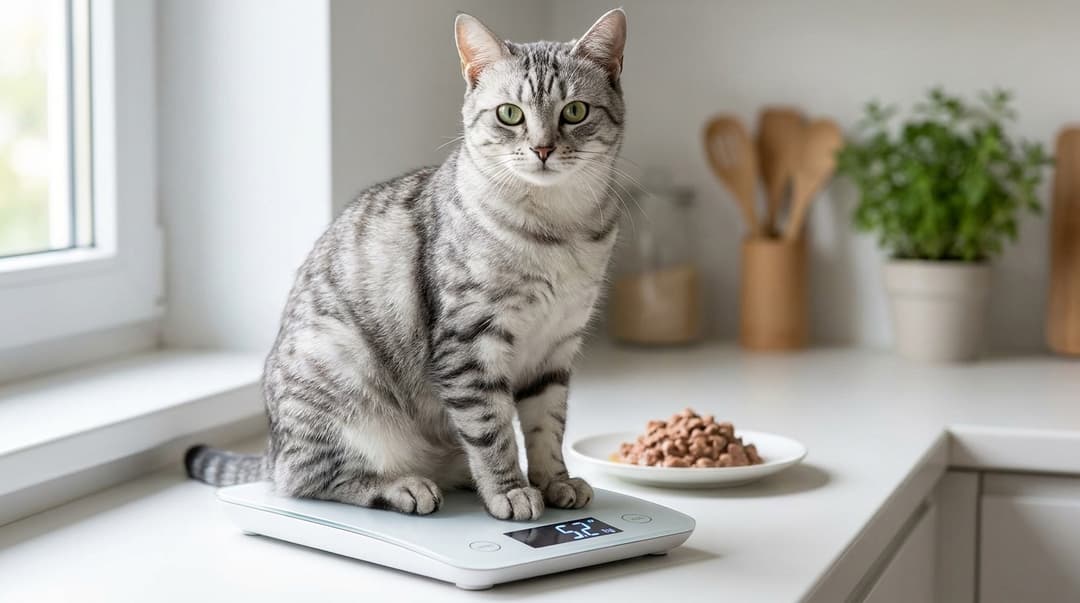
Cat Weight Loss Calculator
Feline calorie targets for safe weight loss — prescription-diet aware, grounded in RER × DER.
Tell us about your cat
All fields stay in your browser — we never store or share them. Adjust weight and age to see targets update live.
Average adult cat weight is 8-12 pounds. For overweight cats needing weight reduction cat food, consult our recommendations.
For kittens under 1 year, use decimals (e.g., 0.5 for 6 months)
Your calorie plan
Daily target
2 meals / day
0 kcal / day
0.00 cups · 0 g total
CALORIES
0
kcal/day
CUPS
0.00
dry (est.)
MEALS
2×
per day
Per Meal Portion
Feeding Schedule
Feed twice daily: morning and evening, 12 hours apart
Dry food options
- • Prescription weight diets when your vet recommends them
- • High-protein, controlled-calorie formulas
Weight reduction tips
- • Trim calories gradually (about 10–20% steps)
- • Weigh food with a scale or level measuring cup
Keep going with a related calculator.
Step-by-step inputs, calorie targets, weight-loss safety, reference tables, and answers — use alongside the calculator above.
How to Use the Cat Calorie Calculator
Getting an accurate calorie target for your cat takes under a minute. Here is what each field means and how to fill it correctly.
Step 1 — Enter your cat's breed (optional). Different cat breeds have measurably different metabolic rates. Maine Coons and Ragdolls tend to have slower metabolisms than Abyssinians or Bengals. Selecting a breed applies a breed-specific adjustment to the calculation. If your cat is a domestic shorthair or mixed breed, leave this blank — the calculator uses a standard feline metabolic baseline.
Step 2 — Enter your cat's current weight in pounds. Use your cat's actual weighed weight, not a visual estimate. Cats are notoriously easy to misjudge — a cat that looks slightly chubby may be 30% over ideal weight. If your vet has given you a target weight, you can enter that instead to calculate maintenance calories at the goal weight rather than the current weight.
Step 3 — Enter your cat's age in years. Use decimals for kittens — 0.5 for a 6-month-old, 0.75 for a 9-month-old. Age affects the DER multiplier significantly. Kittens under 1 year need 2–3x more calories per kilogram than adult cats. Senior cats over 10 years often need fewer calories, though some seniors actually need more due to reduced nutrient absorption — the calculator accounts for this distinction.
Step 4 — Select activity level. Be realistic. Most indoor cats are Low activity — they sleep 14–16 hours per day and have short, infrequent play sessions. Moderate applies to cats with daily interactive play of 20–30 minutes. High applies to young cats with intense daily play, access to outdoor enrichment, or multi-cat households with constant chase and wrestling. Overestimating activity is the most common input error and leads to systematic overfeeding.
Step 5 — Select indoor cat and spayed/neutered status. Indoor cats have lower energy expenditure than outdoor cats — they do not hunt, patrol territory, or face temperature extremes. Spayed and neutered cats have 15–20% lower energy needs than intact cats due to the absence of reproductive hormones. Both checkboxes together reduce the DER multiplier, which is correct — most indoor neutered cats are chronically overfed at bag-guide portions.
Step 6 — Click Calculate. Your daily calorie target appears along with approximate cup and gram equivalents. The cup estimate assumes standard dry kibble at 350 kcal/cup — always check your food's actual kcal/cup on the packaging and adjust accordingly.
Understanding Your Results
What the calorie target means. The number shown is your cat's Daily Energy Requirement — the total calories needed per day to maintain current weight at the selected activity level. For weight loss, the calculator applies a safe deficit — typically 20% below maintenance — which produces gradual loss of 0.5–1% of body weight per week. This rate is medically important: cats that lose weight too fast are at serious risk of hepatic lipidosis (fatty liver disease), a potentially fatal condition.
RER — Resting Energy Requirement. For cats, RER is calculated as 70 × (body weight in kg)0.75, the same NRC formula used for dogs. For a typical 5kg cat this gives approximately 234 kcal. This is the floor — the minimum calories needed for organ function at complete rest. Never feed below RER without direct veterinary supervision.
DER multipliers for cats. The calculator applies these standard feline multipliers to RER:
- Kitten under 4 months: RER × 3.0
- Kitten 4 months to 1 year: RER × 2.5
- Intact adult: RER × 1.4
- Neutered adult, moderate activity: RER × 1.2
- Neutered adult, low activity / indoor: RER × 1.0
- Weight loss target: RER × 0.8
- Senior cat (7–10 years): RER × 1.1–1.2
- Senior cat (10+ years): RER × 1.1–1.4 (some seniors need more)
Why the result is often lower than the bag guide. Commercial cat food bags are written for average intact outdoor cats at moderate activity. Most owned cats in Western countries are indoor, neutered, and low activity — meaning the bag guide routinely overestimates by 20–40%. Studies of feline obesity consistently identify ad libitum feeding and bag guide adherence as primary causes. The RER-based result is more accurate for your specific cat.
Cups vs grams — which to use. Grams are more accurate. A measuring cup of dry kibble can vary by 15–20% depending on kibble size, shape, and how loosely it is poured. A kitchen scale removes this error entirely. If your cat needs 180 kcal and your food has 360 kcal/100g, the answer is exactly 50g — no variability. Consider switching to weight-based feeding if your cat's weight is not responding as expected.
Cat Calorie Guide by Weight and Life Stage
Use this table alongside your calculator result to verify your output is in a reasonable range.
Indoor Neutered Adult Cats — Daily Calorie Target
| Current Weight | Ideal Weight Target | Maintenance kcal | Weight Loss kcal | Senior (7–10yr) |
|---|---|---|---|---|
| 3 kg (6.6 lbs) | 3–3.5 kg | 210 kcal | 168 kcal | 220 kcal |
| 4 kg (8.8 lbs) | 3.5–4 kg | 265 kcal | 210 kcal | 275 kcal |
| 5 kg (11 lbs) | 4–4.5 kg | 315 kcal | 250 kcal | 330 kcal |
| 6 kg (13.2 lbs) | 4–4.5 kg | 360 kcal | 235 kcal | 375 kcal |
| 7 kg (15.4 lbs) | 4.5–5 kg | 405 kcal | 235 kcal | 420 kcal |
| 8 kg (17.6 lbs) | 5–5.5 kg | 445 kcal | 235 kcal | 460 kcal |
Note: Weight loss kcal for overweight cats is calculated at 80% of the ideal weight maintenance — not 80% of current weight. This prevents severe restriction in very overweight cats.
Kittens — Daily Calorie Requirements
| Age | Weight | Daily kcal | Meals per Day |
|---|---|---|---|
| 8 weeks | 0.8 kg | 200 kcal | 4 |
| 12 weeks | 1.2 kg | 280 kcal | 4 |
| 4 months | 1.8 kg | 380 kcal | 3–4 |
| 6 months | 2.5 kg | 470 kcal | 3 |
| 9 months | 3.2 kg | 520 kcal | 2–3 |
| 12 months | 3.5–4 kg | 460 kcal | 2 |
Kittens should never be calorie restricted. Feed to appetite until 6 months, then transition to measured portions based on the calculator.
By Food Type — Approximate Portions at 250 kcal Daily Target
| Food Type | Typical kcal density | Approx. daily portion |
|---|---|---|
| Dry kibble (standard) | 330–380 kcal/cup | 0.65–0.75 cups |
| Dry kibble (weight management) | 270–310 kcal/cup | 0.8–0.9 cups |
| Wet food (pâté) | 80–100 kcal/100g | 250–310g |
| Wet food (chunks in gravy) | 60–80 kcal/100g | 310–415g |
| Raw (whole prey ratio) | 130–160 kcal/100g | 155–190g |
| Prescription weight diet | Check label — varies | Always follow vet instruction |
Common Cat Breeds — Typical Healthy Adult Weight Range
| Breed | Typical Adult Weight | Notes |
|---|---|---|
| Domestic Shorthair | 3.5–5 kg | Most common; wide variation |
| Maine Coon | 5–8 kg (female), 7–11 kg (male) | Large breed — higher kcal absolute, lower per kg |
| Ragdoll | 4.5–7 kg (female), 6–9 kg (male) | Slow metabolism; prone to obesity |
| Siamese | 3–5 kg | High metabolism; rarely obese |
| Bengal | 4–7 kg | Very active; needs high-activity multiplier |
| Persian | 3.5–5.5 kg | Low activity; prone to overfeeding |
| British Shorthair | 4–7 kg | Moderate metabolism; prone to weight gain |
| Abyssinian | 3–5 kg | High activity; rarely needs weight loss |
Questions about this calculator
It uses the same RER × DER formulas veterinary nutritionists use for cats. The math is exact; your inputs are estimates. For most healthy indoor adult cats, you should be within ±10% of true requirements.
The math, openly documented.
Inputs
You enter the facts that change the estimate.
species · age · weight · lifestyle
Normalize
We validate ranges and convert units when needed.
lbs ↔ kg · months ↔ years
Formula
Published veterinary or industry-standard calculations.
result = f(valid inputs)
Results
Rounded outputs — schedules, ranges, or targets — with disclaimers.
display + notes
What to never feed your dog
Even tiny amounts can be fatal. If your dog ingested any of these, call your vet or the ASPCA poison line (888-426-4435) immediately.
Open Food Safety CheckerMore from Nutrition

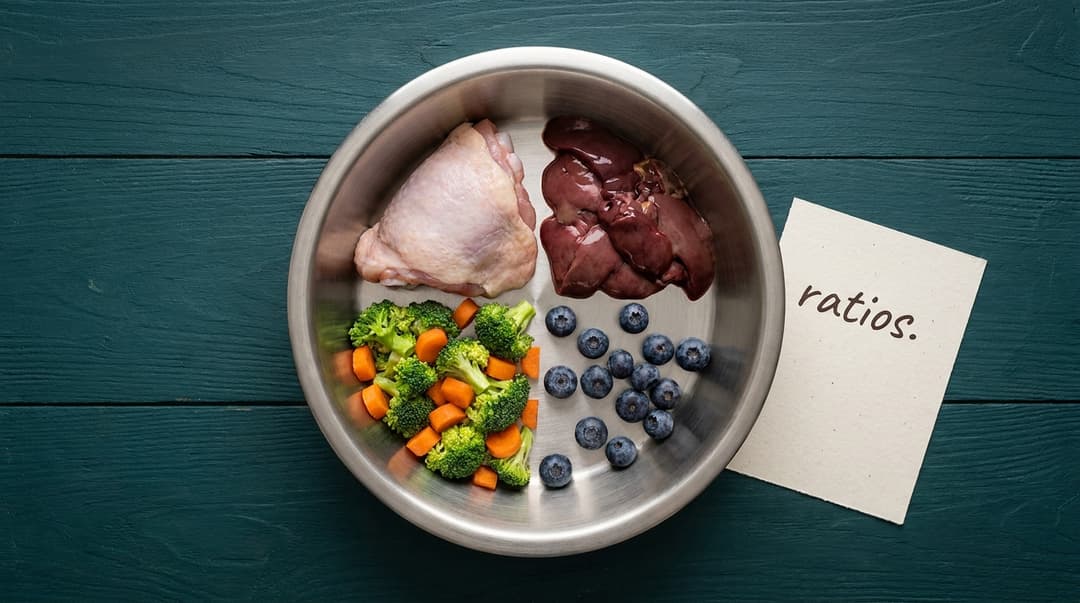
Raw Diet Planner
BARF ratios for dogs and cats.
Open tool
Food Safety Checker
Search foods for toxicity guidance.
Open tool
Dog Food Calculator
Daily portions in cups and grams from RER × DER.
Open toolArticles from Insights
Got an edge case the calculator can't handle?
189 active threads about cat nutrition and weight right now. Verified vets and experienced owners answer within hours.