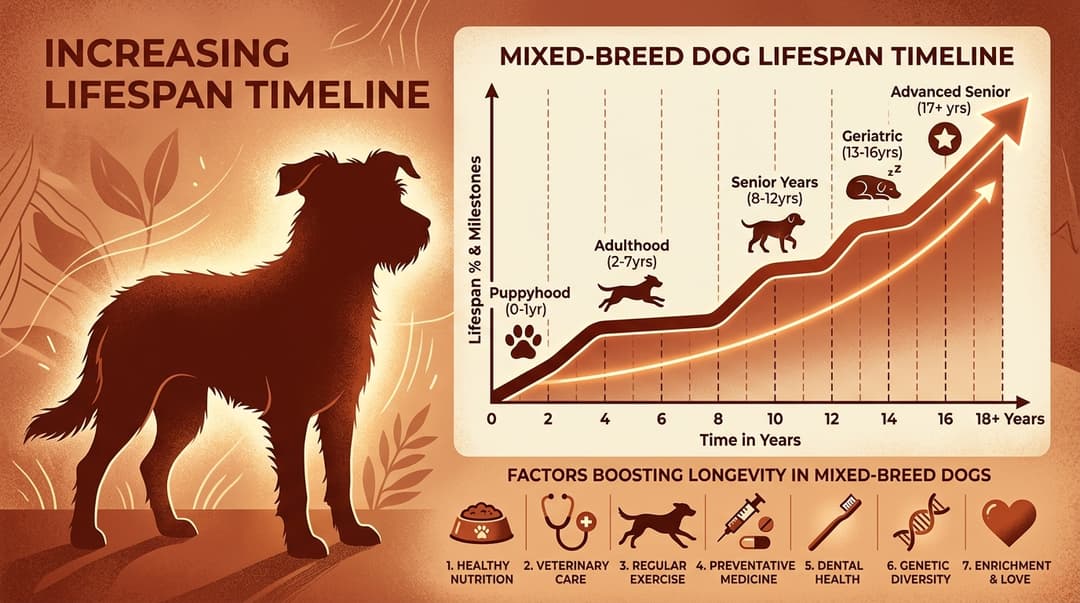
How Long Will Your Mixed-Breed Dog Live?
Your inputs
Results update live as you type.
Your results
Fill in the form to see your estimate.
Ready when you are
Fill in the form to see your reference estimate
Veterinary reference only
Population-level estimate, not an individual prediction.
Keep going with a related calculator.
How Long Will Your Mixed-Breed Dog Live?
There's no breed standard to look up for a mixed-breed dog, but that doesn't mean lifespan is unpredictable — size is the single strongest predictor across all dogs, purebred or not. Large-scale veterinary lifespan studies consistently show an inverse relationship between adult body weight and median lifespan: toy and small dogs commonly reach 13-16 years, medium dogs around 11-13, and large/giant breeds often 8-11 — a pattern that holds for mixed breeds based on their adult size rather than any single parent breed. Some research has also found mixed-breed dogs modestly outlive purebreds of comparable size, which is generally attributed to greater genetic diversity reducing the concentration of breed-specific hereditary conditions. This calculator uses your dog's current weight, age, and general build to estimate a lifespan range grounded in size-based data rather than guessing at a "primary breed."
How to use this calculator
Enter current weight (or estimated adult weight, if still a puppy) and spay/neuter status. Size class does the heavy lifting in the estimate, since it's the strongest cross-breed predictor of lifespan in the data.
Median lifespan by size class (approximate)
| Size class | Adult weight | Typical median lifespan |
|---|---|---|
| Toy/small | Under 25 lb | 13–16 years |
| Medium | 25–50 lb | 11–13 years |
| Large | 50–90 lb | 10–12 years |
| Giant | 90+ lb | 8–11 years |
Understanding your results
This is a population-level estimate, not a prediction for your specific dog — plenty of individual dogs exceed their size class's typical range, and genetics, care quality, and simple variation all move the real outcome around the median shown here. The size-based approach exists specifically because there's no single breed standard to anchor a mixed-breed estimate to, and the research consistently shows size matters more than breed identity for lifespan prediction anyway — some studies even find mixed breeds modestly outliving purebreds of comparable size, generally attributed to reduced concentration of breed-specific hereditary conditions (hybrid vigor). A DNA test can identify likely predominant ancestry for health-risk screening purposes, but it won't meaningfully sharpen this lifespan estimate beyond what size class already captures.
What actually moves a dog above or below the median. Body condition maintained near ideal throughout life, preventive dental and vet care, and avoiding both obesity and excessive lean-muscle stress all correlate with dogs exceeding their size class's typical range — these are modifiable factors, unlike size class itself.
Spay/neuter's effect is real but modest. Some research associates spaying/neutering with a small longevity benefit, but the effect size is meaningfully smaller than the difference between size classes — it's a secondary factor layered on top of the size-based baseline, not a comparable driver.
Turning a population estimate into a personal care plan
A size-based lifespan range is most useful as a planning anchor rather than a number to fixate on, and the practical value comes from what you do with it. If your mixed-breed dog's size class carries a median lifespan estimate on the lower end (large or giant), that's a reasonable prompt to be more proactive about the modifiable factors known to correlate with dogs exceeding their expected range — maintaining lean body condition rather than letting weight creep upward, staying current on preventive dental care (since dental disease is linked to broader systemic health issues, not just tooth loss), and not skipping routine wellness exams even when nothing seems wrong. None of these guarantee a longer lifespan for any individual dog, but they're the specific, actionable levers the research points to, as opposed to the size class itself, which isn't something you can change.
Interpreting the estimate as your dog ages past the median
The framing shifts somewhat once your dog's current age approaches or passes the lower end of their size class's typical range — at this point, the estimate is less useful as a forward-looking prediction and more useful as a prompt to shift the focus of veterinary care toward comfort and quality-of-life monitoring rather than purely preventive screening. This doesn't mean treating an older dog as fragile prematurely; plenty of dogs live well beyond their size class's median with an active, comfortable life the whole way through. It does mean that senior-focused wellness exams (often recommended twice yearly rather than annually past a certain age), closer attention to mobility and cognitive changes, and open conversations with your vet about what quality-of-life monitoring should look like for your specific dog become more relevant than the population-level lifespan number itself, which was always a starting reference point rather than a countdown.
When to consult a professional
For health, dosage, or nutrition decisions, always confirm calculator output with your veterinarian. This tool provides reference estimates, not medical advice.
Questions about this calculator
Body size is one of the most consistently replicated predictors of canine lifespan across large veterinary datasets, and it applies regardless of ancestry — it reflects broader biological aging patterns, not breed-specific traits.
The math, openly documented.
Inputs
Enter the details that affect your estimate.
weight · age · breed
Normalize
Validate ranges and convert units when needed.
lbs ↔ kg
Calculate
Veterinary or industry-standard formulas applied.
result = f(inputs)
Results
Clear outputs with context and disclaimers.
display + notes
More from Breeds
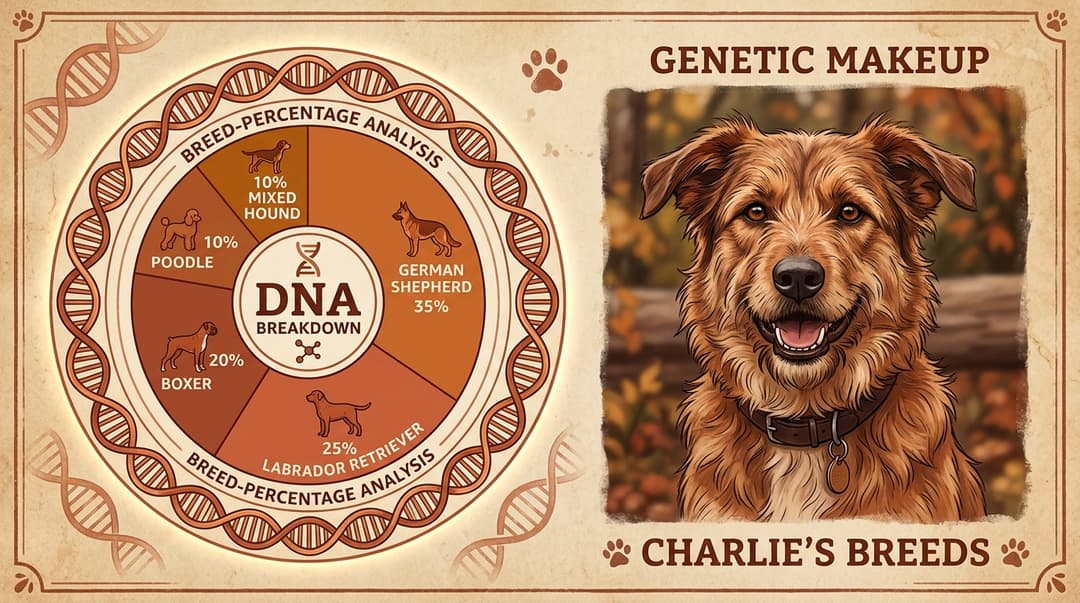
What's the Breed Mix of Your Dog?
dog breed percentage calculator: Get a rough breed-mix estimate from physical traits, or see what a DNA test (typically
Open tool
What Breeds Make Up Your Dog?
dog breed identifier: A trait-based identifier quiz for mixed-breed dogs — size, coat, ear shape, and behavior patterns,
Open toolArticles from Insights


Got an edge case the calculator can't handle?
247 active threads about dog nutrition right now. Verified vets and experienced owners answer within hours.